Vampires movies have been around since the beginning of the horror genre. With an undead force stalking its victims in the dark, the subgenre feels like a mashup of zombie movies, slashers, and creature features, while being something so much more. Sometimes vampires are purely there to scare, other times they’re sympathetic, and often sensuality and romance are involved, with a once living person now cursed by an insatiable desire.
Because they’ve been part of film for over a century, limiting the absolute best and most important vampire movies to just four is a challenge. This means omitting the likes of The Lost Boys, Bram Stoker’s Dracula, Interview With a Vampire, and all of those Christopher Lee Hammer Films. So which four make it as the faces of the vampire Mount Rushmore?
‘Nosferatu’ (1922)
There is no list like this that does not begin with Nosferatu, the first ever vampire movie. Although it’s an unofficial adaptation of Bram Stoker‘s novel Dracula, director F.W. Murnau is not restrained. Nosferatu follows familiar beats, with Max Schreck as Count Orlok, a vampire who travels across the ocean to Germany, complete with a plague in tow. Once he lands, he sets his sights on Ellen Hutter (Greta Schröder), the only woman who may be able to bring an end to his terror.
Nosferatu is a course in filmmaking and how to overcome limitations. Because it’s 1922, this is a silent film, meaning that the film must succeed based on its visuals. Murnau uses German Expressionism, a form of storytelling with the emotion layered on the screen through the use of lighting and twisted shapes. Nosferatu is filled with dark corners and elongated shadows, like the terrifying shots which show Orlok’s visage lit against a wall, or in a brilliant moment, his long hand reaching out. Max Schreck becomes the character, so much so that his peculiar performance led to the biopic Shadow of a Vampire starring Willem Dafoe. With his long face, pointy ears, and rat-like teeth, Orlok will send chills down your spine from a century away. There have been reboots of Noseferatu, but none did so much with so little.
‘Dracula’ (1931)

The most famous vampire movie ever made came nine years later with Tod Browning‘s Dracula. The plot is close to what Nosferatu had already done, except with the addition of Van Helsing (Edward Van Sloan) as the famed vampire hunter, and a much different representation of the villain. Rather than being monstrous, the titular Dracula, with Bela Lugosi in the role, is a suave, sophisticated antagonist with his cape, bow tie, and slicked back hair. He’s portrayed as more man-like than a horrendous creature. The pop culture representations of Dracula now, from the Hammer films to the Count in Sesame Street, started here. Bela Lugosi IS Dracula, no matter how many other adaptations there have been.
Notably, this is the first variation of Dracula to appear on-screen with sound, allowing the audience to hear what the Count sounds like with his thick, rolling, hypnotic accent. Browning nails the gothic horror aesthetic while continuing to employ the German Expressionism-like style of filmmaking that focuses on shadows and atmosphere. The director also takes his time, letting the dread slowly build, and using the tension of silence to great effect. Maybe Dracula is dated for some modern audiences, but this is the most iconic vampire movie and always will be. Dracula is a moving history lesson playing out right in front of your eyes.
‘Let the Right One In’ (2008)

There were countless vampire movies between 1931 and 2008. So why does the Swedish film Let the Right One In find itself on Mount Rushmore? Because it takes everything we know about vampires and turns it on its head, defying expectations to take a well-worn subgenre in a fresh direction. Based on a novel of the same name by John Ajvide Lindqvist, Tomas Alfredson (Tinker Tailor Solider Spy) directs this unique coming-of-age film about a bullied boy named Oskar (Kåre Hedebrant) in desperate need of a friend. He finds one in an odd girl new to town named Eli (Lina Leandersson). The twist is that Eli is a centuries-old vampire. However, rather than Oskar’s life being in danger, Let the Right One In is a sweet story about friendship and what two people will do for each other.
Vampire movies often relegate the undead to the role of the antagonist. Let the Right One In switches that up by making Eli the hero. She’s a dangerous, bloodthirsty killer, for sure, but she’s written as a creature in pain who needs someone even more than Oskar does. Rather than fearing Eli, both the audience and Oskar fall for her through one shocking twist to the next. Alfredson doesn’t overdo it with his direction. Rather than being too stylish, he stands back and lets the kids tell the stories, dipping in here and there to show the contrast of deep red blood on white snow. It’s a sad story, but Let the Right One In has one of the most messed-up, feel-good endings in horror history.
‘Sinners’ (2025)

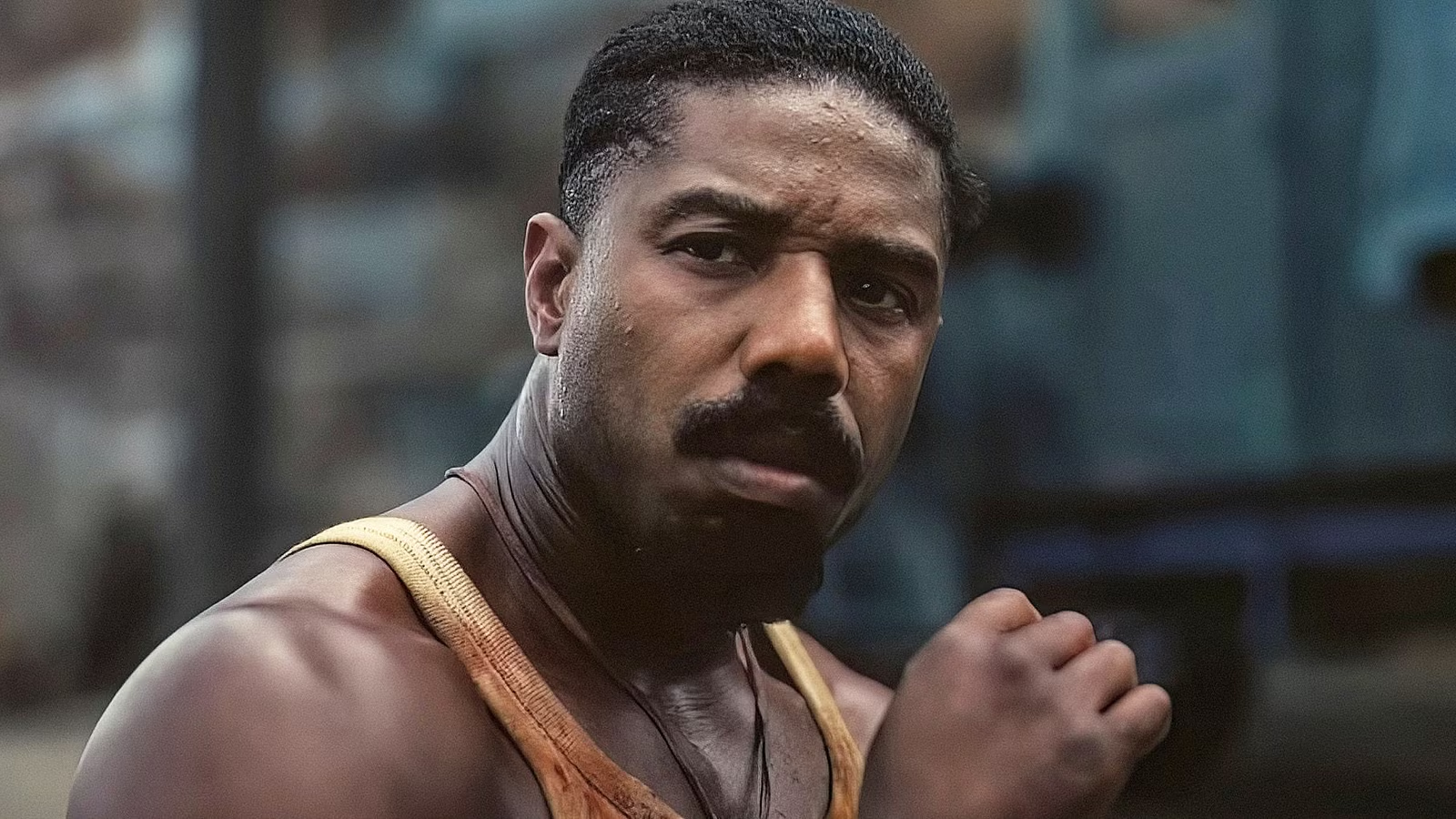
Will Ryan Coogler ever make a bad movie? If anything, the writer and director only seems to be getting better, and Sinners proves it. Yet again, he teams up with Michael B. Jordan in what may be his most challenging role yet, because this time, he plays two characters, twin brothers Smoke and Stack. The first third of the movie isn’t a vampire movie at all. Instead, it’s a well-shot period piece about siblings in 1930s Mississippi who start their own juke joint. There’s already enough drama with local racists and the return of love interest Mary (Hailee Steinfeld). Then the vampires show up, led by the terrifying Remmick (Jack O’Connell), and all hell breaks loose.
Sinners made history by becoming the most nominated film in Academy Award history. It more than deserves every single one of them. Coogler’s directing is flawless. Jordan makes you forget that he’s playing two different people on screen at the same time. Veteran actor Delroy Lindo shines. The cinematography is stunning, the costumes impeccable. Sinners has it all. There’s a deep message there about racism. Rather than being a downer of a movie though, Sinners is also a celebration of Black culture, especially with the transformative history of Black music scene. Even if those aspects were missing, Sinners is still a great vampire movie. What puts it on Mount Rushmore is that it’s so much more.