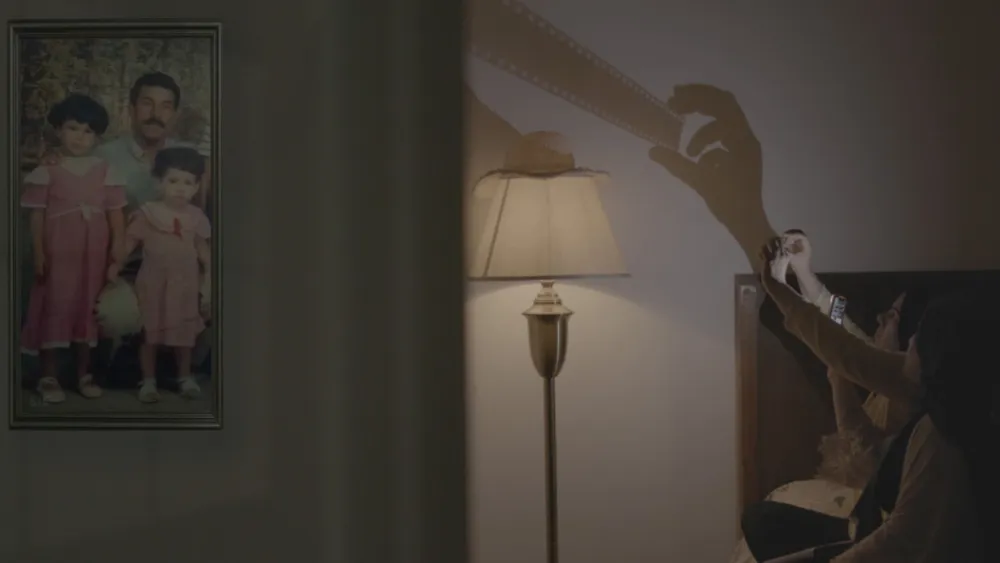
In her sophomore feature “My Father Killed Bourguiba,” Tunisian filmmaker Fatma Riahi examines her father’s role in a failed plot to overthrow the country’s first president, exploring how his political choices impacted the family after his imprisonment and how that’s shaped the course of her life.
The film, which is produced by Riahi in co-production with Dora Bouchoucha and Lina Chaabane of Tunisian outfit Nomadis Images (“The Voice of Hind Rajab,” “Aisha Can’t Fly Away”) and Omar Ben Ali of SVP Production, was selected for the Pitching Forum at the Thessaloniki Intl. Documentary Festival, which runs March 5 – 15.
“My Father Killed Bourguiba” is a deeply personal journey for the director, who delves into her family’s archive to tell the story of a father who was part of a group that planned to overthrow the regime of Habib Bourguiba — the country’s first president after independence — by military coup in 1987.
The plot failed — the film takes its title from an errant choice of words to a prison guard by the director’s five-year-old sister — and yet the ramifications turned Riahi’s family and personal life upside down. Drawing on family photos and letters she exchanged more than 30 years ago with her father while he was in prison, the director tries to understand his choices while reflecting on their impact “on the little girl I was then and the woman I have become,” she said.
Speaking to Variety in Thessaloniki, Riahi — whose first feature, “A Haunted Past,” premiered at IDFA in 2018 — explained that while “My Father Killed Bourguiba” is intimately connected to the politics of the time, “it’s not a political film.”
“I grew up between two seemingly opposing ideas: the political vision my father believed in and the one Bourguiba defended,” she said. “Rather than resolving this contradiction, the film allowed me to sit with it and accept its complexity.” Through the process of reckoning with opposing viewpoints, she hopes she and others will be able to come to terms with the rift that continues to divide Tunisia today.
“Maybe that will help us to understand each other and to accept each other, even if we are different and even if we are coming from different points of view.”
Heralded as the “father of Tunisia,” Bourguiba ruled the country for three decades after Tunisia declared independence from France. Despite his progressive views, he was widely seen as an authoritarian and a despot. Meanwhile, Riahi’s father, Mabrouk, was a member of the so-called “Security Group,” a more ideologically conservative movement that was determined to overthrow the Bourguiba regime.
In November 1987, however, just one day before Mabrouk and his co-conspirators planned to launch their coup, then-Prime Minister Zine El Abidine Ben Ali carried out his own successful plot, toppling the regime and placing Bourguiba under house arrest. Two months later, Mabrouk and his fellow plotters were arrested and imprisoned by the Ben Ali government.
That marked a turning point for Riahi and her family, who in the years that followed would face systematic harassment from the regime and its supporters — all because they had been thrust into “a conflict which I did not choose, a conflict caused by my father’s choices,” she said.
Yet throughout those tumultuous years — and even after her father’s death, in 2005 — the family stayed silent about their ordeal.
“I rarely spoke about what happened to our family, except with a very small circle of close friends,” Riahi said. “Silence was shaped by fear.”
That changed in 2011, when a popular revolt finally brought down the hated Ben Ali regime. In the years that followed, Tunisia set up a Truth and Dignity Commission, with Riahi and her sister called to testify in the summer of 2017 alongside thousands of other opponents of the Ben Ali government, who were targeted and harassed for their views. It was, she said, “the decisive moment that triggered me into making this film.”
“It was the first time I spoke in front of a camera, in front of strangers, and even in front of my sister, about that period of our family’s history,” the director said. Recounting how her family suffered because of Ben Ali’s collective punishment policy, Riahi “discovered the power of confession.” Afterward, she realized, “I wanted to talk more.”
“My Father Killed Bourguiba,” however, isn’t only in conversation with the past. Reflecting on her own journey to motherhood, Riahi noted how she’s increasingly thinking about what she passes down to her two children, recognizing that — for better or worse — her choices could shape the course of their lives, much how her father’s helped determine hers.
“I try not to pass on trauma, fear or sadness to my children,” she said. “I speak to my eldest son about the revolution, Tunisia, and his grandfather, but I remain very selective.
“At the same time, through this film, my children are indirectly involved in this past, even if only symbolically,” she continued. “I sometimes feel conflicted about that, but I also see it as something positive. Learning history, practicing honesty and being encouraged to question the past may make them more aware, less afraid and less silent than we were.”
The Thessaloniki Intl. Documentary Festival runs March 5 – 15.