When producer Jared Jacovich was asked whether he thought this was what his old friend David B. Weaver would be doing a decade after graduating from Emerson film school, his answer came without hesitation. “Yes,” he said. “100 percent, yes.”
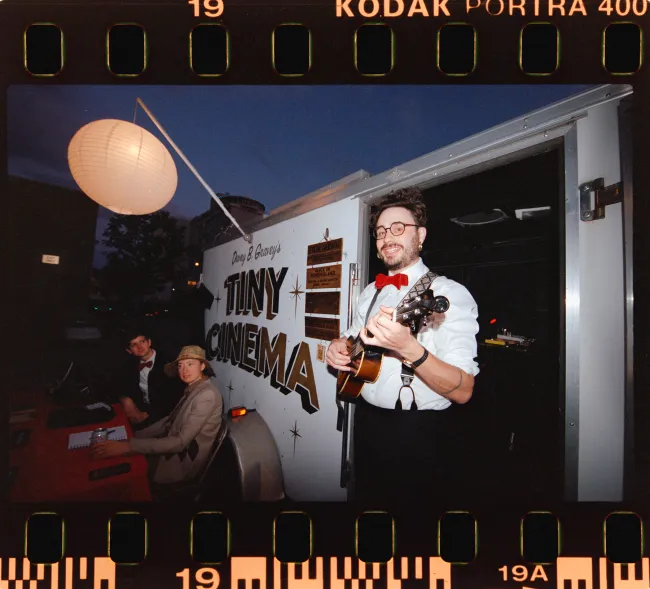
That certainty is striking given what Weaver — better known to select Los Angeles audiences by the name Davey B. Gravey — actually does. On most Saturday nights in Silver Lake, Weaver pulls a solar-powered trailer into Sunset Triangle Plaza, where he opens a small door and ushers only four people at a time into a fully functioning movie theater that screens his short fascinating films for just a donation.

“It’s so pure,” Jacovich said. “People talk a lot about the cinematic experience, going into a big theater and sharing it with a lot of people. That’s important. But when you distill that into its tiniest form, when you make the screen as small as it can be and fit as many seats as possible, it still works. At least for Davey. That feeling doesn’t go away.”
Inside Davey B. Gravey’s Tiny Cinema, as it’s called, you’ll find checkerboard linoleum floors, vintage seats salvaged from an old theater in Boulder, and glowing glass wall sconces that were custom-made for the owner by a friend. There’s a Super 8 projector pointed at a set of red velvet curtains, which flutter apart only for the man himself.

The experience feels oddly magical, as if a fantasy street barker from another era has suddenly materialized in the middle of modern L.A. “The idea arrived fully formed, somehow,” said Weaver. “It just felt very correct to me. It was like, ‘There’s something here. There’s something beautiful about this.’”
With Weaver himself nowhere to be seen, and Gravey donning his best spectacles and suspenders, the host/headliner eventually shuts the door and asks the audience which of his silent short films they’d like to see. Harboring not one but two renegade talents, Tiny Cinema also serves a punk-rock purpose for Weaver, allowing the indie director to present his work in the most enchanting conditions possible.
Scored live on musical instruments that line the back of the room, Gravey’s micro-venue doesn’t announce itself beyond some string lights and a curious invitation to check out the next showing. Those who happen to wander close enough (or smartly follow the recommendation of the right post on social media) are roundly rewarded with an escape that feels at once impossibly old and startlingly new, totally obvious yet genius.
“My number is printed on the back of the trailer, so I’ll sometimes get a random call on the highway,” said Weaver, snapping Gravey’s dreamlike vaudeville act into an even funnier reality. “They’re like, ‘Hey, I’m driving behind you right now. What is Tiny Cinema?’ I’ll explain it, and then, they’re like, ‘Oh, OK. That’s neat. See you never!’”
Celebrating more than a decade as Davey B. Gravey, Weaver built Tiny Cinema in Colorado in 2014. The project’s DNA stretches back further to film school in Boston, where Weaver fell deeply in love with the cult of Super 8 filmmaking.
“It was magic to me,” he said. “I loved the aesthetic of it. It felt like living nostalgia.”

That fascination turned into experimentation. Magnifying glasses placed in front of projectors transformed amateur images into circular, inverted vignettes that felt ripped from another world. Weaver and his collaborators shot scenes upside down, re-inverted them through glass, and paired the visuals with live guitar and narration. That messy, revelatory foundation paved the way for Weaver to invent Tiny Cinema.
“There was something about it that felt like a less passive experience of cinema,” he said. “It was more active. It felt like a live show, but you were still experiencing a story in movie form. I really loved that combination, and still do. There’s nothing like it.”
After graduating, Weaver returned to his hometown in Colorado. He began playing music and worked as a projectionist at Alamo Drafthouse, continuing to tinker with film in his creative time. When a friend invited Weaver to participate in a carnival-themed festival in Oregon, the director proposed building a temporary movie theater. He shot a short for the event, titled “Low Noon,” only to receive a call when it was nearly wrapped.
“The whole event fell through,” Weaver laughed. “Everything got canceled.”

Suddenly, Weaver was left with a finished short, sunk costs, and no audience. But rather than abandon the idea of programming his own microtheater, the soon-to-be Davey B. Gravey reshaped it. A friend suggested putting the theater, which would have been stationary at the festival, inside a horse trailer. That concept eventually evolved into a cargo trailer and became a collaborative build that changed Weaver’s life.
“Once it was like, ‘Oh wait, if it’s in a real trailer, we can install a real cinema,’ everything just clicked,” he said. “It felt like the Gravey-verse was being discovered, not created.”
The design choices inside Tiny Cinema are precise and deeply personal, but they’re not fussy. The four theater seats were donated by the Boulder International Film Festival after being saved from the long-closed historic Flatiron Theater. Another collaborator insisted that the lighting be controlled by an absurdly big dimmer. It’s a forged-metal arrow attached to a rheostat and pairs well with Weaver’s Tesla, which is custom air-brushed with a lightning bolt thanks to another one of his talented friends.
“There’s no logical reason for a cartoonishly large dimmer,” Weaver said. “But when he suggested it, I was like, ‘Yeah, of course.’ That’s how this project works.”

By 2017, Weaver added solar panels and onboard batteries, allowing Tiny Cinema to operate entirely off-grid. “It’s all powered by the sun,” he said.
The legend of Gravey and his short filmography grew inside the space, too. Per Weaver, “Low Noon” was a slapdash, necessity-driven Western riff. But “Moonglow,” shot shortly afterward, leaned into darker, more emotional territory — drawing inspiration from a Virginia farm once owned by Weaver’s family. Rusting agricultural equipment and decaying barns gave the sci-fi story an eerie texture that’s strangely suited to a movie theater in a trailer.
“I wanted it to feel spooky,” Weaver said. “There were moments where we actually underexposed shots too much and had to reshoot. But that was part of the process.”
“Up, Up and Away,” completed in 2023, marked another leap for Weaver. Shot over five days with a real hot air balloon — that was actually piloted by Weaver’s dad — the fantasy epic plays like suspended imagination. “We realized we could do it with just one exposition card and no dialogue,” Weaver said. “That became the challenge. Could we tell the whole story musically?”
Jacovich, who reunited with Weaver when he moved to Los Angeles, wasn’t surprised by the evolution. “Davey is the embodiment of whimsy,” he said. “This feels completely intuitive to him. You see it and think, ‘That’s amazing,’ but you also think, ‘Of course.’”
For Weaver, Tiny Cinema isn’t just a showcase of his completed artistic work; it’s a durational performance that asserts Gravey as an undeniable, otherworldly star. After Weaver tows in the trailer and sets the Tiny Cinema up, he ushers in guests, plays live music, and manages the energy for every show before breaking it all down at the end of the night. Jacovich, assuming his own alter-ego (who you can meet for yourself at the door), spends a lot of time encouraging Weaver to take breaks.
“It’s the whole show, every time,” Weaver said. “It’s performing music, being in character, leveling the projector. It’s very energy-intensive and always has been.”

Several years back, Weaver took a hiatus and briefly considered selling his rig. Then, the pandemic shut everything down, and instead of ending Tiny Cinema, the pause clarified it. The project used to operate through private events and sporadic public appearances. But a year ago, Weaver committed to Sunset Plaza on Saturdays.
“A friend told me, ‘Just do it every week,’” he said. “Find a spot and let the community form.”
Pedestrian-heavy and slightly surreal, this particular corner of East Los Angeles offers Weaver and Jacovich a kind of “lobby.” It’s a threshold between the city and the cinema that has a warm glow that’s key to selling passersby on an unexpected evening. A weekly ritual for some, many discover Tiny Cinema by accident and keep coming back.
“To know the Tiny Cinema is to love the Tiny Cinema,” Jacovich said. “The second you walk in, you get it.” That affection has fueled Weaver’s most ambitious project yet: “HELLCAT.” The upcoming short, currently fundraising toward a $50,000 budget, expands on an incredible trailer Gravey is already previewing in Sunset Plaza. “HELLCAT” aims to use a real cat actor and show a practical car stunt shot on multiple Super 8 cameras.

“It’s the biggest tiny movie of all time,” Weaver said. It’s also a natural next step.
“As soon as an artist says, ‘I don’t know if this is possible,’ that’s when I know it’s worth doing,” said Jacovich, who is producing “HELLCAT.” “It doesn’t get more independent than this. Seriously. Independently made, funded, distributed, exhibited. Everything.”
In an industry increasingly defined by algorithmic thinking, contraction, and collapse, Tiny Cinema offers something defiantly human: a singular filmmaker who built his own theater, to show his own movies, to sit with audiences every night. For Weaver, the appeal of Gravey and Tiny Cinema has long been toying with the sense of scale itself.
“Maybe I’ll just completely do my own thing over here, forever,” Weaver joked. “There’s something anti-establishment about that. The point isn’t to grow. The point is to be tiny. That’s what makes it special. That’s what makes any of it worth doing.”
You can visit Davey B. Gravey’s Tiny Cinema in Sunset Triangle Plaza on Saturday nights in Silver Lake, Los Angeles from 6 p.m. to 10 p.m.(ish). Dates for special exhibitions are listed on the theater’s official website, and more info about the upcoming “HELLCAT” is available on Kickstarter.