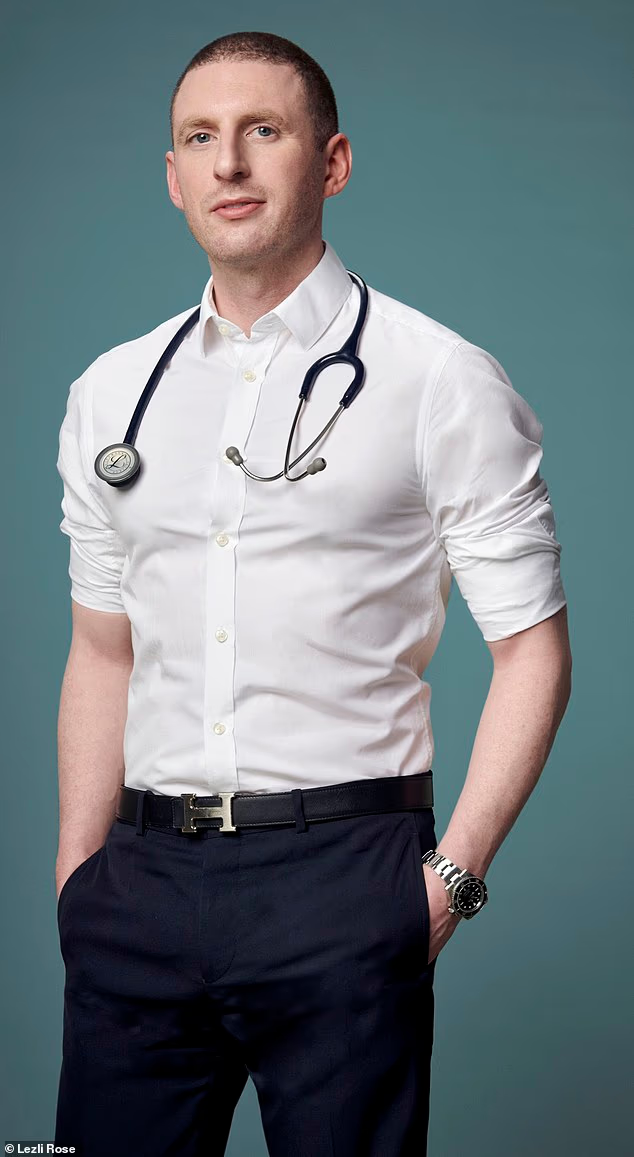
The skin is the largest organ in the body. It regulates our temperature, protects us from infection and performs countless vital biological functions we never think about.
But it is also the part of us that the world sees before they have heard us say a word. And yet we persist in treating problems that affect the skin as though they are trivial.
As a doctor, I find this attitude not just frustrating but dangerous. Take psoriasis, which affects about 1.8 million people in the UK. It is often dismissed as a rash, or worse, wrongly assumed to be the result of poor hygiene.
In fact, it is a chronic condition caused by an imbalanced immune system that causes thick, red, scaly and intensely painful plaques across the body.
The physical suffering is considerable. But the psychological toll is, in many cases, even worse.
Research has found that up to 60 per cent of psoriasis sufferers have a psychiatric illness. Rates of depression run at around a third in those with moderate to severe psoriasis.
About 10 per cent are suicidal and the unemployment rate is nearly twice as high as that of the general population.
These are not the statistics of something trivial.
I developed acne as a teen. I went to my GP, who shrugged, told me it was perfectly normal and gave me a cream that made my face sore and red, writes Dr Max Pemberton

Research has found that up to 60 per cent of psoriasis sufferers have a psychiatric illness
Eczema tells a similar story. Research has shown that 15 per cent of sufferers report suicidal thoughts, rising to 25 per cent in those with moderate to severe itching.
Boys with eczema are less likely to form romantic relationships. Anxiety and social isolation are common.
And then there is acne. Like many people, I developed acne as a teen. I went to my GP, who shrugged, told me it was perfectly normal and gave me a cream that made my face sore and red. I did not go back. I accepted that this was simply part of growing up. Except it did not go away.
I entered my 20s still very prone to spots, and then my 30s. My acne was not, I should say, anywhere near as severe as some people’s but I was acutely aware of it. And I had not appreciated quite how much it was affecting my life until a specific moment I still remember clearly.
A friend texted asking if I was free that evening. A particularly angry crop of spots had just erupted and I simply could not face going out with them on display. I made an excuse. Then it struck me how completely ridiculous that was.
I thought back and realised it had happened before. That spots, of all things, had quietly started to dictate how I lived.
I made an appointment with a dermatologist. It was, without exaggeration, one of the best decisions I have ever made.
Shortly after my skin cleared, I was out one evening and mentioned this to a friend. He is a big, tough man. Not someone who you would think could be undone by a skin condition.
He looked at me and, in a very quiet voice, told me that he too had been plagued by acne for years. That when it was bad, he would sometimes not leave the house for days. There had been times when it had got him feeling so down that he had thought about killing himself.
He had never told anyone because he was convinced he was being weak, that nobody would take him seriously, that they were, after all, just spots.
But they are not just spots.
Research by the British Skin Foundation found that nearly one in five people with acne have contemplated suicide because of it. The same number have ended a relationship because of it.
Nearly 60 per cent have experienced verbal abuse about their skin.
Victoria Beckham has spoken about how acne at the height of her Spice Girls fame knocked her confidence so severely that she stopped smiling in photographs.
People who have not experienced it may find that difficult to understand. I completely get it.
The problem is made worse because patients are so routinely dismissed. I was dismissed as a teenager.
My friend suffered in silence for years because he assumed nobody would take him seriously. There is a broader cultural attitude here, one that treats anything affecting the skin as somehow less serious, less worthy of attention than conditions that affect other organs.
My own acne was eventually treated with a well-known drug called Roaccutane. I know that there has been a great deal of alarming coverage about its links to depression and suicide and those concerns deserve to be taken seriously.
But the crucial point that tends to get buried is this: acne itself is linked to depression and suicide. We are prescribing this drug to people who are already at elevated risk.
In all my years working in mental health, I have never seen a patient who became depressed because of Roaccutane.
I have, however, seen a great many who became depressed because of their skin. After a nine-month course, my skin cleared completely. I felt as though a weight had been lifted.
On the advice of my dermatologist, I still take one tablet a week and I have not had a significant spot in years.
If you are suffering and feel it is affecting your mental health, please do not suffer in silence.
Push for a referral to a dermatologist. Do not allow anyone to tell you that you are being vain or over sensitive.
Get into a routine like Cindy
How you start your day has a huge effect on your mood, mental clarity and resilience to stress. Last week, Cindy Crawford, 60, shared her morning routine. She rises at 6am and her regime includes dry-brushing her legs, drinking a shot of apple cider vinegar and walking barefoot on the grass outside her beachside home for ‘grounding’ before taking a dip in her Jacuzzi.
All before 8am, when her Pilates instructor arrives.

Cindy Crawford’s regimented morning routine begins at 6am, but this blueprint is not for everyone
Good for her! I say that with no envy whatsoever. Obviously, this is not a blueprint for most of us but Cindy is making a vital point. The specific contents of your routine matter far less than the fact of having one at all. I make a cup of tea, sit for ten minutes and listen to the radio while I look out the window. Then I write a list of jobs. A morning ritual need not be extravagant to be effective.
It simply needs to be yours.
The news that a new non-hormonal tablet has been approved for menopausal women who can’t take HRT is a godsend. Women suffering from hot flushes and night sweats but with a history of certain cancers, blood clots or other conditions, had been left with few options. Fezolinetant (brand name Veoza), targets brain signals responsible for triggering these symptoms, rather than replacing hormones. It is not a substitute for HRT, and it won’t address other menopausal symptoms, but it is a significant development.
Dr Max prescribes… a gratitude diary
I recently finished a refresher course on cognitive behavioural therapy (CBT) and one of the proposals was keeping a daily gratitude diary. Each evening, write down three things you are grateful for – a good coffee, sunshine, your dog. Studies show that this measurably improves mood, reduces anxiety and builds psychological resilience. It works by training the brain to scan for the positive rather than defaulting to the negative.