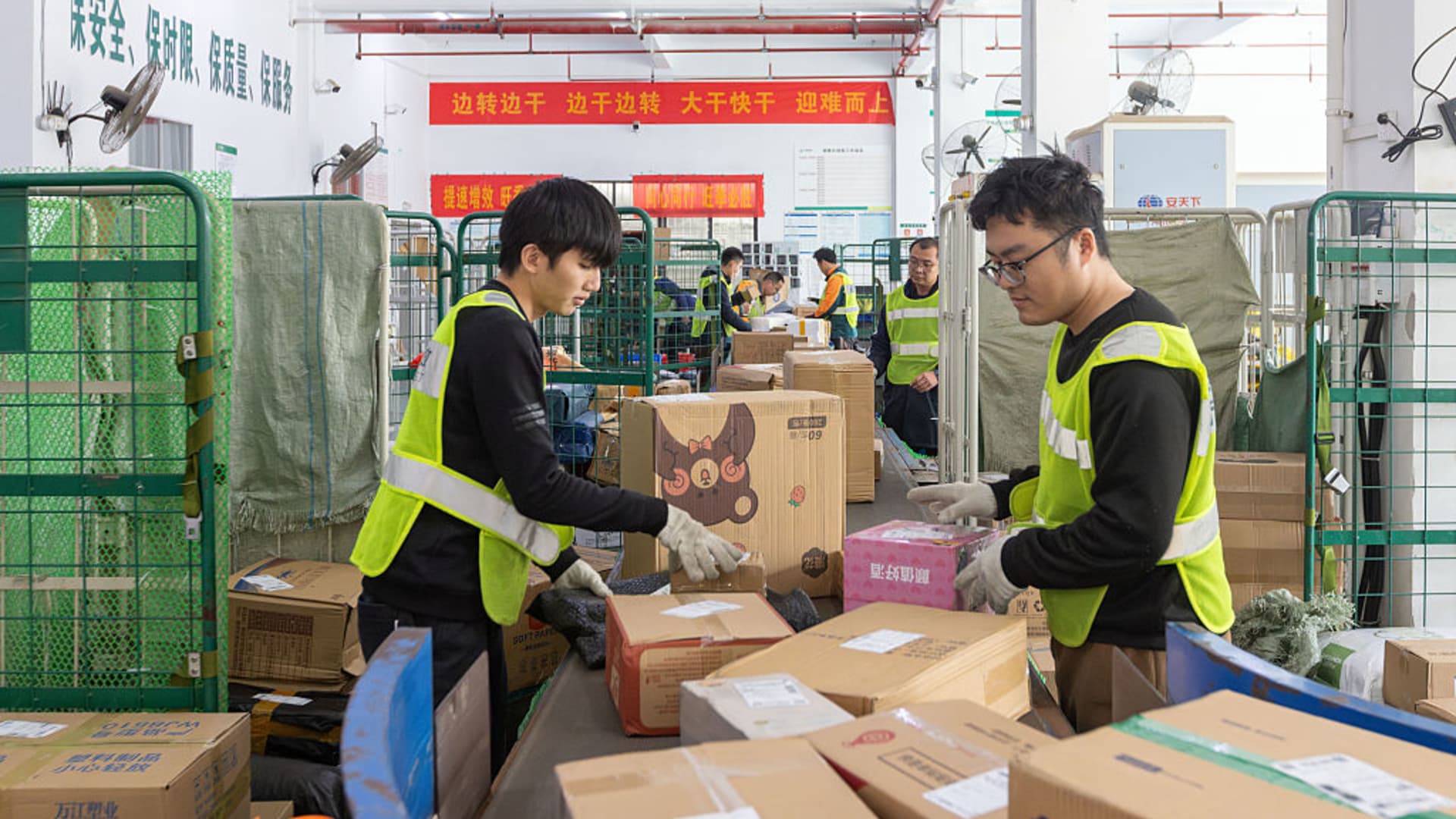
Staff sort parcels on the mail sorting assembly line at the Postal Delivery Logistics Joint Distribution Center in Mengshan County, Wuzhou City, Guangxi Province, China, on January 28, 2026. (Photo by Costfoto/NurPhoto via Getty Images)
Costfoto | Nurphoto | Getty Images
China’s economy started on a strong footing this year, with consumption and production both beating expectations as holiday spending and strong foreign demand provided an early boost.
Retail sales for the first two months rose 2.8% from a year earlier, according to data from the National Statistics Bureau on Monday, beating economists’ forecast for a 2.5% growth. That growth, however, reflected a notable slowdown from the 4% rise in the January-February period in 2025.
The consumption momentum was partly buoyed by the Lunar New Year holiday in mid-February, said Yuhan Zhang, principal economist at think tank The Conference Board’s China center, pointing to gains in tobacco and alcohol sales, as well as in spending on gold and jewelry.
Industrial output climbed 6.3%, also exceeding expectations, with Reuters poll having estimated a 5% jump. Industrial production has been a relative bright spot in the world’s second-largest economy, thanks to resilient external demand, particularly from European and Southeast Asian nations.
Investment in fixed assets, which includes property, rose 1.8% from a year earlier, compared with estimates of a 2.1% drop. Within fixed-asset, investment in real estate development continued to decline as the property crisis drags on, falling 11.1% in January and February, moderating from the 17.2% drop in 2025.
Separate data released on Monday showed that the prolonged decline in China’s home prices across 70 major cities worsened in February, with new-home prices dropping 3.2% from a year earlier, the steepest decline in eight months, according to Reuters.
Excluding property development, investment rose 5.2% year over year, supported by inflows into infrastructure and manufacturing.
Fixed asset investments saw a historic slump in 2025, declining 3.8% year over year, as a deepening property downturn and tighter constraints on local governments’ borrowing has hampered one of China’s traditional growth drivers.
Geopolitical headwinds
Despite resilient economic data, government officials acknowledged growing headwinds to the economy, stemming from geopolitical tensions and deep-rooted problems in its growth model that have weighed on corporate profitability.
“We should be aware that the evolving external environment is exerting a great impact on China and the geopolitical risks keep rising,” the Statistics Bureau said.
Spokesperson Fu Linghui told reporters Monday that China’s energy supply capacity remained sufficient to cope with the heightened volatility in global oil prices, saying that Beijing will closely monitor its impact on inflation.

Data suggests Beijing may be more insulated from the Strait of Hormuz closure than other major economies, as China has spent the past two decades diversifying its energy sources and building its strategic reserves.
Seaborne oil imports through the Hormuz waterway now account for less than half of China’s total oil shipments, according to Rush Doshi, director of China Strategy Initiative at the Council on Foreign Relations. Nomura also estimated that oil flows through Hormuz represent just 6.6% of China’s total energy consumption.
That said, Goldman Sachs on Friday trimmed its China real GDP growth forecast by 0.1 percentage point due to higher energy costs — a smaller cut than the 0.3 percentage point to 0.5 percentage point reduction it forecasts for other regional economies.
Goldman also raised its annual consumer inflation outlook for China to 0.9%, from 0.6% forecast earlier, and expects factory-gate prices to rebound 0.8% this year as higher oil prices feed into the supply chain.
Chinese leadership unveiled its annual economic goals for 2026 just last week, tamping down the GDP growth target to a range of 4.5% to 5%, the least ambitious goal since the early 1990s.
Urban unemployment rate stood at 5.3% in the first two months this year, official data showed, compared with the average rate of 5.2% in 2025.
— CNBC’s Evelyn Cheng contributed to the story.