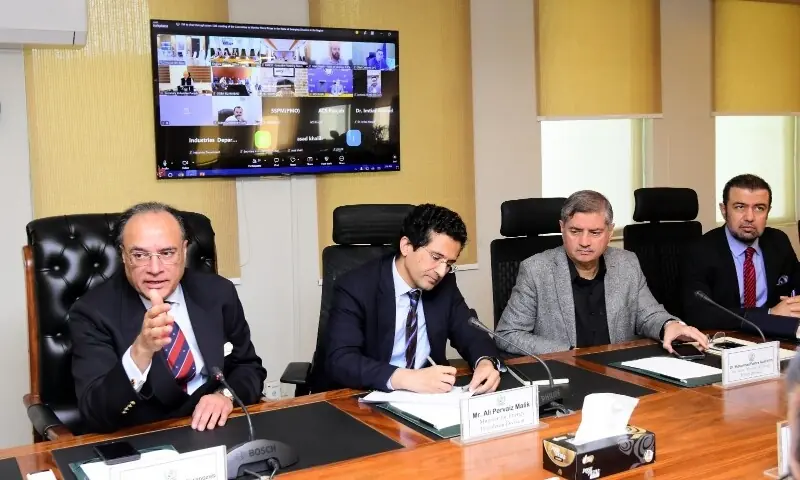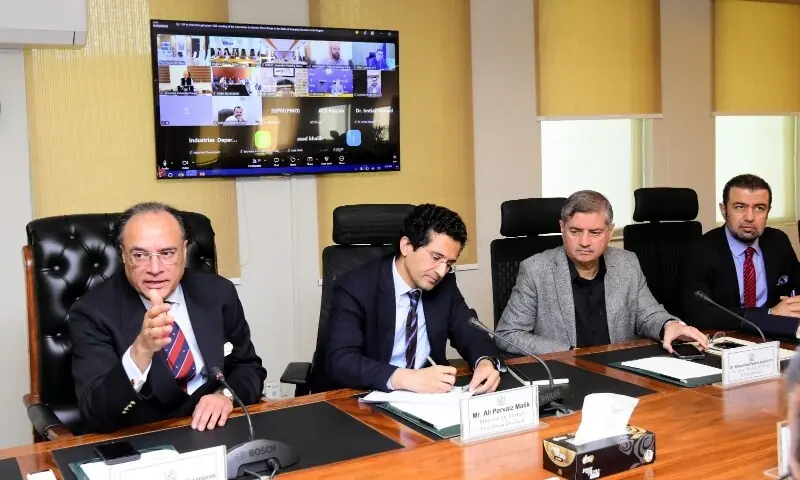
ISLAMABAD: A committee tasked with monitoring petrol prices was informed on Monday that Pakistan was “adequately positioned in terms of fuel availability”, with March requirements fully secured and, based on current cargo planning and supply arrangements, coverage was available up to mid-April.
The development comes after the government announced a Rs55 per litre hike in the prices of both petrol and high-speed diesel to deal with the fuel crunch resulting from the ongoing Middle East conflict.
According to a finance ministry statement, the committee was briefed today on the national inventory of crude oil and refined petroleum products, ongoing import arrangements, and supply chain logistics.
The committee was informed that the country “remains adequately positioned in terms of fuel availability, with March requirements fully secured”.
It was further briefed that, “based on current cargo planning and supply arrangements, coverage is available up to mid-April” and efforts were being taken to extend coverage towards the end of April, the statement added.
It said that the meeting of the committee, chaired by Finance Minister Muhammad Auragzeb, was held at the Finance Division in Islamabad as part of its “daily review” of the energy sector amid tensions in the Middle East.
The committee was told that overall stock levels and scheduled imports indicate that the country has “comfortable inventories of crude oil and key petroleum products for March, with sufficient planning in place to ensure continued availability during April”.
During the meeting, “procurement patterns and maritime logistics” were reviewed as well. As per the statement, the committee stressed the need for “further diversifying sources of supply to enhance resilience of the national energy supply chain”.
The committee was further informed that “procurement strategies are already moving towards greater diversification, with efforts under way to broaden sourcing from the international market and reduce reliance on any single corridor, thereby strengthening Pakistan’s overall energy security”.
The finance minister gave reassurance that the government remained “fully focused on ensuring uninterrupted availability of petroleum products across the country,” adding that the “current stock position and supply outlook remain stable”.
He stressed that “there is no basis for panic buying or unnecessary stockpiling of fuel”. The committee also directed relevant authorities, in coordination with the Oil and Gas Regulatory Authority and provincial governments, to “closely monitor stock levels and market activity to check any incident of hoarding”.
“It was emphasised that any attempts to create artificial shortages or disrupt normal supply would be dealt with strictly in accordance with the law,” the statement read.
In attendance at the meeting were Petroleum Minister Ali Pervaiz Malik, Maritime Affairs Minister Muhammad Junaid Anwar Chaudhry, State Bank of Pakistan Governor Jameel Ahmad and other relevant officials.
Govt ‘fully prepared’ to deal with ongoing situation: PM Shehbaz
Separately, Prime Minister Shehbaz Sharif held a meeting where consultations were held on “further relief measures” for the public, state broadcaster PTV reported.
During the meeting, the premier noted that due to the government’s “timely action”, the country maintained an “adequate quantity of petroleum products”. He added that the continuous supply of oil was made possible “due to the decisions of the committee formed to maintain economic stability in the country”. Speaking about the austerity measures, the premier said that “work was underway to take further steps”.
He maintained that the third-party auditors have been issued instructions to ensure compliance with the measures.
He said that the government “remained fully prepared” to deal with the ongoing situation.
“Economic stability and public relief remain the government’s top priority,” PM Shehbaz said. He issued directives to fuel distribution companies to ensure that the fuel is sold at the government-mandated rates.
The prime minister was briefed that the government continued to monitor fuel rates, as well as the available oil reserves, and other relief measures. He was also briefed about of a newly-introduced feature on the “PAK App through which consumers can report the unavailability of fuel or its sale at exorbitant rates”.
‘Petrol reserves sufficient for 27 days, diesel for 21’
Earlier in the day, a meeting of the Senate Standing Committee on Petroleum was told by Petroleum Secretary Hamed Yaqoob Sheikh that Pakistan has sufficient petrol reserves for 27 days and diesel reserves for 21 days.
The standing committee was chaired by Senator Manzoor Ahmed.
The secretary said that jet fuel (JP1) reserves were available for 14 days, crude oil reserves for 11 days and liquefied natural gas (LNG) reserves for nine days.
Additionally, he informed the committee that the import of oil of quality below Euro 5 standard had now been allowed. Sheikh said that 70 per cent of Pakistan’s petrol comes from the Middle East, and due to the suspension of ship movements affecting supply, prices have increased.
The price of high-speed diesel rose from $88 to $187, while petrol increased from $74 to $130, he added.
“A ministerial committee formed by the prime minister reviews the situation of petroleum products on a daily basis,” Sheikh told the meeting, adding that the government was trying to increase the use of existing reserves.
Senator Manzoor Ahmed said that the “entire benefit was passed on” to oil marketing companies. In response, the petroleum secretary said that the price hike had been adopted to stop the hoarding of petroleum, and this “did not benefit oil marketing companies”.
Oil marketing companies continued to import despite the increase in prices, he added, saying that the move had “affected oil marketing companies across the country”.
Asked by Senator Hidayatullah about petroleum product prices before March 7 and the extent of their increase, Ogra officials said that diesel prices had risen by 100pc, while petrol had increased by 70pc.
The petroleum secretary added that “the government is working on a package to provide relief to motorcycles and rickshaws” and that they have taken measures which would “provide relief to the people”.
“Sixty per cent of India’s petrol imports have been affected … All countries are trying to ensure the safe supply of petrol,” he said, adding that two of Pakistan’s ships were also stuck in the Strait of Hormuz.
Officials said that there were two agreements in place for importing LNG from Qatar.
“LNG supply from Qatar has been completely stopped since March 2,” Ogra officials said. “Eight cargoes were scheduled to arrive in March, of which only two arrived, while six cargoes are expected in April.”
The officials added that Sui Southern Gas Company had cut gas supply to a fertiliser plant by 50pc, and gas supply to the power sector had been reduced from 300 million cubic feet per day (MMCFD) to 130 MMCFD.
Officials said LNG would not be available in the country after April 14, and the power sector’s gas requirements would not be met in April, adding that “the sector’s needs will be met from other sources”.
They further said that gas would be supplied to domestic consumers, while LNG could be purchased from the State Oil Company of the Azerbaijan Republic (Socar). However, spot purchases would cost $24 per unit, while gas from Qatar is available at $9 per unit. “This will make electricity more expensive,” they added.
On Sunday, the government also increased the price of kerosene oil by another Rs40 per litre and approved a Rs23 billion price differential subsidy for payments to oil marketing companies to keep the prices of petrol and high-speed diesel (HSD) unchanged for the current week.
Last week, PM Shehbaz announced that petroleum prices would remain unchanged for the current review period, stressing that the decision was aimed at easing the financial burden on the public.