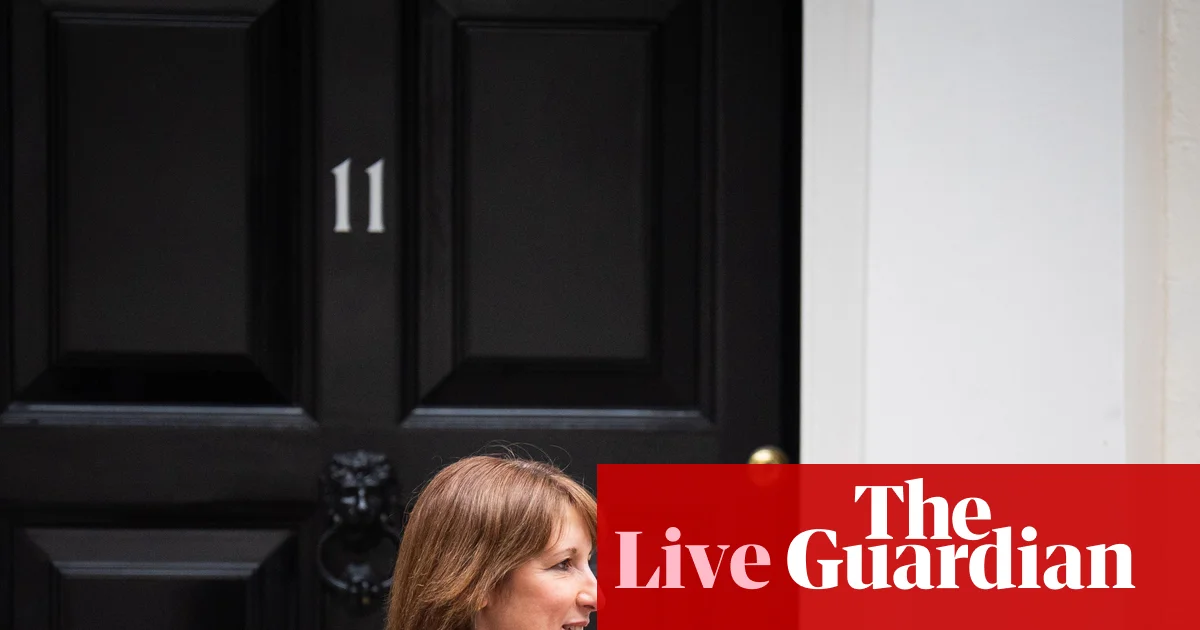
Reeves to give Mais lecture shortly
Here at the Bayes Business School in the City of London, Rachel Reeves is about to deliver the annual Mais Lecture, with a big focus on Europe, AI and regional growth expected.
The Mais lecture is a City institution, having been established in 1978 to honour Lord Mais, a former Lord Mayor of the City of London.
The Mais lecture is typically given by a leading politician, central banker or economist, to an audience of senior City figures, academics, alumni, students and the media.
Over the years, Sir Geoffrey Howe has spoken about “The Fight Against Inflation” in 1981, Tony Blair outlined “The Economic Framework for New Labour” in 1995, Bank of England governor Eddie George presented on “Monetary Policy in Britain and Europe” in 1997, and French president Valery Giscard d’Estaing disucssed “The New European Debate: The Eurozone and the Greater Europe” in 2001.
Reeves is the first person to give two Mais lectures, having been here in 2024 too.
Key events
Today’s lecture will be about “The active and strategic state”, the screen in the lecture hall here suggests.
There’s a big team from the Treasury here to support Rachel Reeves, including Torsten Bell, Dan Tomlinson, Lord Livermore and Lucy Rigby.
Reeves to give Mais lecture shortly
Here at the Bayes Business School in the City of London, Rachel Reeves is about to deliver the annual Mais Lecture, with a big focus on Europe, AI and regional growth expected.
The Mais lecture is a City institution, having been established in 1978 to honour Lord Mais, a former Lord Mayor of the City of London.
The Mais lecture is typically given by a leading politician, central banker or economist, to an audience of senior City figures, academics, alumni, students and the media.
Over the years, Sir Geoffrey Howe has spoken about “The Fight Against Inflation” in 1981, Tony Blair outlined “The Economic Framework for New Labour” in 1995, Bank of England governor Eddie George presented on “Monetary Policy in Britain and Europe” in 1997, and French president Valery Giscard d’Estaing disucssed “The New European Debate: The Eurozone and the Greater Europe” in 2001.
Reeves is the first person to give two Mais lectures, having been here in 2024 too.
Photograph: Graeme Wearden
Over at Bayes Business School in the City of London, guests are arriving for Rachel Reeves’s Mais lecture, due to start in 45 minutes.
They’re mingling over sushi, pastries, sliced meat, fruit and cheese.
MPs ask Lloyds how customers saw other users’ data
Parliament’s Treasury Committee are demanding answers from Lloyds Banking Group about the IT glitch which allowed some customers of Lloyds, Halifax and Bank of Scotland to see other users’ transactions.
Dame Meg Hillier, chair of the Committee says the incident appears to be an ‘alarming breach of confidentiality’ (indeed!) and is seeking further clarity on what happened.
In a letter to Lloyds, Dame Meg wants to know how many cutomers were affected by last week’s incident, what information was revealed, and what compensation will be paid.
She asks:
-
Please can you provide the Committee with an overview of the incident, including the channels (e.g. app, internet banking) and brands that were affected by this incident. This should include a timeline of your response;
-
A description of the information that has been incorrectly presented to people other than the correct account holder, including whether it was limited to just information about transactions or whether other personal information, including National Insurance numbers, was released;
-
Whether it is possible to identify those whose information has been incorrectly passed on to others, and if so, how you will communicate with those customers;
-
The number of customers that have been affected by the incident. This should be separated into the number of people who saw other people’s information, and the number of people whose information was erroneously provided to others, if possible;
-
What steps you are taking to encourage those who may have taken copies of data to which they were not entitled to delete it;
-
The amount of compensation that Lloyds Banking Group has so far paid related to this incident and to how many people, and whether Lloyds Banking Group will be proactive in providing compensation to those who may at present not know they have been a victim of this data breach;
-
When Lloyds Banking Group first informed the Financial Conduct Authority and the Information Commissioner about this breach;
-
Your initial explanation of the reason for this failure of data protection.
Dr Eleanor Crane, assistant professor in Quantum Computing at King’s College London, has welcomed the government’s pledge of £2.5bn for AI and quantum technologies, saying:
“This investment will provide an incredible boost to quantum research, and will enable the UK to keep its longstanding role at the forefront of quantum computing.”
But…. challenges need to be overcome to drive quantum computing in the UK, Dr Crane adds:
“The challenges which need to be overcome to drive quantum computing in the UK are: creating attractive positions for lecturer and professor level positions in quantum computing for internationally renowned scientists (further to the existing positions in quantum sensing and communications), and finding ways to enable widespread collaboration with leading European countries in quantum who have an aligned vision of the future such as France, Germany, Spain, Finland and Austria.”
Here’s the chancellor’s message on AI:
This government will make the UK the best place in the world for quantum and AI companies to start, scale and stay.
In a changing world, our economic plan is the right one.https://t.co/CnW6Kw7sA1
— Rachel Reeves (@RachelReevesMP) March 17, 2026
Many medium-sized UK firms have already turned to AI, new research shows.
AI adoption among mid-sized firms has jumped from 35% to 55% over the last two years, a survey conducted by the Centre for Economics and Business Research (Cebr) on behalf of HSBC UK has found.
This increase is due to AI offerings such as large language models, advanced analytics and workflow automation entering the mainstream, CEBR says.
Nina Skero, chief executive at Cebr, explains:
“Our findings show AI is beginning to influence productivity outcomes in the UK mid-market in a meaningful way.
“However, productive adopters remain a minority within the mid-market. That suggests there is still significant headroom for gains across the sector. If more firms move from initial adoption to deeper integration, the aggregate impact on UK productivity and national output could be substantial by the end of the decade.”
HSBC UK has launched a scheme called the AI & Productivity Financing Initiative, which will provide £5bn of lending to help UK businesses invest in “essential, future-ready capabilities”.
Over in Germany, investor morale has tumbled as the Middle East conflict has threatened to push up inflation and derail Germany’s economic recovery.
The ZEW economic research institute’s monthly gauge has plummeted to just -0.5 points in March, down from 58.3 points in February.
Economists had expected a smaller fall, to 39 points.