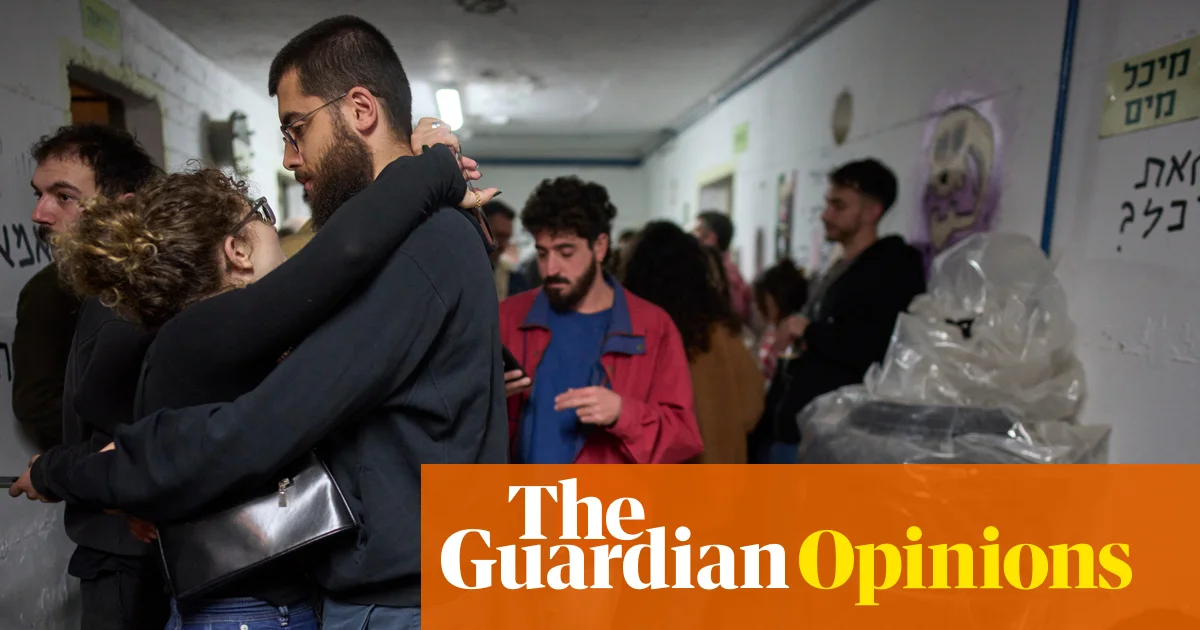
First, if you are lucky, there is a loud warning alert on your phone. Then the sirens scream from all around you. Within seconds, people move quickly but calmly: to a safe room, to a shelter, sometimes simply to the nearest underground car park. Some families sleep in public shelters, unsure whether they can reach safety from home in time, young children in tow.
In my case, the past few weeks have meant hours in a shared reinforced room with neighbours, time alongside strangers – and their calming dogs – in public shelters, and, fortunately, many nights sleeping in a safe room between sirens.
Each time you wait as the sound of interceptions echoes somewhere overhead. Sometimes the moments are more frightening: the thud of cluster munitions breaking apart in the sky, or the impact when they land, injuring or killing people within earshot.
For the past few weeks, this has been part of daily life in Tel Aviv as missiles launched by the Islamic Republic and Hezbollah target Israeli cities.
Most are intercepted. Some are not. Most tragically in Beit Shemesh, where nine people – including three children from the same family – were killed by a missile strike. Even when bombs are blocked, the experience leaves its mark: the sudden spike of adrenaline, the quiet messages sent afterwards to loved ones: are you OK?
I had been meant to spend my time here welcoming a group of supporters to see the work of the global organisation whose UK team I lead, New Israel Fund: Israelis and Palestinians rebuilding communities after 7 October, confronting settler violence in the West Bank and defending democracy and equality.
Instead I have had a sobering window into a reality people across this region know far too well.
Previously, when urging compassion during times of conflict, I often wrote that those of us living thousands of miles away should resist importing hatred and violence into our own societies.
This time, instead of writing from London, I am writing as I enter my third week getting a glimpse of the fear and violence that Palestinians, Israelis and people across this region have endured for generations.
What has struck me most is not only the fear of missiles overhead, but the contrast between what I see here and what I hear from many voices abroad.
Here, even in the midst of war, Israelis and Palestinians I work with struggle to hold on to one another’s humanity. Civil society leaders document abuses together, protect vulnerable communities and insist that the suffering of one people never justifies the dehumanisation of another.
Thousands of miles away, however, a very different language often dominates the conversation. In some corners of activist and online discourse, Israeli civilians under missile fire – Jewish and Palestinian citizens alike – disappear from view entirely, reduced to symbols of a state rather than recognised as people running for shelter with their families. Jewish fear and grief are treated as politically inconvenient, or worse, as something that can simply be ignored.
None of this diminishes the legitimacy of criticising governments or demanding an end to war and occupation. It simply insists that human empathy should not disappear along the way.
The consequences of this moral blindness do not remain online. Across Europe and North America Jewish communities have faced a surge in threats, intimidation and attacks whenever violence escalates in the Middle East. Synagogues, schools and community centres operate under heavy security, while Jewish families are forced to weigh the risks of gathering publicly simply as Jews.
Yet some of the clearest moral leadership I see comes from the very people whose lives are most shaped by this conflict. Across Israel and Palestine there are Jewish, Muslim and Christian activists who risk their safety every day to protect communities, challenge violence and insist that neither occupation nor terror will deliver a future worth living in. They continue to believe that this land can one day offer safety, dignity and equality to everyone who lives here.
My own family’s story stretches across much of this region. My mother was born in India; her parents’ families had arrived there from Iran and Iraq. The migrations and upheavals of this part of the world are written into our identities.
One of the lessons she taught us was to hold on to compassion even when the world makes that difficult.
In Hebrew, the words for “womb” and “mercy” are derived from the same source. The same root appears in Arabic in the words for compassion spoken daily in the bismillah. Across languages, faiths and cultures, the idea that mercy begins in the act of bringing life into the world is a reminder of how precious each human life is.
Those watching this conflict from afar would do well to learn from the people living through it – Israelis and Palestinians who refuse to surrender their humanity.
The people running for shelter – in Tel Aviv, Gaza, Beirut or Tehran – deserve nothing less.
-
Do you have an opinion on the issues raised in this article? If you would like to submit a response of up to 300 words by email to be considered for publication in our letters section, please click here.