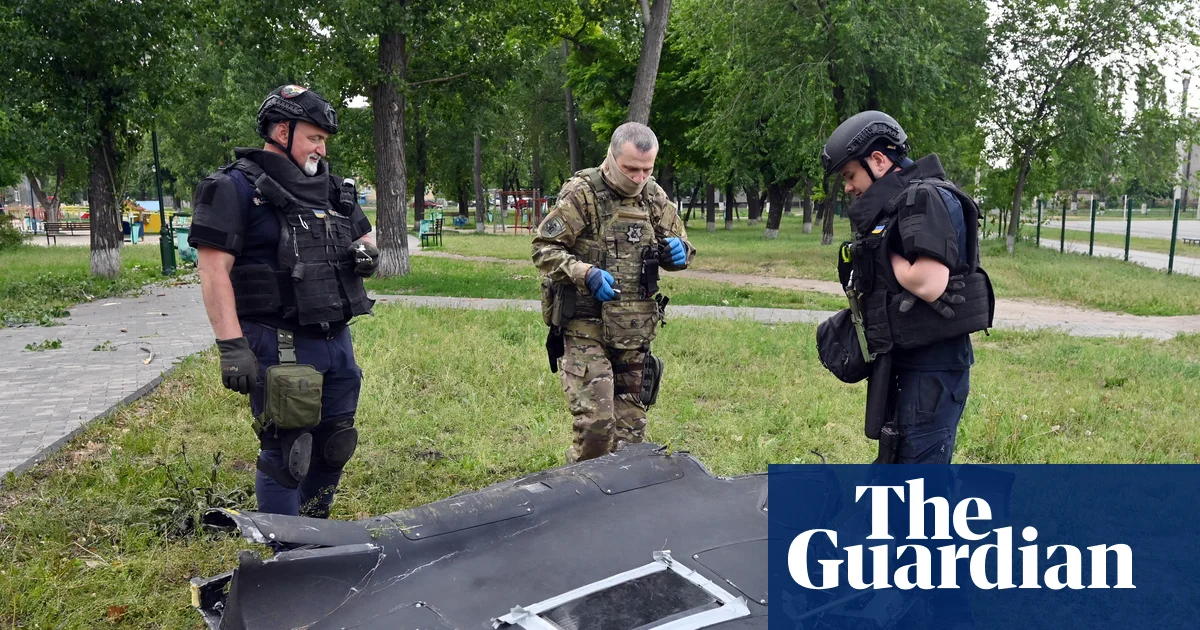
Volodymyr Zelenskyy said 201 Ukrainian anti-drone military experts are now in the Middle East to help defend the region against Iranian-designed Shahed drones, and another 34 were “ready to deploy”. “These are military experts, experts who know how to help, how to defend against Shahed drones. Our teams are already in the Emirates, Qatar, Saudi Arabia, and on the way to Kuwait,” the Ukrainian president told British MPs on Tuesday during an address to the UK parliament.
European nations should prepare for attacks by criminal networks, terror groups and lone attackers as drone technology advances, Zelenskyy warned British MPs. Zelenskyy, in London to meet UK prime minister Keir Starmer, said it was no longer just “a wealthy madman like Putin” who could afford mass attacks, Pippa Crerar reports.
The EU foreign policy chief, Kaja Kallas, warned Russia stands to gain from higher energy prices and the rerouting of advanced air defence systems from Ukraine to the Middle East. But, she said, Ukraine “remains Europe’s top security priority and attention for Ukraine will not be allowed to fizzle out”. Kallas also pushed back against a call by the Belgian prime minister, Bart De Wever, to normalise relations with Moscow and regain access to cheap Russian energy. “If we just go back to business as usual, we will have more of this – more wars,” Kallas said. “We have seen this before, so we have to be very vigilant and not to actually give Russia what they want because their appetite will only grow.”
Finland’s president, Alexander Stubb, agreed with Kallas, saying the Iran war was bad for Ukraine, “mainly because of the oil price which feeds the Russian war machinery. The Russian economy was actually doing extremely badly a couple of weeks back. Now it’s bouncing back.” The US has temporarily waived some Russian oil sanctions in a bid to ease pressure on global supplies triggered by war in the Middle East – a move criticised by some European leaders.
Ukraine has accepted the EU’s offer of technical support and funding to restore oil flows through the damaged Druzhba pipeline but also signalled any resumption of Russian crude deliveries to Hungary and Slovakia was still weeks away. In a letter to the EU released on Tuesday, Zelenskyy said repair work was nearing completion and the pumping station was expected to be restored in 1-1/2 months, “in the absence of any further attacks by Russia”.
Hungary and Slovakia have been cut off from Russian oil deliveries via the Druzhba since late January after Kyiv said a Russian strike hit pipeline equipment and would require time for repairs. The Hungarian and Slovak governments – both of which have kept up political and energy ties with Russia despite its invasion of Ukraine – accuse Ukraine of delaying the resumption of oil flows. Kyiv denies this.
UK officials are preparing for a possible court case against Roman Abramovich after he missed a deadline to release £2.4bn he raised from selling Chelsea FC, Kiran Stacey writes. The Russian billionaire sold Chelsea in 2022 under pressure from the British government after the Russian invasion of Ukraine. Because he was under sanctions at the time, the government granted him a licence to sell the club as long as the money was spent supporting victims of the war. The two sides have been deadlocked over whether the money should be spent exclusively in Ukraine or whether it can be used elsewhere. Spokespeople for Abramovich have been contacted for comment.
Romania’s defence ministry said on Tuesday it was looking for drone fragments reported to have fallen near the village of Plauru across the Danube river from Ukraine, after a Russian overnight attack on its infrastructure. Romania scrambled two F-16 fighter jets to monitor the attack and alerted local residents to take cover.
The Turkish foreign minister, Hakan Fidan, reiterated that Turkey is ready to host the next round of negotiations between Russia and Ukraine, during a phone call with Russia’s foreign minister, Sergei Lavrov on Tuesday, Turkey’s foreign ministry said.