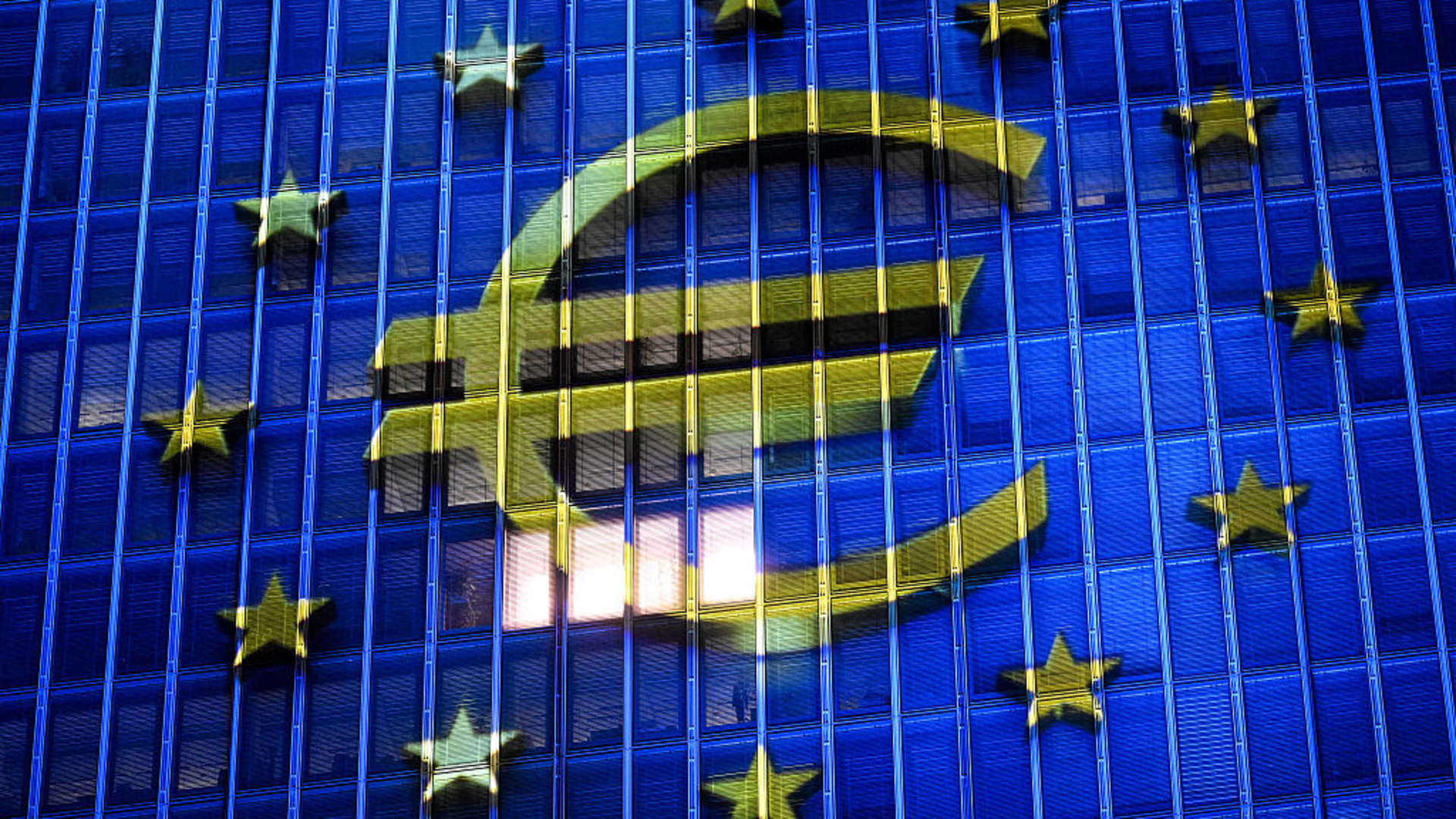
A projection of a Euro currency sign is pictured on the facade of the European Central Bank (ECB) headquarters in Frankfurt am Main, western Germany, on Dec. 30, 2025.
Kirill Kudryavtsev | Afp | Getty Images
The European Central Bank opted to keep interest rates on hold at its latest monetary policy meeting, saying the war in Iran has made the outlook “significantly more uncertain, creating upside risks for inflation and downside risks for economic growth.”
The ECB said the ongoing conflict “will have a material impact on near-term inflation through higher energy prices” while its medium-term implications would depend “both on the intensity and duration of the conflict and on how energy prices affect consumer prices and the economy.”
The ECB was the last of several regional central banks to opt on Thursday to stand pat, with the Bank of England, Sweden’s Riksbank and Swiss National Bank all holding firm as the war clouded the outlook for inflation and growth.
Before the war on Iran began in late February, Europe’s central banks enjoyed a more benign inflation outlook as interest rates looked set to remain stable or keep falling across the region.
But the conflict has upset the economic equilibrium, threatening Europe’s energy supplies, growth and the outlook for consumer prices. Expectations for interest rates across the continent have been upended.
Even before the war began, the ECB was not expected to change stance on its benchmark interest rate, with euro zone inflation data remaining near the central bank’s 2% target. The latest flash data from Eurostat showed inflation in the euro zone rose to 1.9% in February, up from 1.7% in January.
ECB President Christine Lagarde had, at the central bank’s last meeting in February, repeated a mantra that the euro zone’s economic outlook was “in a good place” but warned against complacency. Her caution now appears to be well-founded.

Traders will be paying close attention to ECB guidance and the forthcoming press conference for clues as to how the bank could respond as Iran’s closure of the Strait of Hormuz reduces oil and gas supplies to the region, pushing up energy costs and inflationary pressures.
Bank of England
The Bank of England’s Monetary Policy Committee voted “unanimously” keep its benchmark interest rate on hold at 3.75% on Thursday.
Before the war in Iran erupted in late February, the BOE had been expected to cut its key interest rate, known as ‘Bank Rate,’ at its March meeting, but the conflict has sent global energy prices soaring,
“Conflict in the Middle East has caused a significant increase in global energy and other commodity prices, which will affect households’ fuel and utility prices and have indirect effects via businesses’ costs,” the BOE said in a statement.
Andrew Bailey, governor of the Bank of England (BOE), during the Monetary Policy Report news conference at the bank’s headquarters in the City of London, UK, on Thursday, Aug. 1, 2024.
Bloomberg | Bloomberg | Getty Images
“Prior to this, there had been continued disinflation in domestic prices and wages. CPI inflation will be higher in the near term as a result of the new shock to the economy,” the BOE warned.
The BOE said its policymakers are “alert to the increased risk of domestic inflationary pressures through second-round effects in wage and price-setting, the risk of which will be greater the longer higher energy prices persist.”
The MPC said it was also assessing the implications for inflation, which prior to the war it had expected to decline toward its 2% target, and of the weakening in economic activity that is likely to result from higher energy costs.
London’s FTSE 100 extended losses following the decision, and was down 2.5% at midday London time. The yield on the benchmark 10-year gilt, or bond, was up 14 basis points at 4.874%, while the interest rate on the 2-year gilt was 20 basis points higher at 4.31%.
“Most central banks are facing the same challenging backdrop, but the trade-offs are not equal. The Bank of England’s are uniquely British: stubborn inflation, a weakening jobs market, and little fiscal wiggle room,” Madison Faller, Global Investment Strategist at J.P. Morgan Private Bank. commented Thursday.
“Unlike the U.S., buoyed by solid growth, or Europe, which has made real progress on disinflation, the BOE is walking a tightrope between supporting a sluggish economy and not letting inflation run amok.”
Just weeks ago, markets were betting on two rate cuts; now, they’re bracing for up to two hikes this year, Faller added.
Swiss National Bank
The Swiss National Bank kept its main policy rate on hold at 0.00% on Thursday, with the central bank stating that its “willingness to intervene in the foreign exchange market has increased” in the context of the Middle East conflict.
Doing so, if necessary, would counter any “rapid and excessive appreciation of the Swiss franc, which would jeopardize price stability in Switzerland,” the SNB said.
Asked if there was a “trigger point” at which the SNB would intervene in FX markets, SNB Chairman Martin Schlegel told CNBC Thursday that policymakers were “looking at monetary policy every quarter, and there we decide on the use of our tools, which is the interest rate and also FX interventions.”

“At this meeting, we came to the conclusion that the heightened willingness to intervene in the FX market is what we need for monetary policy right now,” he told CNBC’s Carolin Roth.
Schlegel insisted any intervention would be for monetary policy reasons rather than seeking any competitive advantage for Swiss exporters.
The Swiss National Bank (SNB) in Bern, Switzerland, on Thursday, Dec. 12, 2024.
Stefan Wermuth | Bloomberg | Getty Images
He said the potential threat to the Swiss economy “really depends on the length of the conflict and on the length of high energy prices.”
“If they stay for high for longer, they could have a big impact on the world economy, and hence also on Switzerland,” he added
Sweden’s Riksbank
Sweden’s Riksbank also kept its main policy rate on hold at 1.75% at its meeting on Thursday.
The Riksbank said “the rate is expected to remain at this level for some time to come” but cautioned that the Iran war warranted “vigilance.”
While the war in the Middle East makes the forecast very uncertain, the Riksbank said, it will monitor developments closely and will adjust monetary policy if the outlook for inflation and economic activity so requires.
In Sweden, there are fundamentally favourable conditions for the economic recovery to continue, the Riksbank said, with the inflation rate (currently at 1.7%) still below its 2% target.
“Underlying inflation has been unexpectedly low in recent outcomes. The war in the Middle East is expected to dampen growth somewhat in the near term and push up CPIF inflation as a result of higher energy prices. These are also expected to be passed on to some extent to other prices.”