Ada Jin was suffering from dating app fatigue. She was tired of the constant swiping and the hook-up mentality that’s prevalent on many legacy platforms. She wanted a product that helped facilitate intentional dating and respected people’s time and effort.
So she turned to AI to help humans better connect.
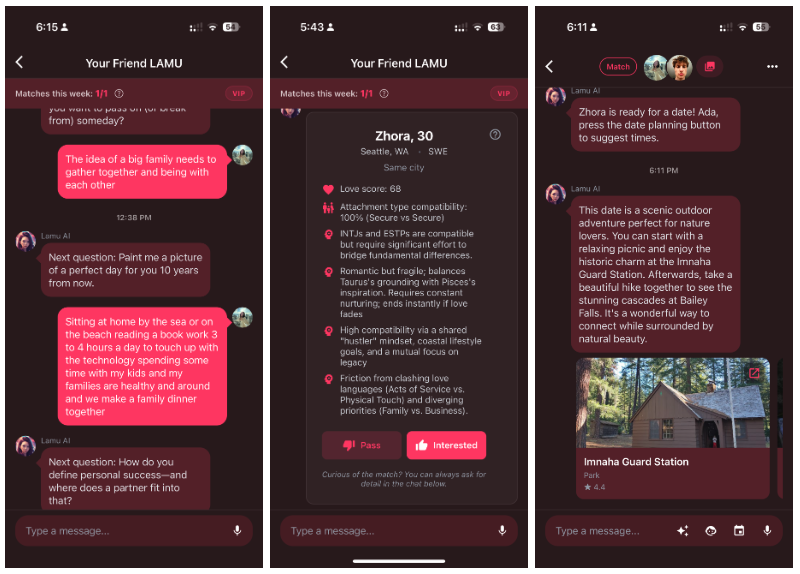
Jin is the founder of Lamu, a Seattle-based digital matchmaking service that relies on artificial intelligence to learn about users and help facilitate conversations and meaningful dates between matches.
“What we’re trying to solve is helping people find the right person more efficiently,” Jin said, adding that unlike traditional human matchmaker services which can cost thousands of dollars, Lamu is “way, way, way more affordable.”

Lamu charges a $9.99 registration fee to get people into the matching pool, and to scare off fake or deceptive profiles.
Users start with an onboarding in which they answer questions presented by Lamu’s AI. Jin said they’ve tried to make it fun and interactive, allowing people to communicate with the AI, even by voice. The AI generates a “love score” and then searches for matches, revealing one or two per week to avoid the paralysis of too many choices. Initial revealed information between matches includes first name, age, city, occupation and some hobbies or interests.
If the matches are mutually interested, the AI puts them in a group chat where the matchmaker serves as “wingman” to help things progress. Photos are only shared at this point so that users have the “full picture” before they choose to meet in person.
Jin thinks Seattle is the perfect place to build such a startup rather than the Bay Area where she previously worked as an engineer at Meta and TikTok. She says Lamu and AI could help penetrate the infamous “Seattle freeze” and loneliness in general.
While San Francisco has more founders and a more active investor base around consumer startups, Jin is invested in the Seattle region’s natural beauty and outdoor pursuits.
Since moving to the city last June, she’s been involved in Seattle’s startup community, which helped her meet her co-founder, Georgiy Lapin, a computer science student at the University of Washington.
Lamu isn’t the only player turning to AI to fix a broken dating culture. The industry’s giants are also utilizing AI in a variety of ways to address some of the issues Jin described.
At its first-ever product keynote earlier this month, Tinder unveiled a number of features including “Chemistry,” an AI-powered personalization layer that uses a scan of a user’s camera roll and interactive Q&As to curate daily recommendations. “Are You Sure?” is another tool using context-aware AI to detect and blur inappropriate messages before they’re even seen. Meanwhile, Bumble recently launched its “Deception Detector,” which the company says has successfully blocked 95% of accounts identified as spam or scams.
As Lamu grows, Jin is betting that users are ready to trade endless swiping for a slower, more deliberate pace. Her goal isn’t to keep people on the platform, but to provide the one thing legacy apps often lack: a sense of direction.
“I really need more clarity,” Jin said, reflecting on the burnout that led her to build the app. “I’d rather just do it once and find the right person.”