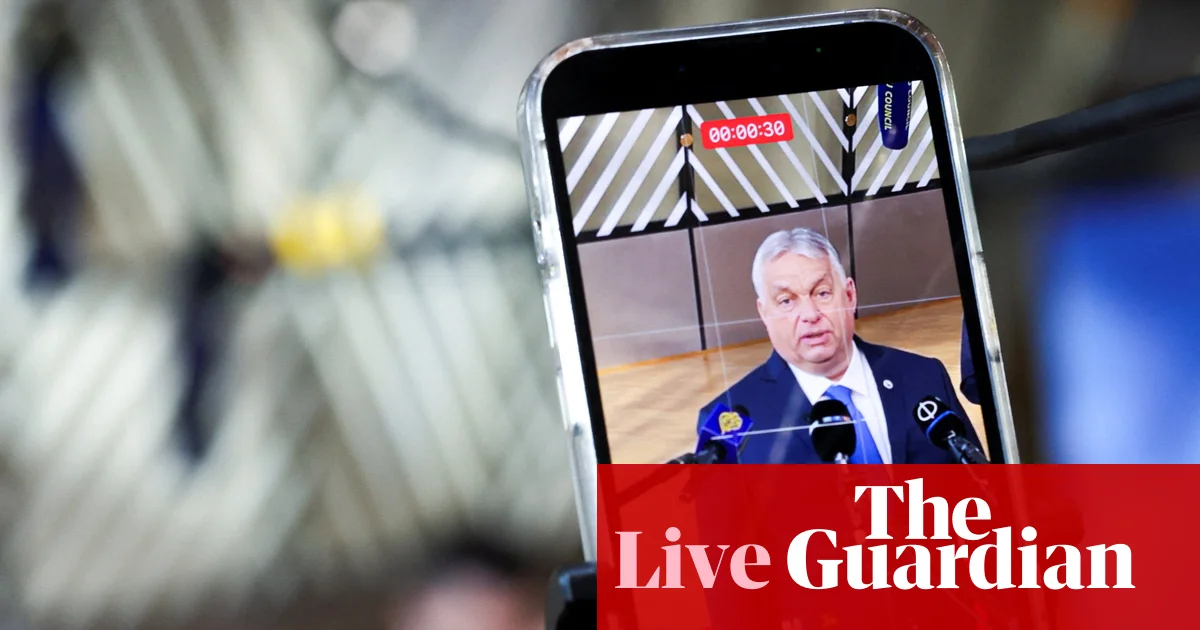
No breakthrough on Hungary’s veto for Ukraine loan so far

Jakub Krupa
The European Council’s conclusions on Ukraine from today’s meeting have just been published and they are once again signed by just 25 countries.
This means that there is still no movement from Hungary and Slovakia as they continue to block any movement regarding Ukraine until the Druzhba pipeline issue gets resolved.
The document includes the usual praise for Ukraine and declaration of “firm and unwavering” support for Kyiv, and the EU leaders’ backing for potential peace talks that would respect Ukraine’s borders and provide “robust and credible security guarantees.”
But on the thorny issue of the EU’s €90bn loan for Ukraine, the statement only reaffirms the intent of the 25 member states to begin disbursing the funds in April – with no change of heart from Hungary or Slovakia.
Similarly, on the 20th sanction package against Russia, it focuses on intentions and hopes for “swift adoption,” but does not actually move towards it.
One to watch if there is any later movement on this as the talks on other issues continue during the day, but as things stand it does not look like there will be a breakthrough on this issue.
Remember: the Hungarian election – in which Ukraine plays an important role in Viktor Orbán’s campaign – is less than four weeks away.
Key events
-
US vice-president JD Vance could visit Hungary to endorse Orbán ahead of elections, reports say
-
Zelenskyy expresses frustration with lack of progress on €90bn loan, sanctions, accession talks amid Hungary’s veto
-
EU leaders fail to convince Hungary’s Orbán to end his blockade of vital Ukraine loan – snap analysis
-
No breakthrough on Hungary’s veto for Ukraine loan so far
-
Side talks on energy prices, migrations on margins of EU summit in Brussels
-
Spain delays budget after announcing emergency measures to reduce living costs
-
‘We are the family’: low-budget thriller highlights Hungary’s election tension
-
Even if Orbán loses in April, and that’s not certain, headaches he causes will not disappear with him – analysis
-
German parliament moves to curb fuel prices in wake of Iran war
-
Estonia summons Russian top diplomat over airspace violation
-
Merz calls for de-escalation in Middle East, offers Europe’s help to stabilise region
-
Macron condemns ‘reckless escalation’ in Middle East after Iranian strikes on Gulf energy sites
-
Macron backs competitiveness push as he calls for de-escalation in Middle East
-
European parliament’s trade committee votes to progress EU-US trade deal
-
Czech Republic’s Babiš wants to talk competitiveness, ETS, energy impact of Middle East war
-
EU experts arrive in Ukraine to check Druzhba pipeline, Kyiv says
-
Russia ‘gaining from war in Middle East,’ Kallas says, as she accusses Orbán of not cooperating in good faith
-
Middle East crisis can take attention away from Ukraine, Lithuania’s Nausėda warns
-
Dutch PM Jetten makes EU debut backing Ukraine, warning against Iran impact
-
Morning opening: Let’s talk about Viktor
US vice-president JD Vance could visit Hungary to endorse Orbán ahead of elections, reports say
Despite the criticism from other EU members, Hungary’s Viktor Orbán could get some help from across the Atlantic amid reports the US vice-president JD Vance could make a late visit to Budapest to back the embattled nationalist prime minister.
Orbán is trailing in the polls behind the main opposition challenger, Péter Magyar, and could end up out of power after 16 years in office, so he needs every helps he can get.
Reuters reported that the exact timing of Vance’s visit was not immediately clear and his plans could change, sources cautioned, as top officials may opt to remain in Washington while the US-Israeli air war on Iran rages on.
In February, US secretary of state Marco Rubio travelled to Budapest after his speech at the Munich Security Conference, and the US president, Donald Trump, repeatedly publicly supported Orbán in his bid to get re-elected.
The White House declined to comment, Reuters said.
Zelenskyy expresses frustration with lack of progress on €90bn loan, sanctions, accession talks amid Hungary’s veto
Meanwhile, Ukraine’s Volodymyr Zelenskyy has posted bits from his address to the European Council meeting earlier today on his social media, making clear his frustration with the delays on the EU side.
He said that the EU’s 20th package of sanctions against Russia continues to be “stalled,” even though “it could have continued the pressure on Russia to move towards real peace.”
He continued:
“For the third month now, the most important financial security guarantee for Ukraine from Europe is not working – the €90bn support package for this year and the next. This is critical for us. It is a resource to protect lives. …
And … even today, we do not know for sure whether this support will be unblocked.”
The Ukrainian president also expressed concerns about the related lack of progress on Ukraine’s accession to the EU as he continues to push for a clear political commitment on the date – repeatedly rejected by the bloc’s leaders.
“Russia must clearly see and truly feel that Ukraine will be in Europe – and that this cannot be stopped. That is why we are carrying out internal reforms and working externally to secure a clear date for Ukraine’s EU membership.
If there is a clear date, it will mean that Russia will not be able to block our accession in any way. You see how different things get blocked, and how difficult it is for a united Europe to implement even decisions that have already been made. This must not be the case with opening the clusters for Ukraine or with our accession – this is a matter of trust, security, and the future.”
Zelenskyy also said that when the peace talks with Moscow eventually resume, “it [is] on all of us together to make sure the Russians do not come … feeling their position has grown much stronger” as a result of the Middle East crisis pushing global oil prices up.
EU leaders fail to convince Hungary’s Orbán to end his blockade of vital Ukraine loan – snap analysis

Jennifer Rankin
in Brussels
EU leaders accused Viktor Orbán of betrayal and bad faith, but have failed to convince Hungary’s prime minister to drop his blockade over a vital €90bn loan for Ukraine.
In an unusual sign of public anger, several leaders made plain their criticism of Orbán who refuses to sign off the loan he agreed last year over a dispute with Kyiv over the damaged Druhzba oil pipeline.
Orbán’s decision to renege on his agreement has infuriated EU leaders, because it undermines EU decision-making, at a moment when Ukraine is running out of money. EU officials want the first tranches of money available for Kyiv from early April.
But Orbán, along with his ally Slovakia’s prime minister Robert Fico, refused to sign a European Council statement on Thursday “look[ing] forward” to the release of funds for Ukraine.
Two EU sources told the Guardian they did not expect a change from Hungary at Thursday’s summit: “Orbán didn’t move in the Ukraine session,” said one.
No breakthrough on Hungary’s veto for Ukraine loan so far
Jakub Krupa
The European Council’s conclusions on Ukraine from today’s meeting have just been published and they are once again signed by just 25 countries.
This means that there is still no movement from Hungary and Slovakia as they continue to block any movement regarding Ukraine until the Druzhba pipeline issue gets resolved.
The document includes the usual praise for Ukraine and declaration of “firm and unwavering” support for Kyiv, and the EU leaders’ backing for potential peace talks that would respect Ukraine’s borders and provide “robust and credible security guarantees.”
But on the thorny issue of the EU’s €90bn loan for Ukraine, the statement only reaffirms the intent of the 25 member states to begin disbursing the funds in April – with no change of heart from Hungary or Slovakia.
Similarly, on the 20th sanction package against Russia, it focuses on intentions and hopes for “swift adoption,” but does not actually move towards it.
One to watch if there is any later movement on this as the talks on other issues continue during the day, but as things stand it does not look like there will be a breakthrough on this issue.
Remember: the Hungarian election – in which Ukraine plays an important role in Viktor Orbán’s campaign – is less than four weeks away.
Side talks on energy prices, migrations on margins of EU summit in Brussels
It’s not a proper international summit if talks aren’t also taking place on the sidelines. High on the agenda: energy prices.
Italian prime minister Giorgia Meloni met with German chancellor, Friedrich Merz, and the Belgian prime minister, Bart De Wever, according to a statement.
Separately, the usual group holding talks on migration also met this morning, with Denmark’s Mette Frederiksen as one of the leaders of the group.
It’s her last EU summit ahead of next week’s parliamentary election in the country.
Spain delays budget after announcing emergency measures to reduce living costs
Elsewhere, Pedro Sánchez’s hopes of passing his first budget in three years will have to wait.
Reuters reported that the presentation of the budget will be delayed as the government works on a package of emergency measures to counter the economic impact of the Iran war.
These measures – due to be announced on Friday – will focus on cushioning the blow from rising fuel and electricity prices caused by the closure of the Strait of Hormuz.
Gas prices have risen by more than 60% since the US and Israel started attacking Iran last month, Reuters noted.
“We’re working on the budget, but nobody predicted this war. The government needs to work on the most urgent matter – and the urgent matter now is this (the war’s impact),” Sánchez told reporters in Brussels earlier today.
Some readers might find it helpful to be reminded about why Orbán is blocking both a €90bn loan to Ukraine as well as another round of sanctions against Russia.
It comes down to the Druzhba pipeline, through which oil from from Russia to Hungary and Slovakia. Deliveries of oil through this route were halted in January. Ukraine blames damage caused to the pipeline on Russian drone attacks while Orbán says that Volodymyr Zelenkyy is holding up oil deliberately.
There may be hopes of a breakthrough but it’s unlikely to come soon. Ursula von der Leyen, European commission president, and António Costa, European council president, offered to cover the costs to repair the pipeline on Tuesday but Orbán said that he’ll keep blocking the loan to Ukraine until oil starts flowing through the pipeline to Hungary.
For his part however, the Ukrainian president has insisted that no Russian energy should transit through Russia, given that such revenue is fuelling Putin’s war.
No international summit is complete without meetings on the sidelines and Italian president Giorgia Meloni met with German chancellor, Friedrich Merz, and the Belgian prime minister, Bart De Wever, according to a statement.
High on the agenda: energy prices.
There was a particular focus on the consequences of the Middle East conflict for the global energy market, as well as on the possible initiatives to be swiftly taken in order to curb the surge in energy prices. The priorities to be jointly promoted regarding simplification, the single market and investments were also discussed.
It comes after Israel’s attack on Iran’s South Pars gas field – and Iran’s retaliatory attacks – sent gas and crude prices soaring overnight.
World leaders are attempting to tackle the energy crisis as the strait of Hormuz remains effectively closed. Earlier, Germany’s parliament moved to restrict how often petrol stations can increase their prices.
Meanwhile Treasury secretary Scott Bessent said in an interview with Fox News that the US is considering removing sanctions from Iranian oil, arguing such a move would allow countries other than China accessing that oil.
You can read more about the importance of the waterway here:
‘We are the family’: low-budget thriller highlights Hungary’s election tension
Flora Garamvolgyi
in Budapest
It’s seven o’clock on a Tuesday night, and one of the most popular movie theatres in Budapest is full, not an empty seat in sight. The audience is not here for a Hollywood blockbuster, but a Hungarian film that barely had the budget to be made.
Feels Like Home (Itt Érzem Magam Otthon) has captured moviegoers not only with its striking visuals but also with its timing – its release coming before Hungary’s pivotal parliamentary elections on 12 April.
The psychological thriller tells the story of a saleswoman who is abducted into a family that follows the orders of an authoritarian father-figure, Papa, and whose members get privileges if they play by the rules. The main character, Rita, tries to escape, but finds that even outside everything seems to be owned by the family, so there is no point in asking for help.
The director, Gábor Holtai, says it was not his intention to create a metaphor for life in Hungary under Viktor Orbán, but that is certainly how it has been interpreted in the fevered final weeks of the election campaign.
Even if Orbán loses in April, and that’s not certain, headaches he causes will not disappear with him – analysis

Jon Henley
Europe correspondent
While there is now a lot of attention on Hungary’s Viktor Orbán and the upcoming election in the central European country, Jon Henley notes that while the bloc’s foremost troublemaker could lose April’s election, the headaches he’s caused will not necessarily disappear with him.
Here is what he says:
“On 12 April, in what will almost certainly be the most consequential vote in (and for) Europe to be held this year, Hungarians are due to elect a new parliament and government – and for the past 15 months, Orbán has been trailing in the polls.
So will everything change? There are, unfortunately, several reasons why it may not.
First, Orbán may not actually lose. …
Second, if Orbán does lose, especially by a narrow margin, he could simply refuse to step down, leaving the EU facing what the European Policy Centre thinktank calls “an unprecedented situation: an illegal and illegitimate government sitting at the table”. …
Finally, even if Magyar wins and Orbán accepts defeat, it is unclear exactly what the new PM will be able to do.”
Read Jon’s analysis here:
German parliament moves to curb fuel prices in wake of Iran war

Deborah Cole
in Berlin
Germany’s parliament is taking unusual action to curb fuel prices in the wake of a spike from the Iran war.
Under a draft law set for approval by the Bundestag lower house on Thursday, petrol stations will only be able raise prices once a day, at 12 midday. They may be reduced at any time. Businesses violating the rule can be fined up to €100,000.
Watch for angry scenes in the queue at 11.55 am.
After topping the list of EU countries with the highest rise in pump prices early on, Germany remains among the countries whose motorists are bearing the biggest brunt of the surge.
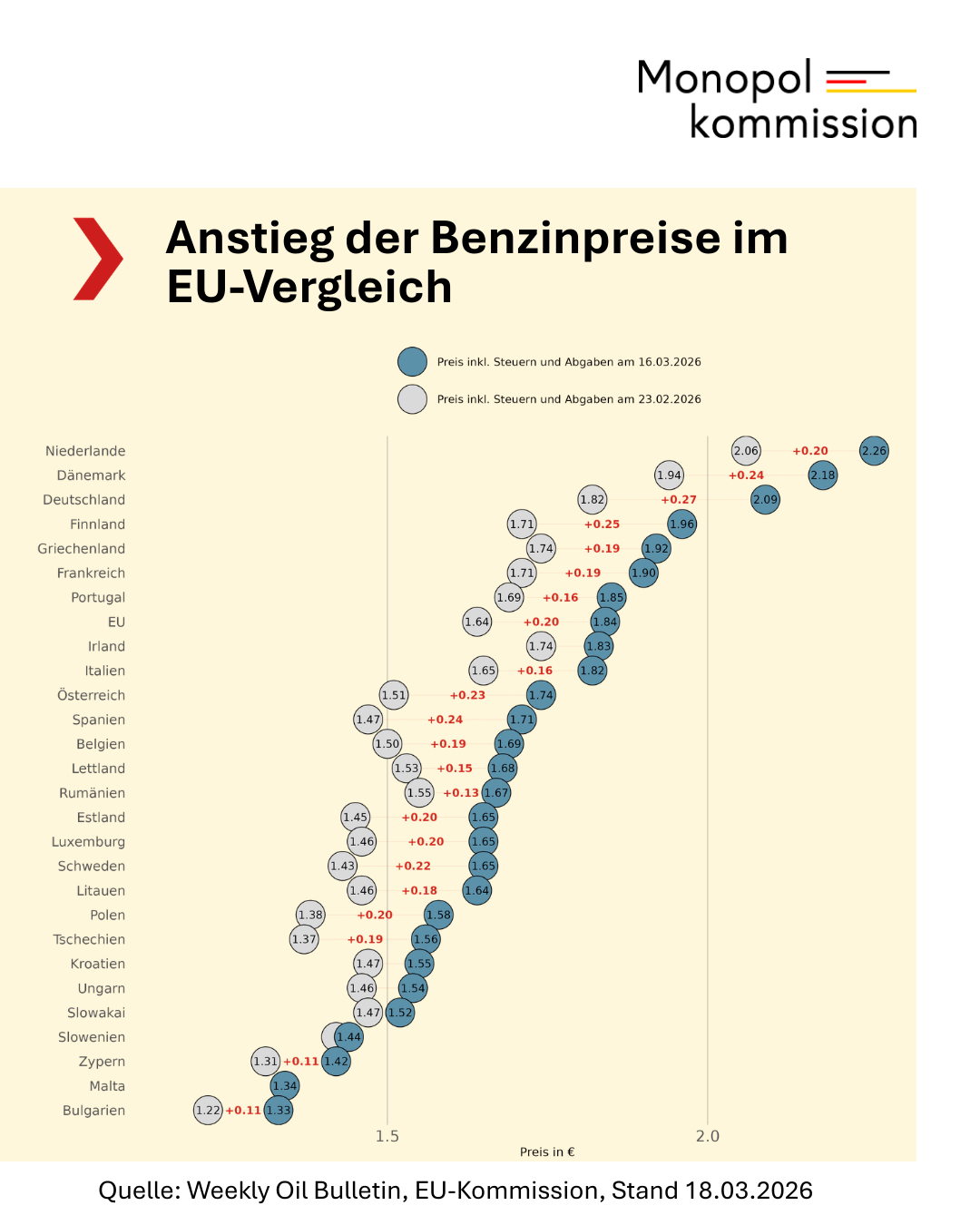
Compared to the week before the US-Israeli military action, prices had increased by 27 cents per litre for petrol and 42 cents for diesel, above the EU average of 20 cents/litre for petrol and 36 cents for diesel, according to EU Commission figures compiled by Monopolkommission, an independent economic advisory body to the German government.
It attributed the rapid rise in fuel prices in Germany to heavy market concentration.
The legislation before the Bundestag will also give the Federal Cartel Office expanded powers to fight price gouging.
Armand Zorn, deputy chair of the Social Democrats parliamentary group, accused the industry of profiteering.
“We do not have a supply problem in Germany, but a clear pricing problem,” he told Bild newspaper. In hardly any other European country had such steep profits been made at the expense of consumers during the crisis, Zorn said.
But market watchers are divided whether the high noon rule, due to go into effect in early April for at least a year after passing the Bundesrat upper house, will do much to help consumers.
The Federation of German Industries (BDI) criticised the planned tightening of antitrust law and the speed with which it is being pushed through.
“The federal government is introducing far-reaching and risky changes to competition law through a rushed fast-track procedure,” said Holger Lösch, deputy chief executive of the BDI. He said that was creating uncertainty among businesses and jeopardising investment across sectors.
“Without involving industry and without a broad public debate, rules are being changed under the pressure of high fuel prices that go far beyond the current situation and would permanently alter the playing field for all companies,” Lösch said. “This intervention in competition law threatens to do a disservice to the entire economy in terms of regulatory policy.”
Prices in recent weeks had been particularly volatile as well as generally elevated so advocates cite a calming effect that will kick in simply due to more predictability and transparency.
The stakes are high for the ruling coalition partners, chancellor Friedrich Merz’s Christian Democrats (CDU) and the Social Democrats.
The parties are running neck-and-neck in a key state election on Sunday in Rhineland-Palatinate, two weeks after the CDU lost to the Greens in the car manufacturing region of Baden-Württemberg by a whisker.
The parlous state of the German economy, the EU’s biggest, and inflation fears driven by the Iran war and US tariffs will be at the front of voters’ minds.
Jakub Krupa
The Brussels summit is under way behind the closed doors, but we will bring you regular updates from the room where it happens if and when we get them.
In the meantime, I will bring you all the latest stories from around Europe.
Estonia summons Russian top diplomat over airspace violation
Meanwhile, Estonia has summoned the Russian charge d’affaires after a Russian fighter jet violated the Baltic country’s airspace on Wednesday, Estonian foreign minister Margus Tsahkna said.
The violation occurred near Vaindloo Island in the Gulf of Finland, off Estonia’s northern coast, where a Russian SU-30 fighter aircraft entered Estonian airspace and remained for around one minute, Estonia’s foreign ministry said.
“The violation was responded to by a unit of the Italian air force, and there was no threat to Estonia’s security,” Tsahkna said.