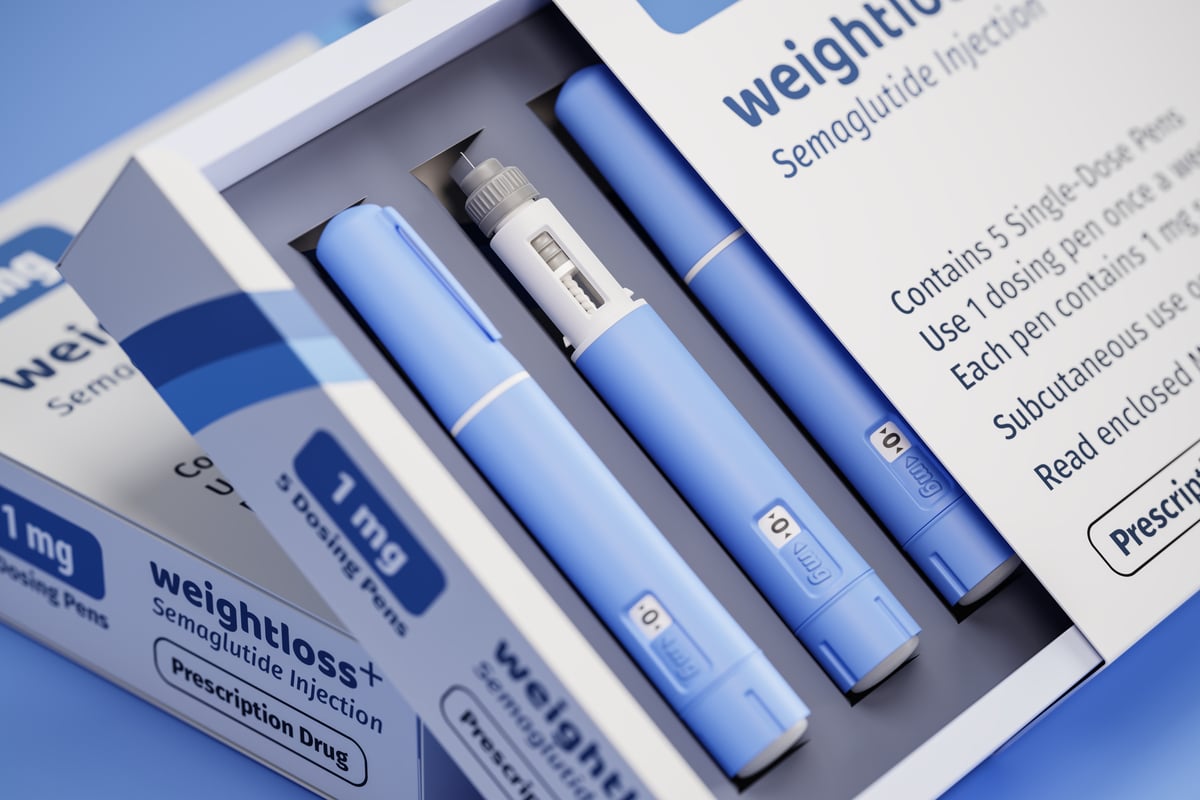
It is hard to explain how impressive Eli Lilly’s (NYSE: LLY) GLP-1 success has been. In 2025, sales of the company’s Mounjaro and Zepbound rose 99% and 175%, respectively. The two drugs have grown so rapidly that they now account for 56% of Eli Lilly’s revenues.
There’s likely to be more growth ahead, too, as demand for these weight loss drugs remains strong. However, it may still be too late for you to buy Eli Lilly. Here’s why.
Will AI create the world’s first trillionaire? Our team just released a report on the one little-known company, called an “Indispensable Monopoly” providing the critical technology Nvidia and Intel both need. Continue »
The interesting thing about Mounjaro and Zepbound is that they weren’t the first GLP-1 weight loss drugs to hit the market. Novo Nordisk (NYSE: NVO) was first to market with Wegovy. However, Eli Lilly’s drugs proved to be more effective and quickly took the lead in the new drug category. That’s an important fact to keep in mind because it underscores the pharmaceutical sector’s competitiveness.
Notably, Novo Nordisk just released a GLP-1 pill, beating Eli Lilly to market again. That will give Novo Nordisk time to regain market share as Eli Lilly works to get its own pill approved by the FDA. Pfizer (NYSE: PFE) is working in the GLP-1 space. If Pfizer can get its long-acting weight-loss drug to market, Mounjaro and Zepbound will have to compete with yet another GLP-1 drug.
Right now, Eli Lilly is on top, but it may not hold that spot forever. In fact, the patent protections that are allowing it to enjoy outsize profits today are time-limited. So, at some point in the not-too-distant future, the company’s GLP-1 success will fade as generic versions of its drugs enter the market.
The big problem with buying Eli Lilly today is that Wall Street has already priced in the company’s success. The stock’s price-to-earnings ratio is a lofty 43x. That’s below the company’s five-year average P/E, but it is dramatically higher than the S&P 500 index‘s (SNPINDEX: ^GSPC) average P/E of roughly 28x and the 23x P/E of the average drug stock.
There are two ways to lower a company’s P/E. The stock price can fall, or earnings can increase. For Eli Lilly’s P/E ratio to drop back to the industry average, earnings would have to rise dramatically from current levels. Just to get the P/E down to the S&P 500’s level would require a fairly large earnings advance. Given the competitive landscape in the GLP-1 market, achieving that may not be as easy as Wall Street seems to hope.