The film Project Hail Mary — which opens widely on Friday — has one of the best opening scenes on the silver screen in recent years. A man wakes up, disoriented and with a fuzzy memory, next to two dead bodies. We find out that he’s a scientist-turned-astronaut on a spaceship headed for a star beyond our Solar System, and those dead bodies are his crewmates. He’s all alone, and it’s now up to him to save life on Earth.
The science of Oppenheimer: meet the Oscar-winning movie’s specialist advisers
The gripping sci-fi plot comes from the mind of Andy Weir, the author of the 2021 book of the same name. Weir has become known for stories like this, in which quick-witted loners have to ‘science’ the heck out of situations to save the day. He made his career with the 2011 book The Martian, in which protagonist Mark Watney (played by Matt Damon in the film version) survives being stranded on Mars by, among other things, learning to grow potatoes in the red planet’s soil.
Weir famously steeps his books in science, going so far as to do calculations on orbital mechanics and stellar astrophysics to ensure that the stories are as realistic as they can be while still being fiction. That all-out nerdery has earned him many fans, says Andy Howell, an astronomer at the University of California, Santa Barbara, who advised Weir on the science in Project Hail Mary. “I’ve talked to so many scientists who are like, ‘this is great’”, Howell says, but also engineers, physics students and others.
So how does the new film, directed by Phil Lord and Christopher Miller, measure up? Nature went to an advance screening and talked to some of the book’s science advisers to find out.
Realistic fiction
Without giving away too much of the plot, Project Hail Mary is about a man, Ryland Grace (played by Ryan Gosling), who embarks on interstellar travel to understand why the Sun is dying. Like Watney in The Martian, he has to summon knowledge from a raft of different types of science — molecular biology, neutrino physics and more — to solve his crisis.
“It’s a great blend of some ideas that have been around, but a fresh take on them — and then some completely new ideas,” says Howell, who also runs a YouTube channel called Science vs. Cinema.
The film version of Project Hail Mary dispenses with many of the detailed science explanations found in the book but still feels grounded in reality.

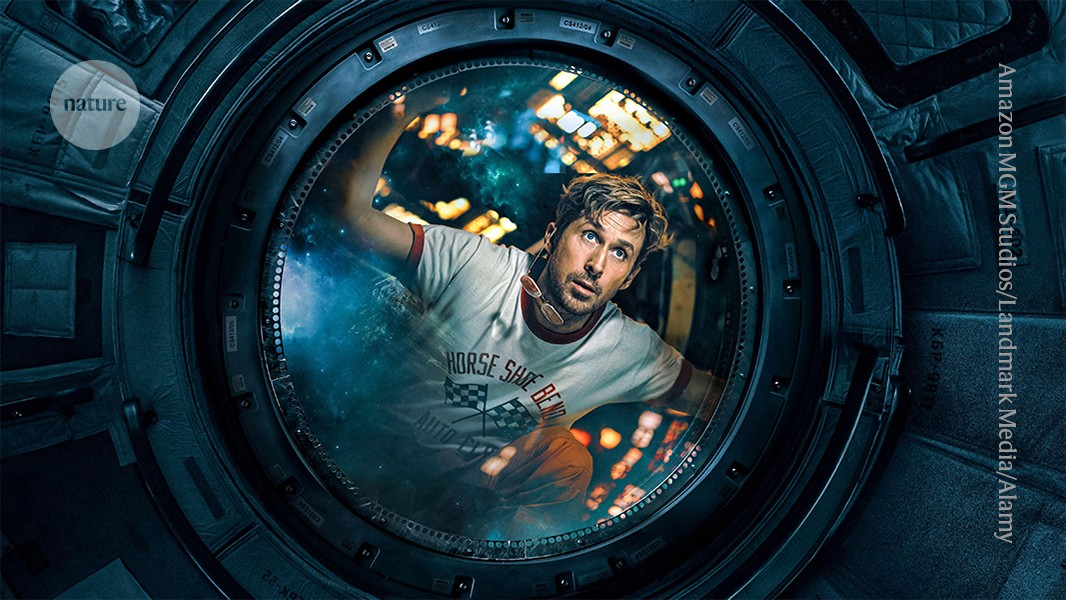
Gosling’s character, Ryland Grace, runs experiments in space to help save life on Earth.Credit: Amazon MGM Studios/Landmark Media/Alamy
Take astrophage, a fictional space microorganism that underpins much of the plot. Weir conceived of it as ‘black matter’ that can absorb huge amounts of stellar radiation and then re-emit the energy to enable interstellar travel. Astrophage doesn’t exist in our world, but Weir made sure it had biology and chemistry that could exist in the Galaxy.
In the film, Grace grapples with the nature of astrophage, which is devouring the Sun, and how it does or doesn’t meet scientists’ notions of extraterrestrial life. It’s reminiscent of debates over how to recognize the signatures of life beyond Earth — for instance, gases in planets’ atmospheres that might have been generated by living organisms.
Building worlds
How astronomers in the film (and book) discover that the Sun is dimming is also grounded in reality. On Howell’s advice, Project Hail Mary gives a shout-out to the amateur astronomers who regularly monitor fluctuations in stars’ brightnesses. In 2019, astronomy enthusiasts spotted the mysterious dimming of the red giant star Betelgeuse; fortunately, it turned out to be caused by the star belching dust, rather than an astrophage attack.
Planetary-science lovers will also be pleased to see real stars and star systems incorporated into the plot, including Tau Ceti (the target of the first-ever search for extraterrestrial life, in 1960 by astronomer Frank Drake) and 40 Eridani (a real system that served as home to planet Vulcan in the Star Trek franchise).