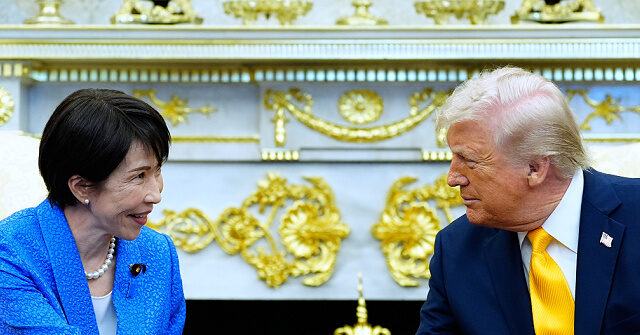
Japanese Prime Minister Takaichi Sanae headed to Washington on Thursday for what she anticipated would be a “very difficult” meeting with President Donald Trump on the war in Iran.
The two seemed to get along very well during their joint press conference at the White House, despite President Trump’s previous disappointment with Japan’s reluctance to participate in securing the Strait of Hormuz.
Takaichi told the Japanese parliament before her departure that she would explain to Trump that her country could not easily meet his demand for helping to provide security in the Strait of Hormuz because force projection is legally banned under Japan’s pacifist constitution.
“I intend to convey these points clearly, and I’m sure the U.S. side understands these laws, given our history,” she said.
Trump said on Saturday that he wanted the countries most reliant upon the free flow of oil through the Strait of Hormuz — including Europe, China, Japan, and South Korea — to assist with defending commercial vessels against Iranian attacks.
“This should always have been a team effort, and now it will be,” he said.
On Tuesday, Trump wrote an angry post on Truth Social expressing his dismay with the lack of assistance from America’s putative NATO allies on the Strait of Hormuz.
“Because of the fact that we have had such Military Success, we no longer ‘need,’ or desire, the NATO Countries’ assistance – WE NEVER DID! Likewise, Japan, Australia, or South Korea,” the president fumed.
“In fact, speaking as President of the United States of America, by far the Most Powerful Country Anywhere in the World, WE DO NOT NEED THE HELP OF ANYONE!” he added.
By dint of her preplanned trip to Washington, Takaichi became the first leader to sit down for a meeting with Trump after the Strait of Hormuz letdown. She was well-positioned to endure his wrath, since the two have gotten along very well on a personal level, but the timing was unfortunate because Tokyo had been optimistic about resolving trade issues with the U.S. during the meeting.
Takaichi was also planning to make the most of talking to Trump before he departs for China at the end of March to meet with dictator Xi Jinping. Trump has since delayed that trip to China for “a month or so” while he deals with the Iran war, possibly as a signal of his displeasure with Beijing’s failure to help with the Strait of Hormuz.
Shortly before Takaichi’s meeting with Trump, Japan issued a joint statement with the UK, France, Germany, Italy, and the Netherlands in which they seemed to soften their position on the Strait of Hormuz, roundly condemning Iran’s attacks on civilian vessels and pledging to “contribute to appropriate efforts to ensure safe passage through the Strait.”
When Trump and Takaichi appeared before the press at the White House on Thursday, Trump seemed to be in a fairly good mood. He sought to defuse the tension by telling a very Trumpy joke in response to a reporter’s question about why the U.S. did not inform its allies before launching Operation Epic Fury with Israel against Iran.
“One thing you don’t want to do is signal. We went in very hard. We didn’t tell anybody about it because we wanted surprise,” Trump replied.
Trump then turned to Takaichi and said, “Who knows better about surprise than Japan? Why didn’t you tell me about Pearl Harbor?” She widened her eyes and shifted uncomfortably in her chair, as though Trump had just served her an extra-large live cobra for dinner.
Takaichi expressed her confidence in Trump’s handling of the war during the press conference.
“The global economy is about to experience a huge hit because of this development. But even against such a backdrop, I firmly believe that it is only you, Donald, that can achieve peace across the world,” she told the American president.
“We’ve had tremendous support and relationship with Japan on everything. And I believe that based on statements that were given to us yesterday, the day before yesterday, having to do with Japan, they are really stepping up to the plate,” Trump said in response.
Trump threw in a little jab that Japan was at least offering to help with the Strait of Hormuz, “unlike NATO.”
A White House official told the Associated Press (AP) on Thursday that Takaichi is hoping to announce a $40 billion nuclear reactor deal between Japan’s Hitachi Ltd. and America’s GE Vernova for small modular nuclear reactors in Tennessee and Alabama. She also hoped to discuss closer regional security collaboration with the U.S., critical mineral supply chains, and energy supplies.