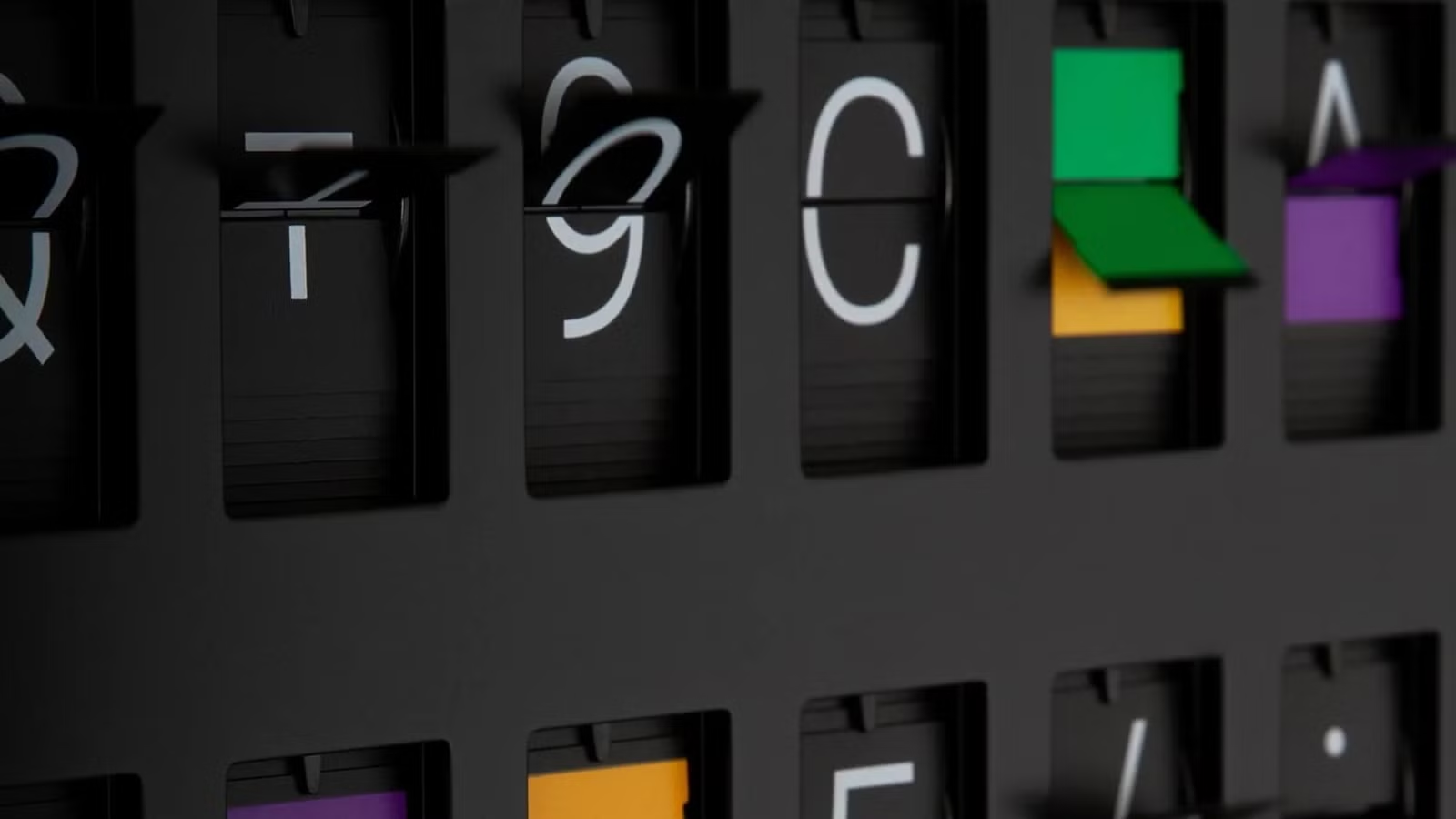
My smart home definitely doesn’t need a dedicated dashboard. Even so, I’ll eventually probably throw something together on the cheap, just because I can. But if I had a few grand to spend on something fancy, I’d buy a far less useful but ultimately more beautiful relic of the past instead.
Vestaboard is a flip-dot display
Flip-dot (or flip-disc) displays are mechanical devices that use physically moving parts to display information. If you’re as old as I am, you’ve probably seen them in train stations and airports, while driving on the highway, on the front of buses and trams, and even on TV in shows like Family Feud.
These devices first appeared in the early 1960s, eventually making their way into most major stock exchanges by the mid-1970s. Unlike projection and cathode-ray tube (CRT) display technology that was popular at the time, flip-board displays were easy to see in any light. Like an E-Ink display, flip-dots only need power to change the position of whatever’s being flipped.
There are many different types of flip-dot displays. High-resolution versions use many dots to make up letters or numbers, while simpler designs like clocks and departure boards flip between elements like numbers or destinations. They all work in roughly the same way, by cycling through the “deck” to find the right element to display.
If you’re wondering what this has to do with a smart home, let me introduce you to Vestaboard. This is a modern flip-dot display for home and work, which is built on the same principle as the original flip-dot displays that were so popular 50 years ago.
The Vestaboard can display messages, art, and information that is pushed wirelessly from a smartphone app or desktop browser. But it should come as little surprise that the Home Assistant community has also produced the Vestaboard Home Assistant Integration, which allows you to use the flip-disc display to push notifications, sensor readings, and anything else you want from your Home Assistant server.
Best of all, Vestaboard has both a cloud-based and local API, so you can set it up locally and it will keep chugging along even when the internet or remote servers stop working.
Two sizes, both expensive
The Vestaboard feels more like a home centerpiece than a useful display. It can’t show you feeds from your cameras, you can’t touch it like you would a tablet, and there’s very limited space on which to display information. It’s like a piece of interactive art, and it has a price tag to match.
There are two sizes available, with the original Vestaboard being the largest of the two. It measures 41.2” wide by 22.0” tall (1046 x 561 mm), and has a depth of 3.5” (89 mm). It has five lines with 22 characters per line, for a total of 132 “bits” (each bit has 64 different characters). For this, you’ll pay $3,499.

Then there’s the baby Vestaboard Note, which is much smaller at 28.4” wide and 12.2” tall (723 × 309 mm) with a depth of 4.3” (109 mm). It has room for three lines of text with 15 characters on each. It’ll set you back $999.

There are some more things to consider with the Vestaboard. Due to the mechanical nature of the necessary elements that slap against one another, these things are pretty loud. You’re either going to love it or hate it, so make sure you know what you’re in for before you commit.
The other issue is that these things are surprisingly popular, and it’s not uncommon for there to be a waitlist in place. It’s not a dealbreaker, but it’s more akin to ordering a home appliance with a lead time than an iPad that shows up in a few days. Good things come to those who wait, and all that.
Got the skills? Repurpose an old flip-dot display
The Vestaboard is expensive and hard to find because it’s an incredibly unique bit of kit. If you want one, there aren’t really any alternatives. Well, not unless you have the skills to repurpose an older working model anyway.
That’s exactly what Reddit user u/GenerallyOkayTimes did. Using ESP8285 and STMD32uino system-on-chip microcontrollers with the Flippity210 library, they were able to bring a BUSE 210 flip display back to life. There’s a whole wiki available with instructions on how to use this library and the hardware necessary to build your own.
Getting your hands on these displays is more difficult, though I found a few for around $100 on Czech marketplaces. These are a bit different from the Vestaboard in that they use dots rather than printed elements, are designed for visibility on the front of buses and trams, and are much smaller.
Still, it could be a fun project if you’re game.
Don’t look at the Vestaboard as a practical object; think of it as some kind of modern art piece. If you’re anything like me, your thoughts of “maybe I can justify a small one?” quickly turn into “but the large one is so tempting!”