The Sweet 16 of the 2026 men’s NCAA tournament is officially set.
ESPN reporters were on-site across the country to break down how each of Sunday’s second-round games was won. Our expert analysts also weigh in on each winner’s chances to advance to the Elite Eight.
How Alabama won: Alabama is on to the Sweet 16 for the fourth consecutive time after a dominant victory over Texas Tech in Tampa, Florida. The Crimson Tide faced a 2-0 deficit to start the game, then never trailed again in a performance that included a barrage of 3-pointers. Alabama went 19-of-42 from deep, the third-most makes in any tournament game since 1987 when the 3-point line was introduced. Latrell Wrightsell led the team with 24 points, and three other players scored in double figures. Labaron Philon Jr. had nine points and 12 assists, the second-most assists by an Alabama player in a tournament game since 1984. — ESPN staff
Alabama’s Sweet 16 opponent: Michigan
How the Crimson Tide can advance to the Elite Eight: It’s not a secret, but Alabama will need to make a barrage of 3s to have any chance of staying close with Michigan. The Crimson Tide lead the nation in 3-pointers made per game, 3-point attempts per game and 3-point attempt rate. They made 19 3s in the second-round win over Texas Tech. That has to continue against Michigan, as it will be be extremely difficult to score consistently at the rim against Aday Mara and Morez Johnson Jr. Defensively, it’s going to be an uphill battle. Alabama has given up huge scoring efforts to good teams on multiple occasions, and the Crimson Tide rank in the middle of the pack in the SEC in defensive efficiency.
This game is going to feature plenty of points and plenty of pace. Alabama won’t back down from a running game with Michigan, and a shootout could play into the Tide’s hands. — Jeff Borzello
How UConn won: The wheels started to come off for UCLA with a little more than five minutes left, as UConn used a 9-0 run to turn a four-point lead into a 13-point cushion. The key sequence: Alex Karaban, the star of the Huskies’ show Sunday, blocked Trent Perry as he went to the basket. UCLA coach Mick Cronin apparently didn’t like the no-call and drew a technical. Karaban hit the subsequent free throws, and Braylon Mullins followed with a layup to help push the game out of reach. The Huskies outrebounded (36-24) and outscored the Bruins in the paint (30-20). — Tim McManus
0:16
Alex Karaban’s 3-pointer has UConn rolling
UConn’s Alex Karaban knocks down a corner 3-pointer to get the Huskies rolling in the second half.
UConn’s Sweet 16 opponent: Michigan State
How the Huskies can advance to the Elite Eight: To beat Tom Izzo, UConn will have to show up as the top-notch defensive outfit that held UCLA to just a 39% clip inside the arc. The Huskies’ win over the Bruins served as a reminder that they can be a great defensive team when they want to be. A week ago, UCLA had produced 132 points per 100 possessions in a Big Ten tournament win over Michigan State. On Sunday, the Bruins — who played without leading scorer Tyler Bilodeau (knee) — scored only 57 points, their second-lowest total of the season. UCLA star Donovan Dent had nine assists but also finished 2-for-9 shooting with a pair of turnovers. That’s the same attention UConn will need to give Jeremy Fears Jr. When he’s comfortable, Michigan State’s offense soars. The Huskies can’t let that happen.
On offense, Mullins could be an X factor. Tarris Reed Jr. had a double-double against UCLA, but not the historic numbers he put up against Furman (31 points, 27 rebounds). Karaban recorded a career-high 27 points against the Bruins, with Solo Ball and Silas Demary Jr. scoring two points combined. If Reed and Karaban can create a balanced inside-outside attack, Michigan State will have to find a way to disrupt that, which could give Mullins — who is averaging 14.5 points in two NCAA tournament games so far — more freedom and opportunities to make plays and create off the dribble or on off-ball screens.
The Huskies have a multitude of options to score, and as long as most of them are effective, they can get back to the Elite Eight. — Myron Medcalf
How Arizona won: The Wildcats’ stellar guard play was again on full display, as Jaden Bradley and Brayden Burries led them in scoring with 18 and 16 points, respectively. Bradley was crucial in the second half as the Aggies made a run to turn what was once an 18-point lead into a four-point deficit. The senior guard continued to drive to the basket and make tough finishes to dispel any notion of an upset. Arizona’s size was dominant as the Wildcats outrebounded the Aggies 53-26 on their way to the Sweet 16 for the third straight season. — Paolo Uggetti
Arizona’s Sweet 16 opponent: Arkansas
How the Wildcats can advance to the Elite Eight: Arizona can advance with a physically exhausting style that has challenged opponents throughout the season. Utah State cut Arizona’s lead to four points with five minutes to play Sunday — the Wildcats had led by as many as 18 — and staged a serious comeback in the final minutes. But Jaden Bradley drove to the rim and scored, Brayden Burries hit big shots and the Wildcats got to the free throw line with 22 attempts in the second half. That’s the taxing style that makes most opponents break.
Arizona is relentless. To beat Arkansas, though, its goal must be to stop the best player in this college basketball postseason: Darius Acuff Jr. If coach Tommy Lloyd can devise a defensive game plan against Acuff without sending a lot of help, then his guards can avoid early foul trouble, which could have an impact on the game. But that’s easier said than done against the projected NBA draft lottery pick. Acuff can make everybody panic, especially in crucial moments down the stretch. Arizona can’t do that if it expects to win. — Medcalf
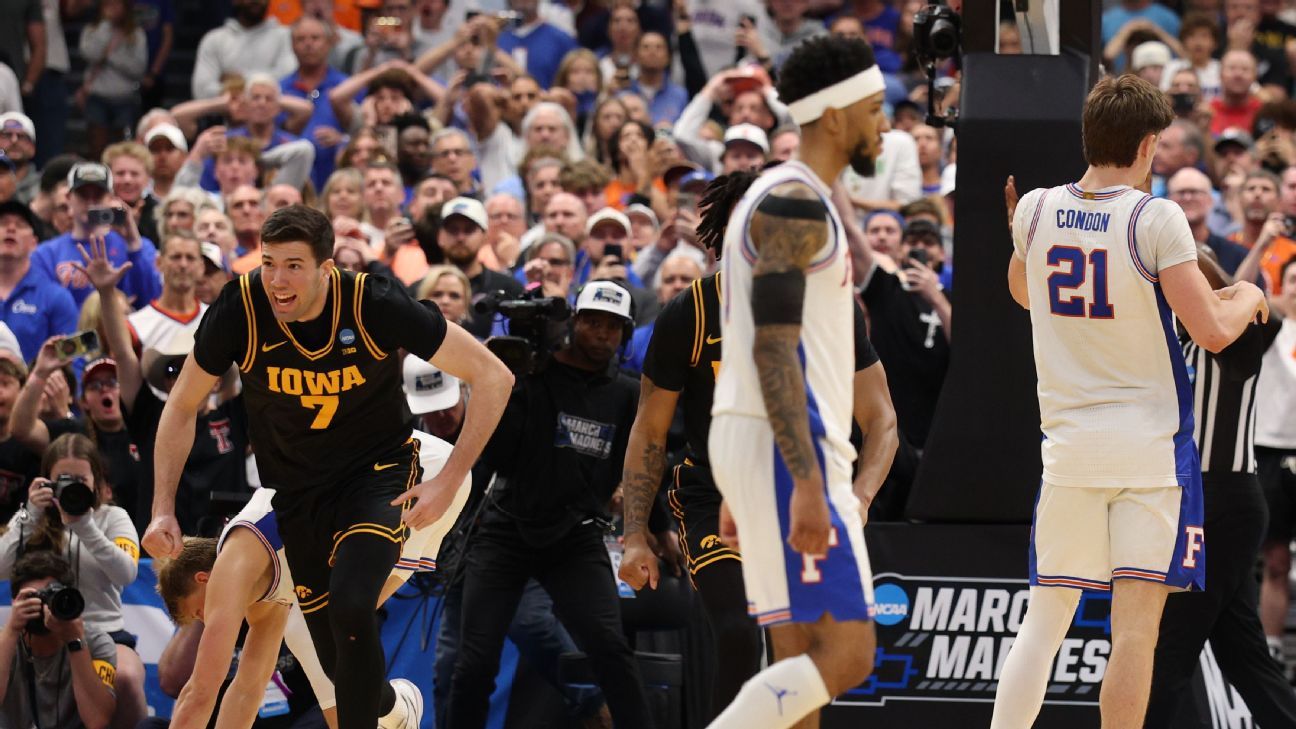
How Iowa won: Alvaro Folgueiras drilled a go-ahead 3-pointer with 4.5 seconds left to upset the defending national champion Gators and advance to the Sweet 16. The Hawkeyes controlled most of the game, leading for 66% of it, thanks in large part to their ability to match the Gators’ physicality. Florida ranks second nationally in paint points per game, but Iowa held a 32-30 edge Sunday. Four Hawkeyes finished in double figures, led by Tavion Banks‘ 20 points with Folgueiras adding 14. They also outscored the Gators on fast-break points (9-7) and held them to a season-low 61 possessions. — Jenna Laine
Iowa’s Sweet 16 opponent: Nebraska
How the Hawkeyes can advance to the Elite Eight: Unlike most other Sweet 16 matchups, we have evidence on how Iowa can beat Nebraska (and vice versa). When the Hawkeyes beat the Cornhuskers on Feb. 17, Bennett Stirtz was relatively inefficient but still finished with 25 points in willing Iowa to a win. When the Hawkeyes lost to the Cornhuskers in the regular-season finale, he finished with 11 points on 10 shots. In the NCAA tournament, Stirtz has received plenty of help from his supporting cast, with Folgueiras averaging 14.0 in two wins and Banks scoring 20 against Florida. Defensively, they have to avoid fouling. The Hawkeyes ranked last in the Big Ten in defensive free throw rate, and there was a noticeable gap in free throw attempts in the two games against Nebraska. When Iowa won, they were plus-6 at the free throw line. When Nebraska won, Iowa was minus-10. — Borzello
How Tennessee won: High drama in Philadelphia — Tennessee fended off Virginia to escape with the win and advance to the Sweet 16. The Cavaliers capitalized on a couple unforced errors to briefly take the lead with about two minutes remaining, but clutch free throw shooting from Ja’Kobi Gillespie and a few missed field goals on the other end allowed the Volunteers to hold on. Virginia freshman Thijs De Ridder did everything he could, scoring a game-high 22 points. He is the first Cavaliers player with at least 20 points and five rebounds in an NCAA tournament game since De’Andre Hunter in the 2019 championship. — McManus
Tennessee’s Sweet 16 opponent: Iowa State
How the Volunteers can advance to the Elite Eight: To beat Iowa State, Tennessee will have to play the same disciplined defense that stopped Virginia in the final minutes of Sunday’s second-round game. That task begins with Felix Okpara, who had four blocks against the Cavaliers and altered other shots, including a late drive by de Ridder that Okpara blocked during Virginia’s comeback attempt. Opposing players had made only 30% of their shots around the rim against Okpara entering Sunday’s game, per Synergy Sports data. He’ll have to protect the rim against Iowa State, which had a significant advantage in paint points against Kentucky (34-20) — but he won’t have to do it alone. Tennessee has the personnel to handle every one-on-one matchup defensively. The Vols can guard at every spot. They will have to put pressure on Tamin Lipsey, sharpshooter Milan Momcilovic and Joshua Jefferson, if he returns, to win. That defensive effort coupled with standout performances from Gillespie and Nate Ament would be the formula for a Tennessee trip to the Elite Eight. — Medcalf
How St. John’s won: Despite shooting 36% from the field and nearly coughing up a 14-point lead, the Johnnies did enough to survive and advance thanks to Dylan Darling‘s buzzer-beating layup. Darling will be the headliner, but Bryce Hopkins was the star in this one — he scored 18 points, added seven rebounds and, most importantly, drained a season-high six of his nine 3-point attempts. St. John’s defense also shut down Kansas for most of the game, forcing the Jayhawks into 16 turnovers. — Uggetti
0:49
St. John’s stuns Kansas at the buzzer to reach Sweet 16
Dylan Darling’s first basket of the game is a layup as time expires to win it for St. John’s in dramatic fashion.
St. John’s Sweet 16 opponent: Duke
How the Red Storm can advance to the Elite Eight: The focus of Rick Pitino’s game plan against Duke will obviously be centered on slowing down Cameron Boozer. St. John’s has one of the elite defenses in college basketball, but what the Red Storm don’t have is the sort of length and athleticism that has troubled Boozer at times. Much of the responsibility will fall on the individual defensive abilities of Zuby Ejiofor and Dillon Mitchell, with the latter probably being tasked with chasing Isaiah Evans in the half court. Offensively, the Red Storm need to keep up their improved 3-point shooting. Before the NCAA tournament, they hadn’t made double-digit 3s in a game since Jan. 10. They’ve now done it in both tournament games, including 11 against Kansas on Sunday. — Borzello
How Iowa State won: After a rather rough start to the game, Iowa State finally got shots to fall in the second half. Kentucky also kept turning the ball over. The Wildcats committed 20 turnovers, their most in an NCAA tournament game since 1993, per ESPN Research. And even though the Cyclones didn’t have senior forward Joshua Jefferson because of a sprained ankle, Tamin Lipsey (26 points) and Milan Momcilovic (20 points) picked up the slack to push them back into the Sweet 16. The big question coming out of this one for the Cyclones: Can Jefferson play next weekend? — Ben Baby
Iowa State’s Sweet 16 opponent: Tennessee
How the Cyclones can advance to the Elite Eight: With or without All-American Joshua Jefferson, Iowa State will have the same blueprint against Tennessee: move the ball to find the best shot on offense, force turnovers with defensive pressure and score on fast breaks. Although they didn’t have Jefferson, who is dealing with a foot injury, the Cyclones forced 20 turnovers in their second-round win over Kentucky while outscoring the Wildcats 34-20 in the paint. Playing through Lipsey — who finished with 26 points, 10 assists and only three turnovers — the Cyclones registered 150 points per 100 possessions and made 63% of their shots after halftime. They are 18-2 when Lipsey’s assist-to-turnover ratio is 3-to-1or better.
Ja’Kobi Gillespie and Nate Ament combined for five turnovers in Tennessee’s second-round win over Virginia. Iowa State can pressure that duo into the same mistakes Otega Oweh and Denzel Aberdeen (eight turnovers combined) made for Kentucky, even if Jefferson sits out another game. That’s how the Cyclones can advance. — Medcalf
How Purdue won: Leave it to the seniors to bring it home for Purdue. Fletcher Loyer had a game-high 24 points and Trey Kaufman-Renn added 19 to send the 2-seed Boilermakers back to the Sweet 16 for the third straight season.
After alternating the guards early in the first half, Matt Painter kept Loyer and point guard Braden Smith on the floor for the entire second half — and the senior tandem not only stabilized Purdue but helped neutralize a Miami squad that looked potent in the first half. In an era when rosters can be flipped on a yearly basis, Purdue is making a strong case for homegrown continuity. It seemed to be the difference Sunday in St. Louis.
Still, give Miami and Jai Lucas a ton of credit. The Hurricanes had a 19-win differential in Lucas’ first season at the helm. — Baby
Purdue’s second-round opponent: Texas
How the Boilermakers can advance to the Elite Eight: The late-season return to form of Kaufman-Renn and Loyer has taken Purdue to a different level — and is likely the Boilermakers’ biggest key moving forward. Kaufman-Renn had 20 points in the Big Ten tournament title game, 25 points in the first-round NCAA tournament win over Queens, then went for 19 points and nine rebounds in the second-round victory against Miami. Loyer was perfect from 3-point range (4-for-4) against the Hurricanes and is now shooting 19-for-35 from beyond the arc in his last five games.
While Texas’ defense has tightened up recently, it was still ranked in the bottom half of the SEC, while Purdue enters the Sweet 16 with the best offense in the country. Moreover, the Boilermakers rank in the top 10 nationally in 3-point percentage, while the Longhorns are in the bottom third in 3-point defense. If C.J. Cox is healthy and can make shots alongside Loyer and Kaufman-Renn, Purdue should be able to light up the scoreboard. — Borzello