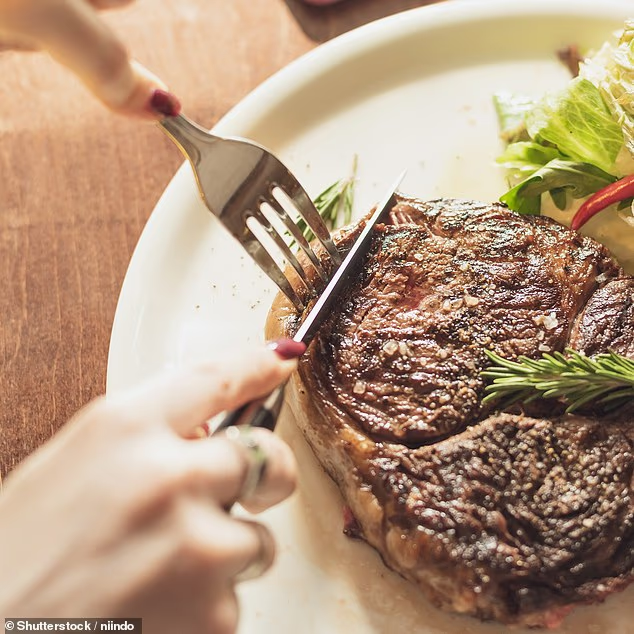
Increasing your meat intake in mid-life could help protect against dementia, experts say.
Scientists have found that carriers of the ‘Alzheimer’s gene’ who regularly eat meat could slash their risk of developing the debilitating degenerative disease by nearly half.
The gene, known as APOE, has long been linked to Alzheimer’s, and is said to be linked to more than 90 per cent of cases of the disease, which is the most common form of dementia.
The first-of-its-kind study, led by researchers from Stockholm University and published in the journal JAMA Network, followed more than 2,000 cognitively healthy Swedish adults, aged 60 or older for around 15 years.
Participants completed detailed dietary questionnaires covering 98 food items, with total meat intake being the main focus of the study.
Overall, the researchers found that higher meat intake was associated with slower cognitive decline and a reduced dementia risk among adults with the gene.
Results showed that among APOE4 carriers, those eating the most meat had a 45 per cent lower risk of dementia than those eating the least.
The researchers also tracked how much processed meat the participants ate. Processed meat was defined as meat that had been altered through salting, curing, fermentation, smoking or other processes.
Eating more meat could help protect APOE4 carriers from cognitive decline, researchers say
Cognitive function was evaluated using tests covering memory, language, and processing speed to produce an average cognition score.
During the course of the study, 296 participants developed dementia whilst 690 died without the memory-robbing condition.
Just over a quarter of participants carried the APOE4 variant – either two copies of the E4 allele or one E3 and one E4 – a well-known genetic risk factor for dementia.
The researchers found that, among these individuals higher total meat intake was associated not only with better cognitive performance overtime, but also with a lower risk of developing dementia.
In participants with the genetic risk factor, those who are the most meat – the equivalent of one chicken breast a day – had nearly half the risk of developing dementia compared to those who ate the least.
Results also showed that a higher proportion of processed meat – like bacon and sausages – relative to total meat intake was associated with increased dementia risk regardless of APOE genotype, suggesting processed meat may negatively impact brain health.
No significant differences were observed between unprocessed red meat and poultry.
Dr Jakob Norgren, study first author said: ‘Viewed alongside reinterpreted evidence from the UK Biobank focusing on unprocessed meat, these findings point to a consistent gene-diet interaction with important implications for public health.
‘Results reinforce the urgency of investing in precisions nutrition research with a focus on APOE, which could ultimately inform future policy development.’
Join the debate
Do YOU believe diet plays a major role in preventing dementia?
The researchers proposed the brain benefits of eating more meat for APOE4 carriers may be partly due to higher levels of vitamin B12 – which is essential for brain health and cognitive function.
A vitamin B12 deficiency can case a wide range of symptoms that affect the brain and nervous system, including problems with memory, understanding and judgment.
The NHS even lists dementia as a possible symptom of a vitamin B12 deficiency.
The researchers hypothesised that APOE4 carriers may rely more on adequate B12, and eating more meat could help maintain levels that protect brain function.
These findings align with previous research which found that older women with the APOE4 gene who ate one or more servings per day of unprocessed red meat could offset gene-related brain aging by around three years.
The team said: ‘This parallels effect sizes observed in our cohort, where the expected excess risk among participants with APOE4 genotypes was absent in the highest quintile of meat consumption across global cognition, episodic memory and dementia outcomes.
‘Given that these genotypes account for approximately 70 per cent of Alzheimer dementia cases in Northern Europe and North America, the absolute number of potentially preventable cases is substantial.’
Experts who were not involved in the current study welcomed the findings, but urged caution when interpreting the results.
Professor Tara Spires-Jones, from the University of Edinburgh, said: ‘This type of investigation cannot prove that the meat consumption was the cause of reduced dementia risk as other factors such as socioeconomic status likely influenced unprocessed meat consumption.
She added: ‘There are growing data across the field indicating that a healthy lifestyle including keeping physically and mentally active and eating a healthy diet can boost brain resilience.
‘However, more data from wider populations are needed to confirm whether meat consumption will directly affect dementia risk.’
Around 900,000 people in the UK are currently living with dementia, a figure expected to rise to more than 1.6 million by 2040. It is the leading cause of death, accounting for more than 74,000 deaths each year.
The APOE gene comes in three different variations – APOE2, APOE3 and APOE4. Each of us has carry two copies of the gene, inherited from each parent.
Around 75 per cent of people carry E2 or E3 variants, while 20 per cent are thought to have at least one copy of E4 – dramatically increasing their risk of dementia.
Previous studies have shown that having at least one copy of the E4 variant almost triples the risk of Alzheimer’s, whilst those with two copies have a 10 to 15-fold increased risk of developing the disease after the age of 65, scientists estimate.
However, because testing for risk variants like the APOE4 gene does not provide any certainty about a person’s chances of developing dementia, it is not routinely carried out on the NHS.