Michael Wipfli, a vocal advocate of Australia’s new social media ban for youth under 16, says he understands the frustration some tweens and younger teens have felt since it came into effect — but he is not losing sleep over the hate mail or criticism, including from his kids’ classmates.
“If people want to vent like that, then so be it,” said Wipfli, a radio broadcaster known to Australians as Wippa, speaking from his home in Sydney.
“There’s kids between the ages of 13 and 16 now that are screaming because they can’t be on it…. The behaviour change will take time.”
The ban has not been perfect. Some kids found ways around age verification, he says, but Wipfli wants the country to stay the course.
“There’s a place for social media; it’s just not in the vulnerable minds of kids under the age of 16,” he said.
Nearly four months into Australia’s landmark ban, Wipfli and other supportive parents say it is a meaningful step. But as more countries consider introducing a social media age minimum, critics continue to question whether bans are the right solution.
Along with angry messages, Wipfli said he has also heard from teachers who report improved concentration in class. Some parents have told him they are filling downtime at home by tossing a ball in the yard or playing a silly game, rather than scrolling.
“I certainly didn’t expect this to be a clean cut, easy ride,” Wipfli said. He described the age minimum as part of a broader “treatment plan of well-being.”
“The Australian government’s talking about a digital duty of care. That’s what I would like to see as the long-term vision.”
Elsewhere in Sydney, Kait Gotham said the ban has been “a non-event” in her household, with her middle son, Asher, skirting age verification by wrinkling his brow during facial scans.
Her eldest son, Ilias, who turned 16 in January, said he had “no trouble at all” chatting with friends on Snapchat or sending videos through Instagram during the month he technically fell under the ban.

Gotham said she was already monitoring her children’s screen time — she and her husband set a daily 30-minute limit for cellphone internet use, for example — and the family often talks about memes or content they encounter. She is open about her own tendency to “doomscroll” and encourages her kids to connect with friends in person.
As a result, she questions whether relying on a ban is the most effective way to reduce online harms.
“I am conscious of what my kids are eating, so why wouldn’t I be conscious of what they’re consuming with their minds? I’m conscious of where they are physically and I think you have to be conscious of where they are in the virtual world, too,” Gotham said.
While some kids need more guidance than others, she asked: “Do we need people to tell us sugar’s bad? Do we need the government to tell us that this isn’t good for us?”
Analysis of impact will take time: experts
Focusing on kids who evade Australia’s ban misses the policy’s intent — to pressure tech companies to reduce online harms, not to vilify teens — and is not, on its own, evidence of whether the policy is working, says Timothy Koskie, a media and communications researcher at the University of Sydney.
Koskie said determining the impact will take time and careful analysis of wide-ranging data, from standardized test scores to reports of cyberbullying.
“The policy was made to address certain risks and if we see those risks go down over the longer term, then we can start to say this might be having a good influence,” he said.

University of Sydney researcher Timothy Koskie tells CBC’s Deana Sumanac-Johnson about some of the markers he’ll track in the coming years to monitor teen mental health, online harm and shifts in digital habits, as Australia evaluates its under-16 social media ban.
Koskie said long-term success will also require that multiple nations — including Canada — to keep pressure on social media companies to adhere to their commitments.
“It needs to not be just Australia, right? Australia needs to have the backing of its friends internationally,” he said.
He added that Canada will need “policy that’s different from ours, that fits the Canadian context,” balancing international coordination with measures that are “specific enough to be effective … in that environment.”
It is still early, and strong evidence is limited, said Johannes Thrul, an associate professor at Johns Hopkins University’s Bloomberg School of Public Health, speaking during a recent briefing about youth smartphone and digital media use.
“[We’ve yet to see] strong causal data showing that age-limit laws themselves improve mental health at a population level,” he said.
Still, Thrul said he is watching countries implementing bans closely. He said age restrictions could be a reasonable starting point if used as part of a broader strategy.

Emma Mason explains why she supports Australia’s social media ban for teens, after her daughter committed suicide because of online bullying.
If you or someone you know is struggling, here’s where to look for help:
– Canada’s Suicide Crisis Helpline: Call or text 988.
– Kids Help Phone: 1-800-668-6868. Text 686868. Live chat counselling on the website.
– Canadian Association for Suicide Prevention: Find a 24-hour crisis centre.
– This guide from the Centre for Addiction and Mental Health outlines how to talk about suicide with someone you’re worried about.
“Social media is not uniformly toxic for all users, but the current platforms are optimized for engagement: To keep people clicking and scrolling, not for their well-being and mental health,” Thrul said.
“We need smart policy guardrails and also better platform design to reduce harm.”

Months after Australia brought in the world’s first social media ban for users under 16, CBC’s Deana Sumanac-Johnson goes there to talk to parents and kids about how it’s working and examines the growing global momentum, including in Canada, to implement similar laws.
Nations exploring age minimums
Since December, several countries have moved closer to Australia’s approach, including legislation that includes a social media age minimum in France that’s currently awaiting Senate review, and a ban in Indonesia set to begin March 28. The U.K. has also opened public consultations on additional measures to support digital well-being for youth, including a potential ban.
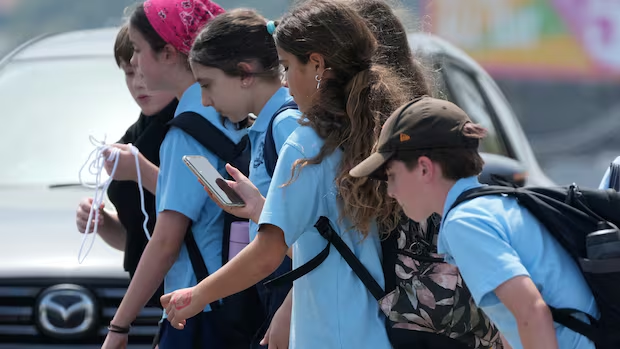
Governments in more than three dozen countries are discussing, considering or implementing social media age minimums and other online safety measures.

(Emilio Morenatti/AP)
Setting an “age of majority” for social media use “merits an open and considered debate,” Canadian Prime Minister Mark Carney said during a visit to Tokyo in early March.
Canada’s online harms legislation “is lagging, so there’s a need to — at minimum — catch up,” he said. Carney added that while he has heard arguments on both sides, he has not yet decided whether Canada should adopt age-restricted social media rules.
“We all want our children to be safe as they navigate the digital world and platforms have an important role to play in meeting that challenge,” Hermine Landry, press secretary to Culture Minister Marc Miller, said in a statement to CBC News.
“Our government intends to act swiftly to better protect Canadians, especially children, from online harm. No decisions have been made and we will have more details to share in due course.”
In recent years, Jenny Perez, fellow parents with Unplugged Canada — the national non-profit she founded — along with other advocacy groups like Children First Canada and health experts, have called for tougher online harms legislation.
Politicians across party lines agree action is needed, Perez said. “There’s no question about that. It’s more about how to do it.”

The Vancouver parent said she is frustrated by how long legislation is taking in Canada. Still, she said a social media age minimum would complement proposals already identified and put forward in previous bills that failed to pass in 2021 and 2025 because of election calls.
Parents are up against advanced and evolving algorithms and cannot supervise their children’s online behaviour all of the time, Perez said.
“We need … legislation to help us with our parenting — not to replace our role as parents, but to set the norm,” she said. She likens a social media age minimum to age limits for driving or alcohol.
“We have waited enough…. Even if we have some disagreements, we should align and work together to make it happen because it’s needed.”

Have you been thinking about how much time you spend scrolling lately? London Morning host Andrew Brown met three London high school students who have been thinking a lot about this and even made a podcast called Heal YAC about it. Here’s some of what Sophia Molchanov, Alice Kim and Eli Kouassi do to limit their scrolling.