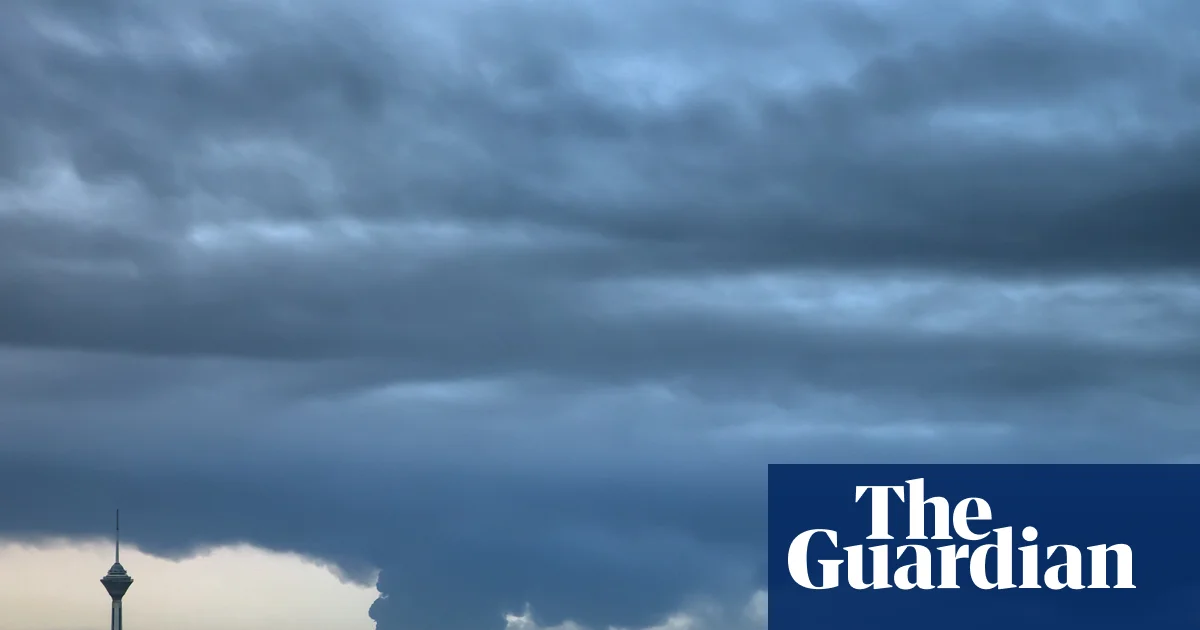
Good morning. The world is at war. From the trenches of eastern Ukraine to the missile-streaked skies of the Gulf, a growing proportion of humanity is living under the horror of conflict. For some observers, there are gnawing fears that the worst is yet to come. The apparent collapse of the rules-based international order, the irrelevance of institutions designed to uphold it, and the interconnectedness of the fighting have sparked warnings that we could be at the beginning of a third world war. Indeed, half of Britons polled in a recent YouGov survey thought world war three was likely in the next five to 10 years.
On Monday, Donald Trump stepped back from deepening the US and Israel’s war with Iran, announcing that he would postpone military strikes on Iranian power plants for a five-day period after “very good and productive conversations” about the end to the fighting. Iran denied this version of events, claiming Trump had been scared off by their threats of attacks on water infrastructure in the Gulf. But, despite calmer stock markets and a sharp drop in the oil price, there is little sign that the fighting is near an end.
For this morning’s First Edition, I asked the Guardian’s diplomatic editor, Patrick Wintour, about the credibility of the claims that we are sliding into a third major global conflict in a little over a century. First, the headlines.
Five big stories
-
Middle East | The Israeli military said it had launched a new wave of strikes on Tehran, after Donald Trump signalled a pause in US attacks against energy infrastructure after what he said were productive talks with Iran.
-
UK Politics | Ministers are looking at providing support for household bills next winter, Keir Starmer said, as he suggested the energy price shock unleashed by the Iran conflict could continue for months to come.
-
London | Security agencies are investigating whether a group linked to Iran is behind an arson attack on four ambulances belonging to a Jewish charity in north London.
-
Climate crisis | More countries will face critical food insecurity if world heats up by 2C, analysis shows.
-
New York | The pilot and co-pilot of an Air Canada Express regional jet have been killed after it collided with a fire truck while landing at New York’s LaGuardia airport.
In depth: ‘The conflicts are inextricably linked’
It is a horrifying question to contemplate: are we in the foothills of a third world war? President Trump’s former Russia adviser, Fiona Hill, is among the loudest voices arguing that we are, says Patrick Wintour. She points to the scale and interconnectedness of current conflicts, imploring us all to recognise the severity of the situation.
“So many parts of the globe are in conflict. The Middle East, Europe and China are all locked in conflict, not necessarily all military. Sometimes it’s diplomatic, sometimes it’s sort of a shadow war, sometimes it’s cyber. We are, I think, in a linked set of conflicts now,” says Patrick. “Take one example, which is illustrative. The Russians have offered to stop giving Iran intelligence or military help if, in return, the Americans force Ukraine into concessions about land. The conflicts are inextricably linked there.”
A major driver of global instability, says Patrick, is the collapse of Pax Americana, the term given to the prolonged post-second world war period of reduced large-scale conflict maintained by US might. Under Trump, the US has given up on its position of maintaining a rules-based international order through alliances and organisations such as the UN, prompting a rapid global realignment. In many parts of the world, the consequences of the American pullback from this system – however flawed – have been brutal.
“No one can quite understand what America is, due to the lack of stability and predictability which was the basis of Pax Americana. There was an alliance of nations, and they had a shared view of how the world should be led. Now that’s gone, and America acts alone,” says Patrick. “The US is also struggling to come to terms with the fact that when it used to say jump, Europe would jump. Now they are not because there is a battle going on inside Europe to try to become more independent from America.”
For the global south, western hypocrisy – perceived or otherwise – is a major diplomatic issue when trying to build common positions to stop fighting, Patrick tells me. There is a sense that the west has not been able to apply the same moral standards to conflicts, such as Russia’s invasion of Ukraine and the conflict in Israel and Palestine.
“For the global south, the argument will be that they’re expected to show undying support for Ukraine against Russia. Yet Europe is very silent about what Israel is doing in Palestine, which obviously the global south feels very strongly about. This bleeds into the kind of relationship the global south has with Europe,” he adds.
A ‘multidimensional war scenario’
For Patrick, the threshold for a third major global war has not yet been met. An opportunistic Chinese invasion of Taiwan would change that. But that appears unlikely, at least in the short term, he says.
“What everyone’s looking at is whether China sees an opportunity with America [being] so distracted, and goes for Taiwan. The Chinese insist that’s not the case, and they certainly won’t do it for a year or two, but it must be tempting for people in the Chinese government if they are intent on recapturing Taiwan. This would be a good moment to do it because America is massively overstretched and also led by an incredibly unpopular leader,” he says. “That would be how we got to a world war, but I don’t think that’s what China is actually going to do. I think we’re in this multidimensional war scenario, and we are going to be like that for quite a long time.”
Military readiness v reality
I end by asking Patrick whether the UK would even be ready for such a conflict. At Davos earlier this year, the Canadian prime minister, Mark Carney, urged middle powers to form alliances that could operate together in a world where US and China are increasingly in competition, warning: “If we’re not at the table, we’re on the menu.”
It depends on what kind of war we are talking about, says Patrick. “We are moving very slowly to try to re-establish our military strength. Reputationally, we are still strong. We still have a very good military officer class. But the actual weaponry and the number of people to fight are limited.
“In Europe, there has been a belief that we could spend more on welfare and less on defence. And now that’s got to change, I’m afraid. That’s going to be very painful, but I think it’s going to be a requirement. And then it is also going to require the UK to think more about its relations with Europe. You don’t have to reverse Brexit, but you’re going to have to recognise that Europe is our future and not America.”
What else we’ve been reading
-
This week’s pet I’ll never forget – a series that never disappoints – is Harriet the hedgehog, who took to living in Roger Leitch’s airing cupboard. Martin Belam
-
Chinamaxxing (pictured above) has been one of the biggest social media trends of the last year, with influencers celebrating Chinese customs by drinking hot water, wearing slippers around the house, using chopsticks and eating Chinese food. Read Isabella Lee’s piece about what she hopes remains from the social media fad. Patrick
-
Fotohane Darkroom is a space for the children of Mardin – a Turkish city that borders Syria and Iraq – to learn how to shoot, develop and print their own analogue photographs, giving them the chance to tell their stories themselves, Flora Medina reports for i-D magazine. Martin
-
While immigration enforcement raids have made international headlines in the US, a recent crackdown in the UK has gone largely unnoticed. Sammy Gecsoyler investigates the huge spike in immigration raids on businesses since Labour came to power. Patrick
-
Hartlepool hit the headlines for saying it had too many, but here Anne Karpf argues, with the aid of a lovely anecdote about children dancing, that memorial benches keep the dead part of the flow of everyday life. Martin
Sport
Cricket | The England Wales Cricket Board has said it will stand by director of cricket Rob Key and multi-format head coach Brendon McCullum despite the men’s team’s humiliating Ashes tour.
Football | Ben White has been recalled by Thomas Tuchel for England men’s friendlies against Uruguay and Japan, ending his partly self-imposed exile. Tuchel also called up Harvey Barnes, whom Scotland had been hoping to lure for their World Cup squad.
Football | Uefa has rejected requests from English clubs to increase the size of Champions League squads to 28 next season, after a backlash led by their counterparts in Spain.
The front pages
“Trump stalls strikes amid claims of ‘productive’ talks with Tehran” is the Guardian splash. “Trump: I’ll run the Strait with ayatollah” is top story at the Telegraph, the FT has “Trump touts diplomatic end to war” and the Mirror says “It’s not over”. The Mail headlines on “Trump blinks first” and the Times runs “Trump: I’d bet on a deal with Iran”. The i Paper splashes on “UK investigates possible Iran link to arson attacks on Jewish ambulances”, while the Sun says “Barmy Beeb bans Bob”, in reference to Bob Monkhouse.
Today in Focus
Israel’s second front: on the ground in Lebanon
The conflict in the Middle East is being fought from the air – except in southern Lebanon where Israel and Hezbollah are fighting a bitter ground war. Will Christou reports.
Cartoon of the day | Pete Songi
The Upside
A bit of good news to remind you that the world’s not all bad
Deep in Cambodia’s limestone caves, scientists have revealed a hidden world of life – including species never seen before. Surveying more than 60 caves across 10 hills in Battambang, a team led by international wildlife conservation charity Fauna & Flora found “a vast array of wildlife” thriving in karst landscapes of sinkholes, springs and caverns. Among the discoveries: a “spectacular new species of pit viper” (pictured above) and multiple new geckos, including a “night wanderer” spotted only in this habitat. The findings suggest many more species may yet be uncovered. In one of the planet’s most fragile ecosystems, the work is a reminder that there are still extraordinary new discoveries waiting in the dark.
Sign up here for a weekly roundup of The Upside, sent to you every Sunday
Bored at work?
And finally, the Guardian’s puzzles are here to keep you entertained throughout the day. Until tomorrow.