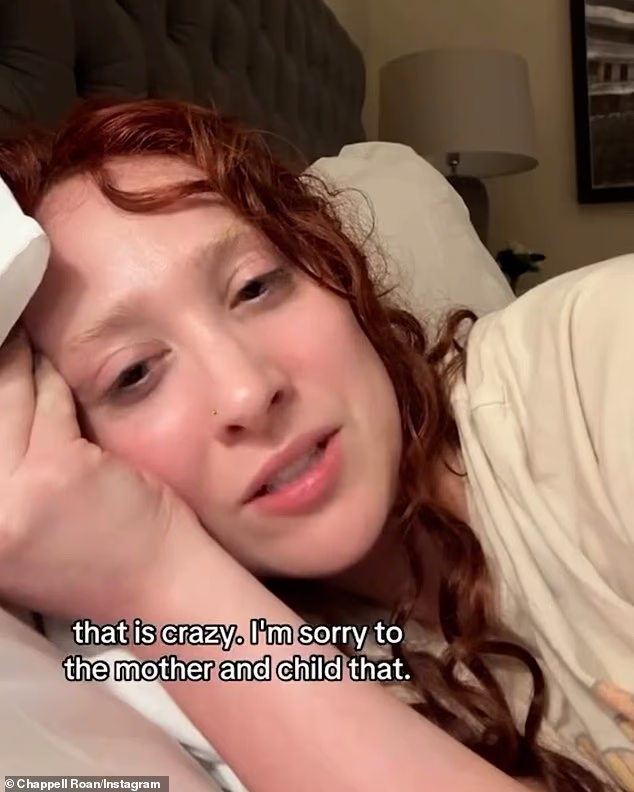
Fans of Chappell Roan leapt to defend the star after an alleged interaction with a young fan – with many arguing she is right to set firm boundaries to protect her mental health.
The row has escalated this week following claims that a member of the singer’s security team confronted an 11-year-old girl at a hotel in São Paulo.
The allegation was shared by footballer Jorginho, who said his partner Catherine Harding‘s daughter – whom she shares with Jude Law – was left upset after approaching the star.
Roan later apologised, insisting she had no knowledge of the incident and adding that she ‘doesn’t hate children’.
But as the story spread, fans rushed to her defence – pointing to her long-standing openness about mental health and the pressures of fame.
One wrote on X: ‘She’s who Britney Spears had to be in order to avoid the mental health issues she has today. I wish Britney had had the boundaries and support system that Chappell Roan has. Her story would have ended differently.’
Another added: ‘Considering this is case number 5 million of the media making Chappell Roan its punching bag over nothing when she’s been really open about her anxiety/bipolar (particularly around fans) you would think people could stop being bloodsucking vultures for a hot minute.’
The backlash – and counter-backlash – has reignited a broader debate around the singer’s increasingly strict stance on fan interactions – and the mental health struggles she says underpin it.
Chappell Roan has apologised to Jude Law’s daughter as she insisted she did not ask any security guard to approach her hours after her team were accused of leaving the young fan in tears
A persona built on separation
Roan, whose real name is Kayleigh Amstutz, has long drawn a clear line between her stage persona and her private self – and has articulated that boundary in unusually stark terms.
In a widely shared statement last year, she wrote: ‘I feel more love than I ever have in my life. I feel the most unsafe I have ever felt in my life.’
Explaining her approach, she added: ‘For the past 10 years I’ve been going non-stop to build my project and it’s come to the point that I need to draw lines and set boundaries. I want to be an artist for a very very long time.’
Roan made clear that, in her view, fame does not grant unlimited access to her personal life.
‘When I’m on stage, when I’m performing, when I’m in drag, when I’m at a work event, when I’m doing press… I am at work. Any other circumstance, I am not in work mode. I am clocked out.’
She also directly addressed what she described as repeated invasions of her personal space: ‘Please stop touching me. Please stop being weird to my family and friends. Please stop assuming things about me… I am scared and tired.’
The statement followed earlier comments about ‘creepy’ harassment and ‘stalker vibes’, as well as a TikTok in which she said: ‘I don’t care that abuse and harassment, stalking, whatever is a normal thing to do to people who are famous… that does not make it OK.’
Mental health struggles and diagnosis
Central to Roan’s position is her history of mental illness.
She has spoken openly about being diagnosed with bipolar disorder at the age of 22, after years of undiagnosed symptoms.
The condition is characterised by alternating periods of depression and elevated mood. In type II bipolar disorder, which Roan has described experiencing, this includes episodes of hypomania – a state of increased energy, reduced need for sleep and impulsivity.
Roan has said her early career was shaped by these symptoms, including periods of intense productivity driven by sleeplessness and the wrong medication.
Speaking in interviews, she has credited therapy and medication with helping stabilise her condition, but has also acknowledged how fragile that balance can be under public scrutiny.
She has described experiencing severe depression, including suicidal thoughts, before seeking more structured treatment.
‘I realised I can’t live like this,’ she said. ‘I can’t live being so depressed or feel so lost that I want to kill myself.’

Chappell Roan has spoken about being diagnosed with bipolar
The impact of fame
Roan has repeatedly linked her mental health to the pressures of sudden fame.
She has said that even everyday activities now require planning and security, removing any sense of spontaneity.
‘If I want to go thrifting, I have to book security and prepare myself that this is not going to be normal,’ she said.
She has also described experiences of harassment, stalking and unwanted physical contact from fans – incidents she says have shaped her increasingly firm boundaries.
In one case, she said a fan grabbed and kissed her without consent. In another, police were reportedly called when an autograph seeker refused to leave her alone.
Her frustration boiled over publicly at the MTV Video Music Awards, where she confronted a photographer who was shouting at her.
‘They think I’m complaining about my success,’ she said afterwards. ‘I’m complaining about being abused. Fame has the vibe of an abusive ex-husband.’

Roan’s strict approach to fan interactions has drawn criticism, with some online voices calling her entitled, while others defend her right to set limits
Drawing the line with fans
In recent years, Roan has used social media to directly address what she calls ‘creepy behaviour’, urging fans to respect her limits – including declining photos and avoiding physical contact.
Her stance reflects a wider shift among younger artists, who are increasingly vocal about boundaries and burnout in an era of constant access via social media.
Supporters argue that the Sao Paulo incident – regardless of the specifics – illustrates the difficulty of navigating those boundaries in real time, particularly when security teams are involved. Critics, however, say the situation highlights the risks of creating distance from fans who have helped fuel her rapid rise.