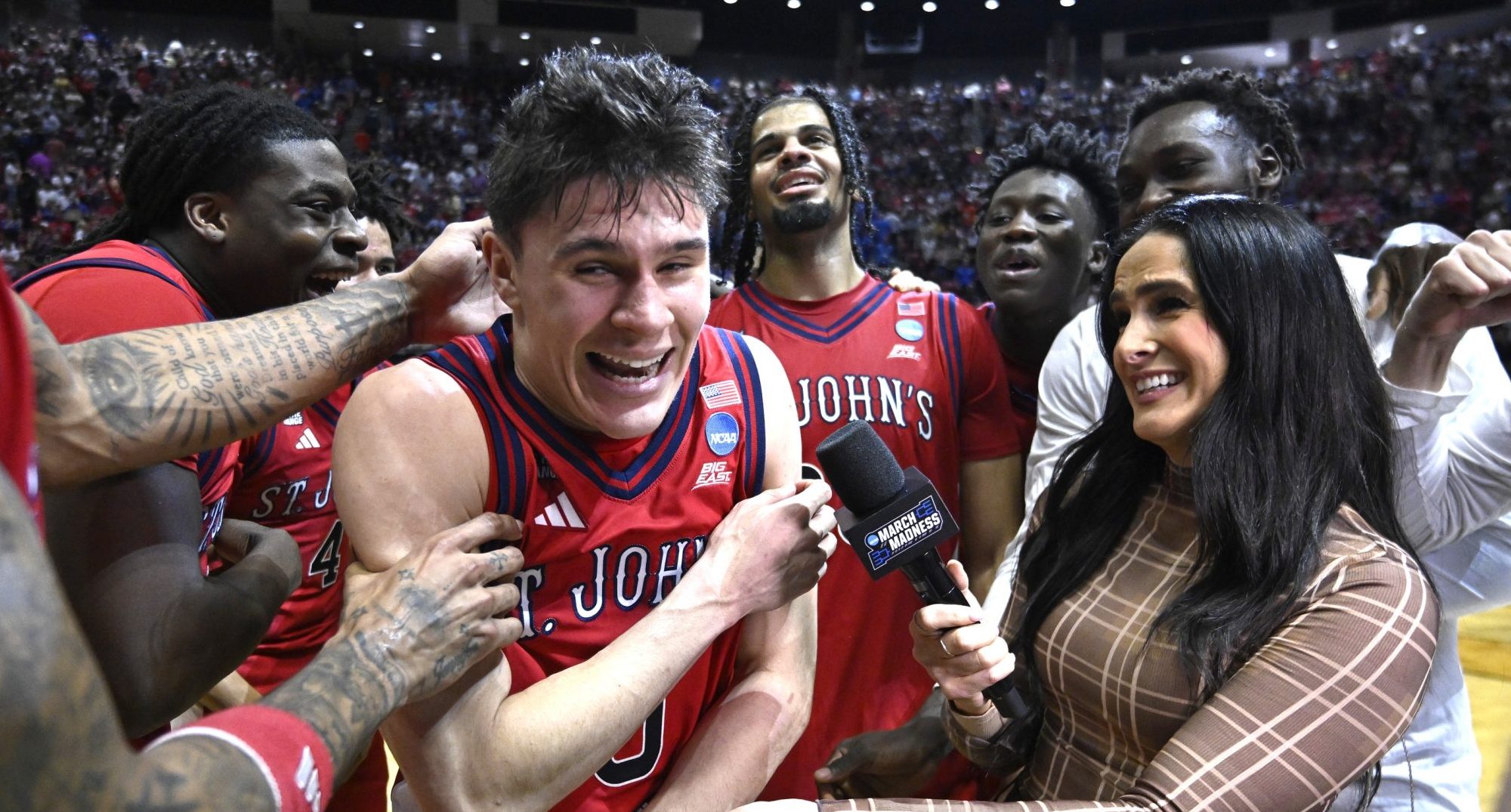
Is there a better sports broadcasting gig than being a sideline reporter for March Madness? Seriously. The assignment might be the most underrated in all of sports.
For one, there’s simply no sporting event as exciting as March Madness. A 68-team, single-elimination bracket filled with hormonal college kids and equally hormonal head coaches competing in the highest stakes environment of their careers? All in front of a massive national television audience? Sign me up.
And CBS Sports/TNT Sports have done an expert job of capitalizing on the borderline primal energy being displayed on the court. That is, in no small part, due to the work of sideline reporters, who are granted extraordinary access to players and coaches during the tournament.
Think about it. Each head coach gives a mid-game interview during the first half of play. The sideline reporter interviews a player at halftime. Then, the postgame interview can feature a star player from the winning team, the coach, or a combination of both, as they experience one of the most thrilling moments of their lives.
Through the first weekend of the NCAA Men’s Basketball Tournament, there were no shortage of brilliant moments featuring sideline reporters, all of whom capitalized on the unique combination of access and energy that March Madness delivers.
Perhaps the most memorable will be Lauren Shehadi’s mid-game interview with Villanova head coach Kevin Willard, who threatened to fire his staff for the Wildcats’ performance. Even when Shehadi gave the “joking” coach an off-ramp, quipping, “Not now!” Willard doubled down, again threatening to fire his entire staff. “Bye coach,” Shehadi then deadpanned before throwing it back to the booth. “Kevin, we’re losing people by the second.”
Villanova HC Kevin Willard: “I’m gonna fire my staff.”
Lauren Shehadi: “Not now.”
Willard: “Yeah, I am. Because we’ve given up 8 points on underneath out-of-bounds defense. The only thing I’m gonna do is fire them and get a new staff.” #MarchMadnesspic.twitter.com/z9OvxS0Yy4
— Awful Announcing (@awfulannouncing) March 20, 2026
The Willard circumstance was, well, abnormal, and Shehadi handled it well. But it’s a lesson that these sideline reporter interviews come in all shapes and sizes.
On the first day of the tournament, Jared Greenberg authored this brilliant postgame interview with High Point head coach Flynn Clayman, who had a pro-mid-major agenda to push moments after his team upset Wisconsin to earn the school’s first-ever NCAA Tournament victory.
High Point HC Flynn Clayman: “It looks pretty obvious to me that high-majors need to play mid-majors early in the season. Because they said we didn’t play nobody. We played somebody now… Nobody would play us. Just like they wouldn’t play Miami (Ohio).”pic.twitter.com/nXB2RMZNaa https://t.co/pmdLjJWbPW
— Awful Announcing (@awfulannouncing) March 19, 2026
Not to be outdone, Greenberg led another laugh-out-loud funny yet insightful interview during Texas’s game against BYU, when Longhorns coach Sean Miller bluntly revealed he didn’t believe his team could guard Cougars star AJ Dybantsa.
Texas head coach Sean Miller was very honest about the team’s chances to slow down BYU star AJ Dybantsa.
“I don’t think we can.”
Dybantsa went on to score 35 points, but Texas still came away with a 79-71 win. 🏀🎙️😂 #MarchMadness #NCAATournamentpic.twitter.com/aoTzVDbRg9
— Awful Announcing (@awfulannouncing) March 20, 2026
Sure, it takes two to tango. Without the overworked adrenal glands of their subjects, sideline reporters might find it more difficult to nail these moments. But this is March Madness, not the Spelling Bee. And sideline reporters are acing the test.
Here’s Shehadi again, who has seemingly mastered the art of asking questions that are short, to the point, and illicit actually interesting answers from coaches and players. St. John’s head coach Rick Pitino flat out told Shehadi he thought Kansas believed his team couldn’t shoot.
“They don’t believe we can shoot, and we’re proving them right right now.”
Rick Pitino tells @LaurenShehadi that St. John’s will keep on shooting pic.twitter.com/r3wiOskAtE
— CBS Sports College Basketball 🏀 (@CBSSportsCBB) March 22, 2026
After the Red Storm won on Dylan Darling’s buzzer beater, Shehadi got Darling to reveal that Pitino had been “yelling at [him], per usual” while in the huddle, which led to a lighthearted back-and-forth.
“Man we got a bunch of dogs. We could have gave in a lot this year but you know we put our head down, came to work everyday. Just a resilient group”
Dylan Darling to @LaurenShehadi following his game winning shot pic.twitter.com/pTsGzILoXo
— CBS Sports College Basketball 🏀 (@CBSSportsCBB) March 22, 2026
For whatever reason, there’s a common thread of charm and honesty in a lot of these March Madness interviews. Here’s AJ Ross speaking with Prairie View A&M coach Byron Smith, who essentially said his team would need an Act of God to beat No. 1 seed Florida.
AJ Ross: “Coach, Florida on an 18-0 run here. What more do you need from your guys to slow this down and get into their game?”
Prairie View A&M coach Byron Smith: “We need some help from the lord. They’re very good…” #MarchMadness pic.twitter.com/H005A0KEzT
— Awful Announcing (@awfulannouncing) March 21, 2026
Compare this to your typical sideline interview with an NFL player or coach, or a baseball manager in a dugout, and the difference is night and day. March Madness provides the environment for these moments to happen, but the sideline reporters bring them to life.
There’s an impressive level of quick-thinking and wit required to excel as a sideline reporter. You never know how a coach or player will react to a question or prompt. But that’s also the beauty of the sideline interview. There’s an element of high-wire act to it all. And when reporters are able to stick the landing, it’s worthy of praise.
Sideline reporting is often a thankless job. Much of their value isn’t immediately apparent to the viewer at home. They’re gathering information, communicating that information with producers, and occasionally popping on the broadcast with a report.
March Madness flips that entire dynamic on its head. Sideline reporters become the stars of the show. No longer are fans bemoaning another boring interview filled with coachspeak. They’re expecting raw, unfettered emotion, and they usually get it.
So for at least a few weeks every year, sideline reporting isn’t such a thankless job. It’s the best job. And we’re here for it.