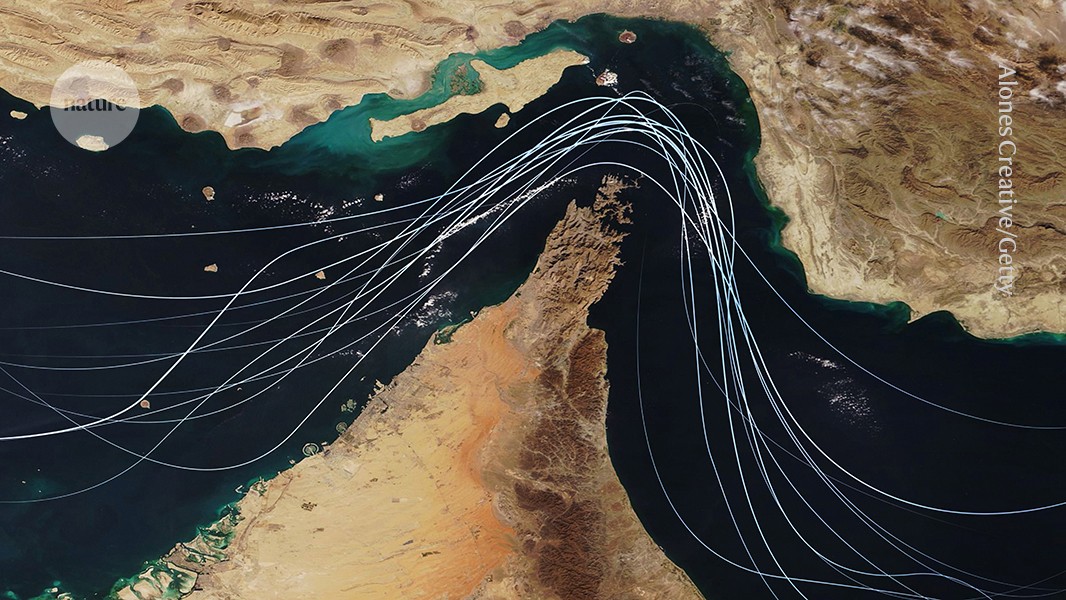
Satellite image of the Strait of Hormuz, showing oil transport routes before its closure on 2 March.Credit: Alones Creative/Getty
The Strait of Hormuz in the Middle East closed for the first time on 2 March, a few days after the US–Israel strikes on Iran, triggering a global energy shock. One-fifth of the global oil and gas trade flows through this narrow sea corridor that separates Iran from the United Arab Emirates and Oman — equivalent to nearly 20 million barrels per day. The current crisis revives concerns over global energy markets and security.

The scars of war last for centuries: how we understand collective trauma needs to change
In a matter of weeks, oil prices have surged across Asia, Europe and the United States, with the effects seen at fuel pumps worldwide. Insurance companies have suspended maritime coverage or raised risk premiums for tankers crossing the region. Key oil and gas companies have declared force majeure, releasing themselves from obligations to supply contractual volumes of oil, gas and refined products to their buyers.
Importing economies have reacted quickly, in particular in Asia, which is the destination for 80% of the oil and petroleum products that go through the strait. Japan’s government triggered the release of oil from its strategic reserves — a measure typically coordinated with other member countries of the International Energy Agency. Pakistan, Vietnam and Thailand are encouraging work-from-home practices to reduce fuel consumption. Such actions can calm markets, but they will be inefficient if supply disruptions persist. Japan’s oil reserves, for example, can support it for around eight months. Repeated reliance on emergency interventions could lead to price volatility and discourage investment in energy infrastructure and trade routes, deepening structural vulnerabilities in energy security.
Other key industries that depend on hydrocarbons are feeling the shock waves. Gulf states account for roughly 35% of global fertilizer production, extract one-third of the world’s helium and make almost half of its sulfur.
While the world grapples with the immediate effects of this crisis, longer-term solutions need to be planned.

How AI is shaping the war in Iran — and what’s next for future conflicts
First, Gulf oil and gas producers need to diversify trade routes to reduce reliance on vulnerable bottlenecks. Most Gulf oil goes through the Strait of Hormuz. Only a few routes bypass it. Oman has pursued diversification since 2022, such as through investments in the port of Duqm and the Ras Markaz oil-storage facility and pipeline network.
Other pipeline, storage and port infrastructures are needed. This will cost hundreds of billions of dollars. The financial burden should not be placed solely on producing states. Global consumers should contribute, to ensure resilience of trade flows in the long term. Gulf countries will need to work together to align resilience investments with potential geopolitical threats. They can draw lessons from geostrategic co-investments in energy infrastructure by some European Union nations. For instance, the Nord Stream pipeline network between Russia and Germany was funded by a consortium of European energy companies alongside the Russian state-owned firm Gazprom.