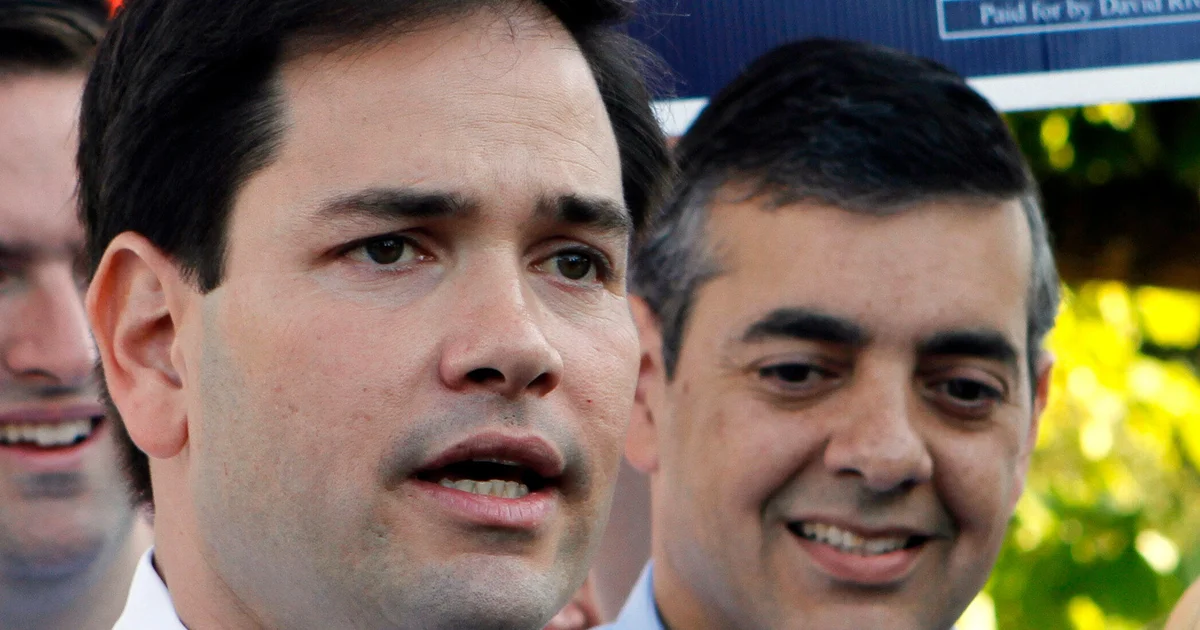
Secretary of State Marco Rubio testified in federal court Tuesday that he had no knowledge of the alleged crimes of former Rep. David Rivera, his onetime housemate who is accused of secretly lobbying for the Venezuelan government during the first Trump administration.
Rubio described a 2017 meeting with Rivera where he said “insiders in the regime in Venezuela” had convinced former Venezuelan President Nicolas Maduro to step aside, and Rubio said he had no knowledge that Rivera had allegedly been contracted out by a subsidiary of a Venezuelan state oil company to arrange the meeting.
“I was skeptical that it was true,” Rubio said about the claims of Maduro stepping aside. “Because we’ve had so many other people” attempt to do the same thing with “double dealers who were constantly making these claims.”
Federal prosecutors allege that Rivera worked alongside his codefendant, Esther Nuhfer, to influence the first Trump administration on behalf of Maduro and then-Foreign Minister Delcy Rodriguez with the goal of lowering political tensions and easing sanctions between the South American country and the U.S. Rodriguez is now the interim president, after the U.S. removed Maduro from power in January and brought him to the U.S. for prosecution on charges including narco-terrorism conspiracy.
In 2022, Rivera and Nuhfer were indicted by a grand jury in the Southern District of Florida on money laundering charges and for failing to register as a foreign agent. Prosecutors allege that the pair were hired in a $50 million contract in exchange for three months of lobbying work in 2017 on behalf of a U.S.-based subsidiary of a Venezuela state oil company, PDVSA, which operates under the name CITGO.
In the indictment, Rivera and Nuhfer are accused of attempting to lobby Rubio, then a Republican senator from Miami, and former White House advisor Kellyanne Conway on behalf of people in the highest ranks of the Venezuelan government. The attempts to meet Conway were unsuccessful, prosecutors said, but added that the pair did arrange two meetings with Rubio, who is a longtime friend of Rivera’s and had been an outspoken critic of the Maduro regime.
During cross-examination from Rivera’s defense team, Rubio said he had no direct knowledge of any crimes alleged in this case.
“I have no such knowledge other than what is in the press and what is in the indictment,” Rubio said when asked if he had any information about the alleged $50 million contract between Rivera and Nuhfer and the Venezuelan oil subsidiary.
Rubio, who is currently heavily involved in the Trump administration’s diplomatic efforts regarding the war in Iran, is set to be the first sitting member of the president’s Cabinet to take the stand in a criminal trial since 1983. Rubio isn’t charged with a crime in the case and has not been accused of doing anything illegal in his interactions with Rivera.
Rubio said he and Rivera are former housemates who lived together in Tallahassee when they both served in the Florida state legislature, and said Nuhfer was a political adviser to both Rivera and his former political operations.
After Rivera left Congress in 2013, Rubio said the communication between the pair became more infrequent, and he was not aware of what Rivera was doing for a living and what consulting work he was involved in.
Rubio said the pair discussed politics “quite often,” mostly focused on western hemisphere events, through 2017, because he was a “vociferous anti-communist voice.”
In July 2017, Rubio said Rivera reached out to him in hopes of setting up a meeting.
“He called me to say it was urgent that he see me and speak to me regarding Venezuela,” Rubio said. The next morning, Rubio said, Rivera flew to D.C. to meet with him “less than 24 hours” later after the call. The meeting was at a home the Rubio family was living at the time.
During the meeting, which Rubio said lasted about two hours, “David said there were insiders in the regime in Venezuela… who had convinced Maduro to step aside” and Raul Gorrin, a Maduro regime insider and businessman, was going to give letter to him to give to President Trump signaling potential resistance to Maduro inside Venezuela. The letter, Rivera had told Rubio, would signal Maduro was ready to step aside and hold free and fair elections back in 2017 before he eventually did the opposite, which was to appoint a separate congress to approve his policies.
“I questioned whether this was real and whether it was worth my time,” Rubio added.
Rivera “showed me a bunch of money” on a laptop that was meant to help the opposition in Venezuela, Rubio said, totaling millions. Rubio said Rivera did not say where the money was coming from, and said he did not take Rivera at his word about the contents of the meeting.
“I took it as a data point,” Rubio said, adding Rivera “told me it had to be me” to receive the letter from Gorin and give it to Mr. Trump and the White House.
Rubio said he reached out to the White House “the next morning” about these events and “briefly spoke to the president” and said “there might be something going on in Venezuela.”
Rubio said he never received the letter, and did not know Rivera had allegedly been contracted out by a subsidiary of a Venezuelan state oil company to arrange the meeting.
“It would have been of interest to me because I would have known…. He was representing an entity” of the Maduro regime, Rubio said.
If he had known, “I would not have taken any subsequent action on this matter,” Rubio said.
There was another meeting that month, Rubio said, where Rivera approached him again, this time saying Gorrin was coming with a member of the anti-Maduro opposition to meet him in Washington, D.C. and deliver the letter that was promised days before.
Rubio said the meeting was at a hotel, and “didn’t last very long” because Gorrin and others told Rubio how bad things were in Venezuela… but did not have a letter to give Trump and the White House.
Rubio said the meeting was a “total waste of my time” adding “I didn’t understand frankly why we had to meet.
“I was frankly angry,” Rubio said. “It just didn’t make any sense”
Days after the meeting, Rubio said his office was made aware of an assassination contract that was taken out against him by a Venezuelan gang, led by Diosdado Cabello. Cabello has been accused of leading the Cartel of the Suns. This resulted in a Capitol police detail for over a year for Rubio, and closed-door briefings on the threats.
In an interview with CBS News Miami before Rivera was indicted, Rubio said that Rivera’s lobbying work had “nothing to do” with him or their relationship.
“He’s someone I’ve known for a very long time. We’ve worked closely but not on this. And there’s not a single person claiming otherwise,” Rubio said.
“This case is about two things: greed and betrayal,” prosecutor Roger Cruz said in his opening statement Monday, the Associated Press reported. “The evidence will show that for $50 million these two defendants made a pact to secretly lobby for Nicolás Maduro, the communist director, and his second-in-command Delcy Rodríguez.”
Rivera has denied wrongdoing. The Associated Press reported that Rivera’s attorneys argued in their opening statement that Rivera’s lobbying was exempt from the Foreign Agents Registration Act, because it was focused on bringing the oil company Exxon back to Venezuela, for the subsidiary, which is based out of Texas.
“This is like a murder case without a murder, a drugs case without drugs, a kidnapping case without a kidnapping,” Rivera’s attorney Ed Shohat said in his opening statement Monday, the Associated Press reported, adding that “not one single policy” in the U.S. was impacted by Rivera’s work.
Shohat argued Monday that Rivera’s meetings with Rubio were unrelated to the consulting work on behalf of the Maduro regime, the Associated Press reported, and allegedly focused on bringing Exxon back to Venezuela.
At the end of his questioning of Rubio, Shohat asked Rubio for his autograph to laughs from the courtroom.
“I want him to autograph it!” Shohat said, when he went to get a copy of Rubio’s autobiography from the Secretary of State, who had been asked about the acknowledgments section, which mentions Rivera and Nufher.
“Is that allowed?” Rubio asked.
U.S. District Judge Melissa Damian, who is overseeing the trial, laughed and put her head in her hands said “I don’t know!”