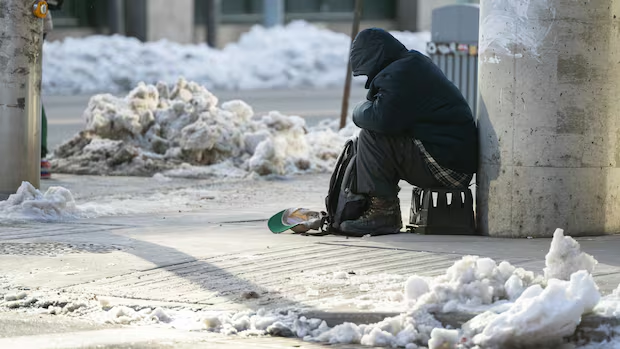
Winter can be tough to bear. Even more so if you’re homeless.
If there is no place to warm up or change out of soggy boots or damp clothes, continuous exposure to freezing temperatures and wind chill can result in severe frostbite and, in some cases, amputation.
While not all of Montreal’s regional health authorities track frostbite amputations, those that do have recorded 46 cases since 2018.
On average, there are about six frostbite amputations a year.
Montreal hospitals do not log whether a patient is unhoused, but anecdotally, “a large portion of our patients, unfortunately, are really homeless,” said Dr. Ali Izadpanah, a board-certified plastic surgeon. He is also the director of Montreal’s regional burn centre at the CHUM, which treats severe frostbite.
“It does happen, of course, [to] the guy who’s outside for a ski or work, but much, much less often,” he said.
The worse the frostbite, the higher the chance of amputation.
But despite a long and cold winter, no frostbite amputations have been reported in Montreal so far this year.
The two worst years for frostbite amputations were 2023 and 2025, which both had 12 cases.
The drop in cases could be connected to two differences this winter season: the addition of hundreds of spots in temporary warming shelters around the city and the use of a new drug protocol to treat frostbite, called iloprost.
On average, there are about six frostbite amputations recorded each year in the city. In both 2023 and 2025, there were 12. So far in 2026, none have been reported. A new drug and additional warming shelter spots are likely behind the major drop.
Drug dramatically reduces chance of amputation
The use of iloprost to treat frostbite in Canada was first developed in Whitehorse and began to be used more widely last winter in Quebec.
Like burns, frostbite severity ranges from Stage 1 — frostnip — to 4, where the skin and underlying tissue is usually dead and has turned black, similar to an electrical burn.
At stages 3 and 4, some sort of surgical reconstruction or amputation is usually needed, said Dr. Izadpanah.
He says the frostbite can only be evaluated once the area has been warmed up.
“Coming off the cold weather, everything looks cyanotic and dead. You warm it up and see what stage it’s becoming, what kind of blisters are forming, what is the extent of the damage,” said Izadpanah.
The iloprost treatment protocol is used on patients who have a Stage 2 or 3 frostbite.
Even though the vessels are damaged, the medication keeps the blood flowing, which prevents the tissue from dying and helps it heal.
“So the chance of amputation decreases substantially,” said Izadpanah.

In the past, if the frostbite was Stage 3, the risk of amputation could run as high as 60 or 70 per cent.
“With the iloprost, some of the studies have shown it goes down to 10 per cent,” said Izadpanah.
The use of iloprost for frostbite is not yet approved by Health Canada, so it requires special approval. In the last year or two, Izadpanah says most major centres in Quebec have access to it. But the doses need to be ordered in advance.
“If you ask for it come the winter, it’s way too late. So we sent the request last year, winter, for this year’s winter,” he said.
Particularly rough winters
While the number of frostbite amputations in Montreal seems to be going down, frostbite is still a concern for those living on the streets.
Even in cases where amputation is initially avoided, the blood vessels remain fragile.
“A limb that has been affected by a frostbite is always more susceptible to having another frostbite. Because the damage has been done,” said Izadpanah.
About 15 to 20 per cent of Montreal’s homeless population live outside, says James Hughes, the president and CEO of the Old Brewery Mission. Some live in encampments or abandoned buildings. Others use Metro stations or hospital emergency rooms as temporary shelters.
“So they are moving around a lot outside and are naturally exposed to cold weather more than people who are not [homeless],” said Hughes.
This winter, the City of Montreal added hundreds of spaces at temporary warming centres. Hughes says the drop in amputations is “terrific” and fears the number could have been much higher if not for the extra spots.
“They’ve absolutely had a positive impact,” he said.

The Montreal health network includes five regional health authorities as well as the CHUM and MUHC. Of those, the regional health hubs that serve the West Island, the central-western part of Montreal and the east end said they did not track frostbite amputations.
The CHUM and the three hospitals overseen by the CIUSSS du Nord-de-l’Île-de-Montréal performed about 75 per cent of the amputations on the island of Montreal since 2018. The rest were done at the MUHC and the CIUSSS du Centre-Sud-de-l’Île-de-Montréal.
Nearly half of the frostbite amputations occurred in 2023 and 2025.
Historical weather data shows both years had several days of frigid temperatures and bone-chilling wind chill. Winter 2025 was particularly brutal, with back-to-back storms last February, which brought nearly 75 centimetres of snow over five days.
‘Loss of identity’
In the homeless population, poor health is undeniable.
Chronic health conditions such as diabetes are common, which can make people more susceptible to frostbite. Drug or alcohol dependence can also dull the pain of frostbite and delay detection, said Hughes.
Although the Old Brewery Mission’s front-line staff are trained to spot frostbite quickly, it’s often too late.
“We see it anecdotally here all the time,” said Hughes. “We have people here in our café and in our emergency services who have lost limbs.”
He’d like to see the city invest in more medical staff who can work directly out of homeless shelters to catch infections and other health ailments early.
Although there are psychiatric services available on-site at many homeless shelters, there isn’t an equivalent for physical health.
“We need to have primary care here, that would be incredibly helpful because people often don’t get referred easily. It’s very hard to give a homeless person an appointment on the other side of town.”

Maison du Père has 30 beds to help support individuals who require extra health care, including patients who had an amputation due to frostbite.
Since January, the organization has helped care for five people who experienced severe frostbite. Two of them remain under observation to see if amputation can be avoided, said Jaëlle Bégarin, who runs the shelter.
Their nurses can change dressings, make sure people are taking their medication and support people who are receiving rehabilitation.
Bégarin said the impact of an amputation can be profound. Some people who were on a waiting list for housing may need to start from scratch if they now need adapted housing.
The loss of a digit, foot or hand can also magnify mental health issues.
“It’s yet another burden on top of homelessness and very often there’s a loss of identity that comes with it,” said Bégarin. “The person no longer recognizes themselves and has to relearn how to rediscover themselves in a different way.”
While both Hughes and Bégarin say the drop in amputations is encouraging, they argue the use of warming shelters is a Band-Aid solution.
They say the city needs to invest in more housing, so people don’t end up on the streets in the first place.
Izadpanah agrees.
“It’s really a social issue,” he said. “So having more support outside for this fragile population, I think, is really the key to decreasing frostbite.”