The first few months of 2026 have delivered a series of increasingly alarming signals about the future of free speech on American television. Networks aren’t facing outright bans, but rather a campaign of mounting political pressure and legal ambiguity enabled by an aggressive expansion of regulatory power.
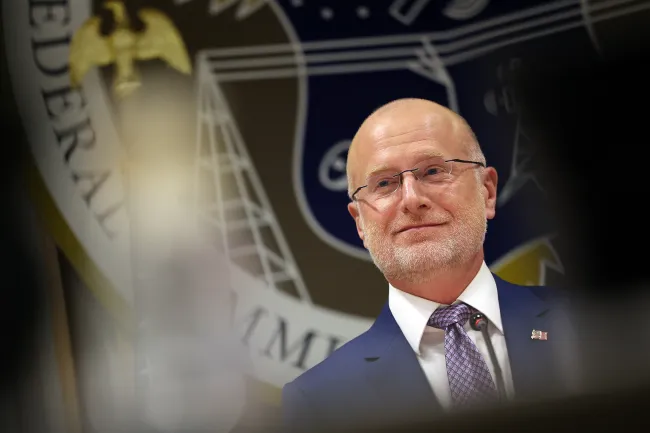
Brendan Carr, the chairman of the Federal Communications Commission, recently threatened to revoke the licenses of local news stations that aired coverage of the Iran war he characterized as “fake.” Carr’s comments echoed many of the explosive, anti-journalist talking points long pushed by President Donald Trump, but were widely dismissed by public policy experts as hollow and potentially unlawful.

The FCC hasn’t denied a license renewal in decades, and any such attempt would likely trigger a long, and potentially losing, First Amendment battle for Carr — and Trump. Still, whether or not the administration’s media agenda is enforceable is almost beside the point. The FCC doesn’t need to pull licenses to change network behavior. It just needs to make enough broadcasters twitchy at the thought of expensive, drawn-out litigation, so that self-censorship subtly becomes the industry’s new norm.
An equally consequential fight has been unfolding around the FCC’s “equal time” rule, with scrutiny aimed at programs like the soon-ending “The Late Show with Stephen Colbert” at CBS and the daytime talk show “The View” at ABC. The regulation, which requires comparable airtime to be given to opposing political candidates whenever they appear on broadcast television, is now an issue for entertainment programming in a way it hasn’t been in decades. That’s largely due to Carr’s posturing.
That bureaucratic tension has fueled widespread speculation about the future direction of CBS in particular. Against the backdrop of Paramount’s corporate maneuvering to buy Warner Bros. Discovery, and the controversial hiring of editor-in-chief Bari Weiss, the risk of heightened FCC exposure has created a case study in how regulators can influence not what gets said, but whether it’s said at all.
Below are four choke points to watch as the pressure campaign quietly reshapes broadcast television.
If Equal Time Makes Politics Too Big a Liability for Hollywood
The equal time rule was designed to ensure fairness in political coverage. But under a more aggressive interpretation, it risks doing the opposite. For late-night and daytime talk programs, booking a politician may no longer be a creative decision so much as a high-risk compliance trigger.
One appearance per segment could obligate producers to offer equivalent airtime not only to major opponents but also to third-party candidates who technically qualify under the FCC’s rule. Buckling under the weight of an already struggling business model, network executives and producers could find the risk of logistical headaches, legal exposure, and internal friction causes a cost/benefit crisis.
The simplest solution? Don’t book the candidates. That might not silence political comedy outright, but it would shrink its reach and dull its impact. Without the direct engagement afforded by broadcast, satire becomes more abstract, less pointed, and easier to ignore. What was once a space for unscripted moments that could shake the establishment may turn into something safer and less relevant.
When Self-Censorship Plagues Both Entertainment and News
Broadcast licenses remain one of the few pressure points the federal government still has over major media companies — particularly because those licenses are directly tied to local stations owned by national conglomerates. Renewals are rare battlegrounds, legally speaking, but the FCC’s influence is felt much more immediately in those moments of corporate vulnerability.
Every merger, acquisition, or license transfer runs through Carr’s department, and recent deals have already hinted at how regulatory pressure can shape editorial policy, staffing and programming decisions, and even internal oversight. Networks don’t need to be directly punished to know that a consequence is on the table. That’s especially powerful when millions, or even billions, of dollars are at stake, and when approval depends on staying in the government’s good graces.
Journalists, Satirists, and Their Audiences Are Being Forced Further Apart
Broadcast once functioned, however imperfectly, as a shared civic space where news, culture, and entertainment intersected. The linear TV era had audiences catching the day’s headlines on the evening news before processing them through talk and comedy at bedtime. But if satire becomes too big a liability for some networks, those conversations will either disappear from Hollywood… or move.
Forcing those elements apart, by siloing political comedy to an online platform or sanitizing those shows altogether, won’t just change network programming. It will accelerate the erosion of shared public discourse, effectively leaving viewers to piece together their understanding of the world from increasingly fragmented sources amid an already claustrophobic attention economy.
News divisions, presumably still protected by clearer First Amendment precedents, will continue to engage with the world’s most pressing issues. But without talk and late-night, the result is a media ecosystem that pushes perspectives further apart rather than bringing them into conversation.
Time for Premium Tier… Free Speech?
If broadcasting becomes more restrictive, the conversation about politics is likely to become more privatized. Cable networks, streaming services, podcasts, and other independent platforms are already better positioned to absorb political content that no longer fits comfortably on network TV. And operating outside the FCC’s licensing regime under Carr, those spaces will face fewer constraints and be more motivated by subscription models, algorithms, and niche audiences like most businesses.
This shift is already underway, suggesting a precarious future across television. Broadcast has been losing cultural cache for years, squeezed by changing viewer habits and declining ad revenue. Regulatory pressure didn’t create that dip, although it could accelerate it. That jeopardizes pushing creators and their audiences toward platforms that feel freer, faster, and more responsive… but have less reach, ultimately.
Those digital spaces are not equivalent to broadcast, and as social media has already demonstrated, every attempt at that migration will come with its own legal and cultural pitfalls. In the end, Carr’s efforts at the FCC stand to turn laws meant to protect free speech into opportunistic muzzles, leaving network TV smothered by a conversation its leadership spent too long avoiding.