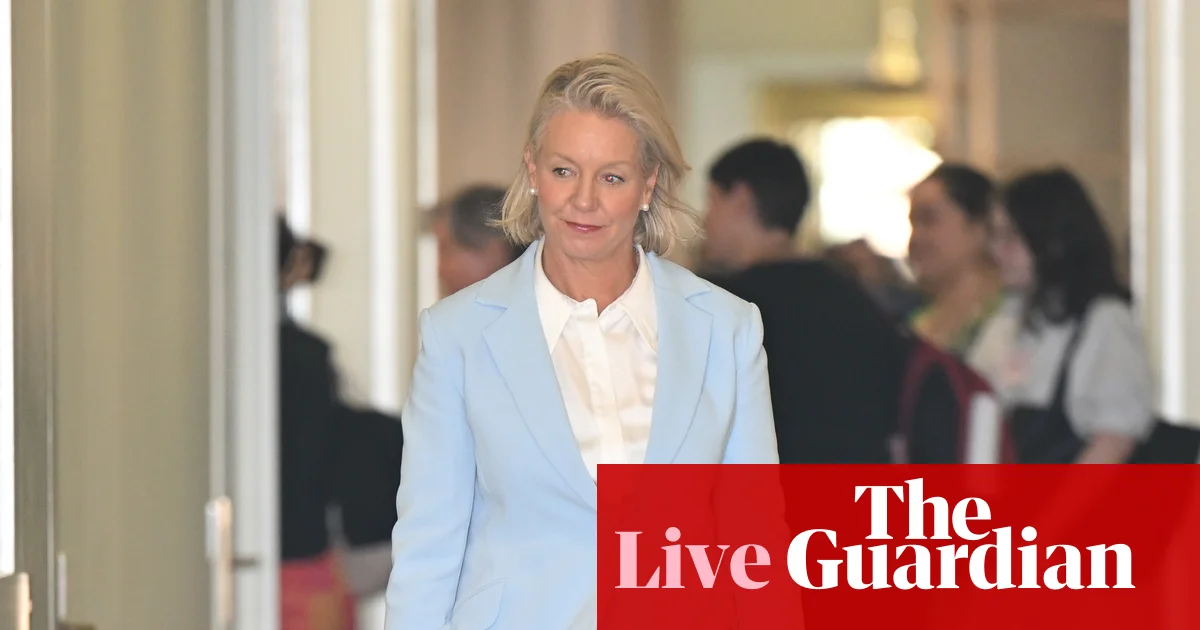
Paterson tells government to trigger Fuel Security Act for supply transparency
The Coalition is digging in, attacking the government’s response to the fuel crisis, and says Labor needs to do more to address the situation.
The government has said more fuel supplies are coming into the country now, and additional fuel is being released so it can be sent to regional areas, but hundreds of petrol bowsers across the country remain empty.
The shadow defence minister, James Paterson, says the government has the power to trigger the Fuel Security Act, which would allow the government to require fuel suppliers and companies to provide more detailed information on exactly where fuel is going and where there are shortages.
Speaking to Sky News, he said:
The energy minister has extraordinary powers in this area. They were passed by the previous government as Taylor was energy minister. It’s called the Fuel Security Act. It gives them visibility of the supply-and-demand issues across the economy, and great authority to lean on energy companies, fuel companies, distributors, wholesalers, intermediaries to make sure that supply gets to where it needs to go. So Chris Bowen is not rolling up his sleeves and getting on to that task.
While nations such as South Korea (as mentioned earlier) are putting in place voluntary measures for households, Paterson says any mandates like fuel rationing would be “terrible”.
I really, really hope we don’t get to that, and I hope the federal government is doing everything they can so that that is not necessary. That would be a terrible thing, that would have a devastating impact on our economy.

Key events
New bill to tackle illicit tobacco to be introduced today
The government will introduce a new bill in parliament today to crack down on illicit tobacco, creating new offences for illicit tobacco activity linked to organise crime, and expand powers for law enforcement to go after criminal profits generated from illicit tobacco.
Black market tobacco has become a significant problem for the government, not just due to the health impacts of smoking, but has burnt a hole in the budget bottom line.
Last year Australia’s crime agency warned illicit tobacco cost $3.3bn in lost tax revenue.
The government says black market tobacco seizures increased over 320% in the last financial year compared with four years ago.
The new legislation will also increase penalties for importing, possessing, buying, selling, producing and manufacturing illicit tobacco.
The assistant minister for customs, Julian Hill, said the issue isn’t isolated to Australia.
There is no one cause or single solution to tackle the illicit tobacco market. We need a multipronged and multi-jurisdictional approach to tackle the issue, including ongoing and enhanced collaboration with the states and territories.
Paterson tells government to trigger Fuel Security Act for supply transparency
The Coalition is digging in, attacking the government’s response to the fuel crisis, and says Labor needs to do more to address the situation.
The government has said more fuel supplies are coming into the country now, and additional fuel is being released so it can be sent to regional areas, but hundreds of petrol bowsers across the country remain empty.
The shadow defence minister, James Paterson, says the government has the power to trigger the Fuel Security Act, which would allow the government to require fuel suppliers and companies to provide more detailed information on exactly where fuel is going and where there are shortages.
Speaking to Sky News, he said:
The energy minister has extraordinary powers in this area. They were passed by the previous government as Taylor was energy minister. It’s called the Fuel Security Act. It gives them visibility of the supply-and-demand issues across the economy, and great authority to lean on energy companies, fuel companies, distributors, wholesalers, intermediaries to make sure that supply gets to where it needs to go. So Chris Bowen is not rolling up his sleeves and getting on to that task.
While nations such as South Korea (as mentioned earlier) are putting in place voluntary measures for households, Paterson says any mandates like fuel rationing would be “terrible”.
I really, really hope we don’t get to that, and I hope the federal government is doing everything they can so that that is not necessary. That would be a terrible thing, that would have a devastating impact on our economy.
Taylor tells government to direct fuel to empty petrol stations
Angus Taylor says the government needs to pick up the phone and get fuel companies to move fuel to areas facing shortages. It’s a similar direction to the Coalition’s line of questioning in question time yesterday afternoon.
Yesterday, the energy minister, Chris Bowen, told the house that 757m litres of petrol and diesel have now been released and moved into regional areas.
He also accuses the government and the prime minister of being “sold out”, but doesn’t clarify who they’ve been sold out to.
The fuel stocks are up. They’ve [the government] told us that. They said that yesterday, fuel stock levels are up. So move it to the sold out servos. There’s over 500 servos that haven’t got fuel. The fuel stocks are there, pick up the phone and tell the companies to move the stocks. It’s simple.
Host Sarah Abo tries to push back, and asks Taylor how that works when all states are facing a distribution problem. But he repeats that the government has said there’s more fuel stocks in the country now, so they should call the fuel companies and tell them to “move the stocks to the sold out servos”.
Once again, Abo pushes back and asks how this is a long-term solution for a crisis that will continue to impact the world for months to come.
Taylor doubles down and says the solution is continuing to move the fuel around, and reducing inflation.
The longer-term solution, clearly, is we’re going to see higher prices over the coming weeks and potentially many months, and we’ve got to keep the fuel moving … We have a budget coming up, and we need to see downward pressure on inflation.
‘We sit here without a plan’: Nationals senator
Nationals senator Bridget McKenzie says the government is playing a “blame game”, while countries around the world put in place emergency plans to tackle the fuel crisis.
On what solutions should be on the table, McKenzie says the trucking industry has been calling for GST relief, but doesn’t back a fuel excise cut because she says it hurts the whole transport industry.
Speaking to the Today show this morning, she said countries such as South Korea have been implementing a range of emergency measures for households.
You’ve got the federal and the state governments blame gaming, who’s in charge, and meanwhile, we sit here without a plan. We’ve got other countries right around the world instigating emergency provisions, prioritising their own citizens and their own nation’s needs … South Korea is implementing a plan. They’re also got rationing being implemented as well, and different countries are implementing different things.
A simple cut to fuel excise won’t help our transport industry at all, and that won’t stop that flow-on impact.

Krishani Dhanji
Good morning, Krishani Dhanji here with you, thanks to Martin Farrer for getting us started.
It’s the final sitting day of the fortnight, which will again be dominated by the fuel crisis and war in the Middle East, and the ongoing economic fallout.
And this morning might feel a little different with fewer talking heads in the corridors. With the ABC still on strike until 11am this morning, the mics and camera remain turned off and the pollies won’t be showing up for their regular interviews.
But despite all that, it’s going to be another busy day, so let’s get stuck in!
Farmers warn fuel crisis could lead to food shortage in Australia
Farmers’ leaders have told us that the Covid era will seem like a “tea party” compared with the economic problems that could be unleashed by the current fuel crisis.
Michael Hampson, boss of dairy farmer cooperative Norco, says the disruption could be so bad that “we won’t be worried about running out of toilet paper – we’ll be worried about not having food”.
Read the full story here:
Tropical Cyclone Narelle threatening Kimberley coast
In non-politics news, Tropical Cyclone Narelle has intensified once again and this time threatens Western Australia’s Kimberley coast after wreaking havoc across northern Queensland and the Northern Territory since last week.
Communities in the state’s world heritage-listed Shark Bay are preparing for a potential direct hit tomorrow night, and although Perth is likely to escape a direct hit, the city will see heavy rainfall, forecasters think.
Read our full story here:
Australia condemns Iran’s attacks on Gulf states
Australia has condemned Iran’s indiscriminate attacks on Gulf states and Jordan, joining with many other like-minded nations at an urgent debate at the United Nations.
The UN urgent debate focused on a resolution brought by a group of countries to discuss Iran’s “recent military aggression launched by Iran against Bahrain, Jordan, Kuwait, Oman, Qatar, Saudi Arabia and the United Arab Emirates” and the “targeting civilians and civilian infrastructure, which has resulted in the loss of innocent lives”.
In a statement last night read out by Australia’s ambassador to the UN, Clare Walsh, Australia said:
We reiterate our call for Iran and its proxies to cease all such attacks immediately. Australia stands in solidarity with members of the Gulf Cooperation Council and Jordan and affirms support for their sovereignty, security and territorial integrity, including by co-sponsoring their resolution, we recognise the profound impact that Iran’s actions are having on civilian populations in the region.
Australia continues to call on all parties to uphold international humanitarian law, to protect civilians, including humanitarian personnel.
The statement contained no mention of actions by the US or Iran.
Welcome
Good morning and welcome to our live politics blog. I’m Martin Farrer with the best of the overnight stories before Krishani Dhanji takes the wheel.
Australia has condemned Iran’s indiscriminate attacks on Gulf states and Jordan, joining with many other like-minded nations at an urgent debate at the United Nations. More details in a moment.
There is more gloom this morning about the worsening economic impact of the Iran war and how it threatens fuel shortages and higher food prices. We have more coming up, but we’ll also be across breaking economic news today which includes Reserve Bank assistant governor Christopher Kent speaking in Sydney this morning, which could include insights about how the crisis is being seen in Martin Place. The national accounts are released later in the morning and the OECD interim economic outlook is coming this evening.