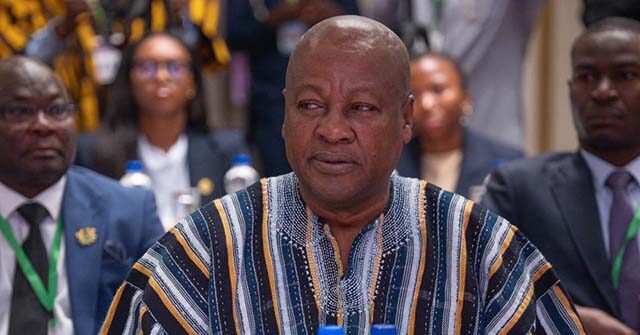
Speaking at an event on slavery reparations at the United Nations in New York on Tuesday, Ghanaian President John Dramani Mahama accused President Donald Trump of “slowly normalizing the erasure” of black history in America and inspiring other governments to do the same around the world.
Mahama was in New York to introduce a U.N. resolution that would recognize the trans-Atlantic slave trade as “the gravest crime in the history of humankind,” for which modern nations should pay reparations.
The Ghanaian president used his speech on Tuesday to accuse Trump of wiping out black history by cutting funds to cultural exhibits, especially those that feature “anti-American” themes. He also claimed Trump is removing black history from schools, forcing teachers to stop talking about slavery and segregation, and banning books about racism.
“These policies are becoming a template for other governments as well as some private institutions. At the very least, they are slowly normalising the erasure,” he said.
The White House responded by noting that President Trump enjoyed “historic support” from black voters in the 2024 election, and is “working around the clock to deliver for them and make our country greater than ever before.”
The U.N. General Assembly (UNGA) voted 123-3 to pass Mahama’s slavery resolution on Wednesday, with 52 abstentions. The countries that voted against the resolution were Argentina, Israel, and the United States, while the abstentions included most of Europe — the nations that would be expected to pay for “reparatory justice.”
“We are demanding compensation — and let us be clear, African leaders are not asking for money for themselves. We want justice for the victims and causes to be supported, educational and endowment funds, skills training funds,” Ghanaian Foreign Minister Samuel Okudzeto Ablakwa told the BBC before the U.N. vote was taken.
“Many generations continue to suffer the exclusion, the racism because of the transatlantic slave trade which has left millions separated from the continent and impoverished,” he added, addressing the common criticism that the reparations movement wants to take money from people who have never owned slaves, and give it to people who have never been enslaved.
In addition to demanding monetary compensation for slavery, Mahama demanded the immediate return of African art and artifacts from Western museums. Ablakwa seconded that demand to the BBC.
“We want a return of all those looted artefacts, which represent our heritage, our culture and our spiritual significance. All those artifacts looted for many centuries into the colonial era ought to be returned,” he said.