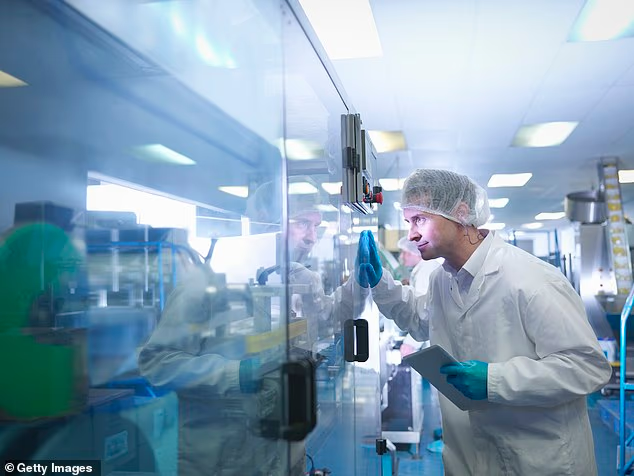
It’s a scene that could be taken straight from a horror film; hundreds of headless human torsos laid out on stainless steel tables, their smooth waxy skin glistening beneath harsh neon striplights.
But if a small group of scientists – and their billionaire backers – get their way, this could be the future of medical research, with laboratory animals replaced with living ‘organ sacks’ grown from anonymous human cells.
R3 Bio, a biotech start-up based in San Francisco, USA, is working towards engineering ‘complete organ systems’ to be used in the research and development of drugs.
The company’s main motivation is to reduce the amount of animal suffering that happens in medical and scientific research, but their vision has attracted the attention of several billionaire investors who see the potential of their invention in the lucrative world of longevity medicine.
One of the firm’s backers is Singapore-based investment fund Immortal Dragons.
Their CEO Boyang Wang said: ‘We think replacement is probably better than repair when it comes to treating diseases or regulating the aging process in the human body.
‘If we can create a non-sentient, headless bodyoid for a human being, that will be a great source of organs.’
However, one particular organ will be missing from R3’s ‘sacks’ – the brain.
R3 Bio has proposed creating ‘organ sacks’ to remove the need for animal models in research (file photo)
The most commonly cited reasons for humans not being used in laboratory experiments come down to ethics – but by leaving out the brain, R3 manage to entirely bypass this sticking point by ensuring that their creations neither feel pain nor have any form of consciousness.
But despite this, R3 co-founder Alice Gilman told Wired that she doesn’t like the organ sacks to be referred to as ‘brainless’.
She said: ‘It’s not missing anything, because we design it to only have the things we want.’
Gilman and R3’s other co-founder, John Schloendorn, claim that the company already has the technology to create mouse organ sacks but deny that they have – yet.
Once they’ve mastered headless mice, the next challenges would be to create monkey organ sacks, before progressing onto ‘bodyoids’ made from human cells.
The non-human primate sacks could be used for drug toxicity testing, and in the case of another pandemic, vaccine trials, sparing thousands of monkeys from a life spent in a laboratory cage.
Despite government legislation to move away from animal testing, figures from the 2024 financial year revealed that US research facilities reported using more than 60,000 nonhuman primates in experiments during that period.
The data, released by the Animal and Plant Health Inspection Service, part of the Department of Agriculture, said that more than 33,000 of those animals were not subjected to pain and nearly 26,000 experienced minimal pain.
However, more than 1,000 – about 1,200 – were subjected to extreme pain, or not given pain relief or anaesthetic due to the nature of the experiments they were used in.
Figures relating to how many animals were euthanised after experimentation are not collated.
In a previous blog post, Gilman explained one of the other major benefits of using ‘human biology platforms’ is that researchers can see how drugs affect the entire human body at once, rather than just one organ or cell group.
She wrote: ‘We need integrated, full-system human biology platforms.
‘That means human cell-based models that incorporate vasculature, immune components, and endocrine signalling.
‘Models that can metabolise drugs, develop inflammation, and respond systemically, not just in one tissue, but across many.
‘If we want to move beyond animal testing, we need to treat system-level modelling as national infrastructure.
That means funding it like a public good, validating it like a regulatory standard, and building it with the urgency of a moonshot.”
‘The human body is not a collection of parts, it’s a system. We can’t keep studying diseases in pieces and hoping the results will scale.
‘Whether we’re testing new drugs, mapping rare disorders, or training AI models, the biology we use needs to reflect the biology we live with.
‘Yes, this will be difficult. Yes, it will take time. But it’s the only scientifically and ethically defensible path to eliminating animal testing. Anything less is wishful thinking.’
While the monkey and human organ sacks are still theoretical rather than a reality, the R3 bosses told the magazine that they would most likely be created using a combination of stem-cell technology and gene editing.
Gilman said: ‘We have things that no one has invented before to create designer organs.’
Furthermore, the organs could save the lives of millions of people across the world who are waiting for a life-saving transplant.
In the UK, figures released in March 2025 revealed that there are 12,000 people in the UK on the waiting list for an organ transplant. In the US it is much higher, with an estimated 100,000 people waiting for a suitable donor organ to become available.
R3’s other big name backers are billionaire Tim Draper and UK-based LongGame Ventures.
Although R3’s proposed organ sacks will not be sentient, one bioethicist says that should organ sacks become a viable option, its success will rest on whether the public accepts the technology.
Hank Greely, a bioethicist at Stanford University said: ‘If you make a living entity without a brain at all, I think we’d be pretty comfortable with thinking it can’t feel pain.
‘I think the ‘yuck factor’ will be strong, but that depends in part on what any resulting things look like and how they behave.
‘It’s highly possible that none of this will ever work, but it’s also possible that it could.’