Listen to this article
Estimated 5 minutes
The audio version of this article is generated by AI-based technology. Mispronunciations can occur. We are working with our partners to continually review and improve the results.
In a way, the Office of the Parliamentary Budget Officer came full circle this week.
In February 2013, as the term of the first parliamentary budget officer neared an end, the Official Opposition put a motion before the House of Commons calling for the independence of the office to be reinforced and for the term of Kevin Page to be extended, at least until the government was ready to nominate a successor.
“We have seen the Conservatives engage in a consistent campaign of attacks on the credibility of Kevin Page,” the NDP’s Peggy Nash said at the time. “The Official Opposition is deeply concerned that the government will attempt to appoint a new PBO who is more lapdog than watchdog. That is not what Canadians need. We need a strong, independent parliamentary budget officer, not another person who talks government talking points.”
Though Stephen Harper’s Conservative government introduced the legislation that created the PBO, Conservatives had criticized Page’s work and questioned the way he went about it, while fighting with the office over its demands for information. With Page’s term set to expire, and the Harper government moving slowly to find a successor, there were fears about the future of the office.
But the parliamentary budget officer persisted. So much so that it is now the Conservatives, in Opposition, worrying loudly about a Liberal government’s selection of a new PBO.
“Now, they are FIRING the budget watchdog for revealing the TRUTH,” the Conservative Party told its supporters in an email this week. “We’re sounding the ALARM. The Liberals MUST reinstate the rightful budget watchdog.”
For the Conservatives, the “rightful” PBO — an adjective that lends a certain monarchical air to the office — is Jason Jacques, who served as the interim budget officer. Jacques made headlines last fall for his provocative comments about the government’s fiscal situation.
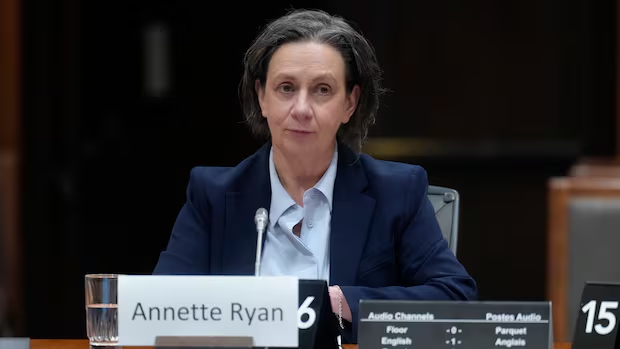
He has not actually been fired — in fact, he remains employed at the office of the PBO. But the government has nominated another person (Annette Ryan) to take on the job for the full seven-year term.
The Conservatives don’t seem to have any specific issues with Ryan, except insofar as she is not Jacques.
“This is not about the current nominee,” Conservative MP Sandra Cobena told reporters this week.
It’s very possible the Conservatives will forget about their concerns as soon as Ryan — who comes to the PBO with a long and impressive resumé — releases a report that is somehow unflattering to the government. It’s possible they only see the change at the PBO as an opportunity to stir up suspicion of the Carney government.
But ideally the appointment of an independent officer of Parliament — an office with an important role to play in both holding the government to account and informing public debate — would not be the subject of political conflict and partisan email campaigns.
Is there a better way to pick a PBO?
If there is a silver lining to the current conflict, it’s that all parties have now, at one time or another, expressed support for a strong and assertive PBO. Thirteen years ago, Conservatives seemed to think Page had been too assertive. Now they seem to view assertiveness as a badge of honour.
But maintaining the credibility of the institution is no small thing and any partisan conflict has the potential to leave lasting damage. For that reason, the latest episode might be cause to think about how the parliamentary budget officer is chosen.
During a debate on the standing orders of the House last month, Conservative MP Michael Chong argued that the government should not have the power to make key parliamentary appointments. And though the government doesn’t have the power to directly appoint the PBO — the House and Senate must vote to approve Ryan’s appointment — it is the government that interviews candidates and selects a nominee to put before Parliament.

With MPs set to cast their vote on the Liberal budget next week, the interim parliamentary budget officer is suggesting there’s a less than 10 per cent chance it will stay within its deficit targets. Opposition Leader Pierre Poilievre has criticized the government’s ‘phoney accounting.’
Last November, Conservative and Bloc Québécois members of the House committee on government operations passed a motion that asked the government to submit a shortlist of PBO candidates to the committee for vetting. The motion was not binding on the government and apparently the committee received no response.
By then, the Conservatives had already staked out a position on who should be the PBO — Conservative Leader Pierre Poilievre publicly called on the prime minister in September to appoint Jacques to a full term. Turning the matter over to the committee in November might not have done anything to depoliticize the situation.
But there might still be something to be said for turning over the full responsibility to Parliament. In Ontario, the legislature’s financial accountability officer is chosen by an all-party committee that is chaired by the Speaker. And the choice has to be unanimous.
Adopting a similar model for the PBO might not completely eliminate the possibility of conflict. But it would at least put Parliament in charge of what is a parliamentary officer.
Making such a change might make it harder in the future to send out urgent emails alleging that the government is trying to cover something up by “firing” the “rightful” PBO. But it still might be worth doing.