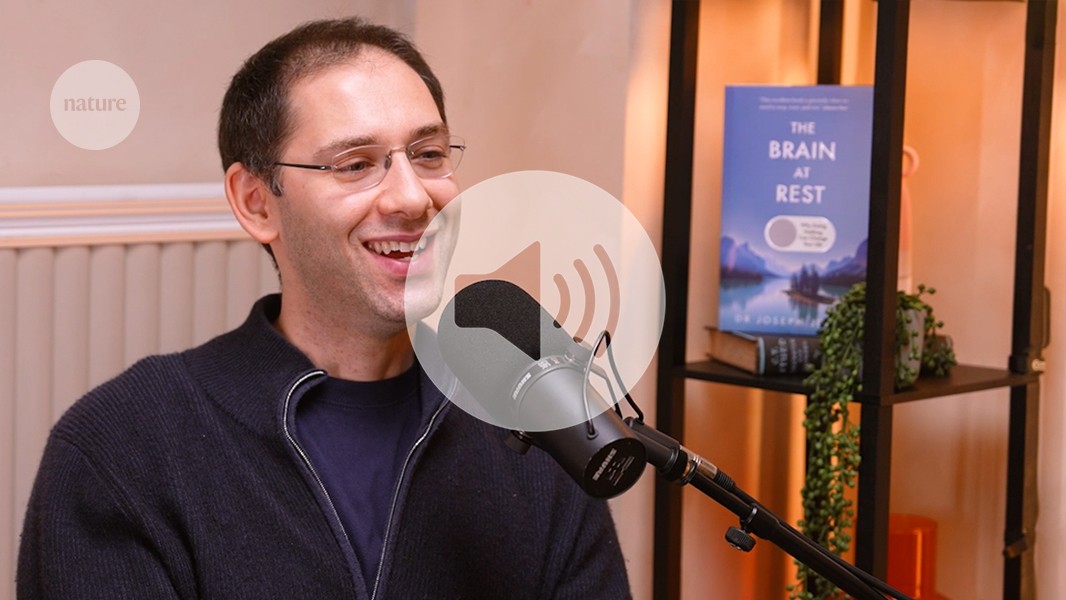
Holly Newson 00:00
Welcome to Working Scientist, a Nature Careers podcast. I’m Holly Newson, and in this series, you’ll hear from authors who can help you in your career.
In this episode, I am joined by Joseph Jebelli, a neuroscientist and the author of The Brain at Rest.
A book that examines what our brains do when we rest, why that rest is so important, and how we can practice different types of rest to improve our lives.
Joseph, thank you so much for joining me.
Joseph Jebelli 00:26
Hi Holly, thank you so much for having me.
Holly Newson 00:29
So, to kick off with, I wanted to ask, what is it about our brains that improves with rest?
Joseph Jebelli 00:34
So, so much. So, when we rest, when we have true rest for the brain.
And as I discuss in the book, that could be things like mind wandering, daydreaming, having 30-minute naps throughout the day, spending time just staring out into space, spending time in nature, in green space, and many other…there are many other ways to truly rest your brain.
You know, scrolling on your phone, I’m afraid to say, doesn’t count or binge-watching Netflix.
But we now know that when you rest your brain, your brain activates a network that we call the default network.
And that’s basically a network of neurons that fans out across your brain.
And the really extraordinary thing is that when you activate your default network with rest, and the crucial thing to say here is it only becomes active when you rest.
So it only becomes active when you step away from your work, when you step away from a cognitively-demanding task.
I mean, in neuroscience, it’s actually called the task-off network.
And when you activate that network with rest, we now know you improve your intelligence, creativity, memory, problem solving abilities, decision making abilities, abilities to predict the future, and like quite a lot more.
It even lowers your chance of developing diseases like dementia and depression.
And so, I mean, there’s just an extraordinary amount of benefits and cognitive abilities that are gained when you rest your brain.
Holly Newson 02:08
And you use the term work pandemic in the book.
Why is that a term that you think is is relevant, is useful?
Joseph Jebelli 02:16
Because when you when you dig into statistics, the picture of our working lives and the levels of burnout is really quite worrying.
While it’s true to say that working conditions today are better than they were in the past, that there’s no doubt about that.
When you actually look at the data, we are in a dramatic regression in terms of burnout and overwork.
So just to give you a few statistics.
So we now know that 750,000 people die every year of overwork.
And the important thing to say is that that is a 20% increase since the year 2000.
We know that three in five employees now have a lack of energy, motivation and really struggle with their work life balance. And that is a 29% increase since 2019.
So, you know, things are moving in the wrong direction. There’s a reason we hear a lot about burnout and overwork now.
And you know, it’s, it’s, it’s happening, you know, all over the world, but it’s particularly prevalent, you know, in America and here in England and in Europe.
It’s a little bit better in Europe because they have better regulations, like, you know, your boss isn’t allowed to bother you on the weekends.
But in Japan as well, they have a real, they have a big problem with it there.
They even have a word for working to death called ’karoshi’, which I talk about in the book.
And so, the reason I call it a pandemic is because, you know, when you when you look at the statistics, when you look at the data, when you look at all of the really negative health consequences that are coming from that.
And the fact that we are literally, you know, working ourselves to death, I think, you know, a lot of that comes from this, this kind of, I feel like it’s a fairly new phenomenon of the hustle mentality.
That it’s a kind of aspirational thing to be, right, that, you know, the working super hard, that it’s that it’s a really good thing for you.
And so that’s basically why I describe it as a pandemic, because it’s, you know, it’s everywhere, and it’s something that some people aren’t noticing, because they just think, well, this is just normal, I’m supposed to work really, really hard.
But actually, as I explained in the book, you know, rest is the real driver of, not only all of your most cherished cognitive abilities, but of your best work, and your long-term productivity.
So, our understanding of work and rest is completely upside down.
We, you know, we need to be resting a lot more in order to achieve good work.
Holly Newson 04:42
And you write about overwork as well as a condition. So what happens to the brain in that state.
Joseph Jebelli 04:47
So there’s two ways to look at it.
So neurologically, we know now that overwork actually thins the frontal cortex in the same way that ageing does.
So it literally makes the brain older than it is.
And it does that by basically attacking the dendrites of your neurons.
So these are just the fine branch, like, branch like projections that come off of the neurons, and they connect with other neurons in the brain, and those that basically allows you to think and to speak and to feel and to experience everything that your brain, your brain does.
And those start to basically wither away.
And the problem with that is that once your dendrites wither away, they’re incredibly hard to regrow, to come back.
And so we also know that overwork actually, it shrinks the hippocampus, which is a region really important for memory, in particular short-term memory. It’s one of the first regions attacked by Alzheimer’s disease.
And it also strangely enlarges the amygdala. And so this is an almond shaped structure deep in the brain that’s really important for your fight-or-flight response.
And that, that explains a great deal as to why overworked people feel very anxious and on edge, and that something’s wrong.
And there’s an a lot, there’s always, always alarm bells ringing in their head.
It’s because that their amygdala is enlarged, you know, they’re suffering with their their short term memory that because they have, you know, the hippocampus is isn’t performing as it should.
And so, those are the kind of neurological stages of it.
And then psychologically, there’s also a group of stages where overwork basically starts as this kind of feeling of dissatisfaction.
And we’re all familiar with this. You know, you’re you’re overworking, you’re dissatisfied, but it’s like a manageable feeling, so you just deal with it.
That then moves into cynicism, where you just don’t care, right?
You sort of adopt the, you know, that really painful British thing, of like, I’m not going to talk about my emotions, just step up a lip and just get on with it.
But then that then moves into dehumanization, where you have a kind of complete emotional hardening, and that’s when you develop a real detachment from your colleagues, and you kind of develop a sense of, often incompetence and guilt and a sense of dread.
And that then shifts into feelings of anxiety and depression.
And the really interesting thing is that that stage, they’ve done these really interesting longitudinal studies in Sweden, where they found that once you get to that stage, it can actually, actually take your brain up to three years to recover.
It can take three years for your brain to recover, to come back to the baseline ability to perform certain cognitive tests well.
So you know, we are arguably in our work-obsessed culture, somewhere along that three-year trajectory.
And so I’m trying to get people to move back the other way by by appreciating what rest is for the brain. And that we need to take it a lot more seriously.
Holly Newson 07:38
And why is the topic so important to you personally?
Joseph Jebelli 07:42
So a couple of reasons, really.
So, I mean, I grew up in a household of like chronic over-workers.
So both my mum and dad worked incredibly hard.
And my dad actually experienced burnout as a result of overwork. And he now suffers with quite bad depression.
And my mum, her work ethic is actually even more extreme than my father’s.
And she now lives with a blood pressure that’s so high in like, like, in medical jargon is, it’s basically, she, it’s like a hypertensive emergency.
They’ve said, like, it’s, it’s so high the GP contacts her almost every day to ask for a blood pressure reading. Wow, because they’re like, this is just this, shouldn’t, you know, we’re surprised or even standing and so, you know, and I’ve tried to speak to them about it.
And you know, my father stopped working now. But my mother still works, and she still works really, really hard.
And it’s, I think, growing up, I sort of that seemed normal to me.
And so then, you know, I’ve always been a very hard worker myself.
And then I realized at one point, though, when I was, I was basically, I was doing my postdoc in Seattle, in the States.
And, I mean, I was, I was working, I was, I was working way too hard.
I was basically, you know, I’d be in the lab, like all day long, doing experiments, you know, mentoring students and writing papers and things.
And then I would, I had this attitude of, I just need to, like, outwork everyone around me, right?
And so I would like, I would always stay quite late.
So I would like, you know, I would do my experiments and write my papers up until like, six or seven o’clock.
And then I would leave, and then I would go straight to a coffee shop and work on my first book until about 10 or 11 o’clock at night.
And at the time, I kind of enjoyed it, because I thought I really liked the fact that Seattle had this coffee culture in which you could just go to a coffee shop until, like, midnight if you wanted to.
And so I thought, oh, this is brilliant you know, I can just carry on working.
But then I realized, as I was doing that, you know, after a few months, I really was starting to suffer.
My memory was suffering. I was a lot more anxious.
And my ability to actually perform well, you know, in the laboratory, that started to take a hit.
And I just thought I, you know, I can’t keep this pace up indefinitely, like, something has to give.
And so seeing the, like, the ill health consequences of my family, and realizing that actually I’m starting to go down this trajectory myself, I realized something has to give.
So I basically, I basically eased up a bit.
And, and it was really interesting, because as soon as I started doing that, so I didn’t stay, didn’t stay in the lab really late, you know, didn’t always go and work on my book.
I just spent a lot more time resting.
And the really interesting thing was things like my memory and my problem-solving abilities, my ability to write more fluidly, that all got much better.
And it wasn’t just to begin with. I thought, I was thinking, you know, what is this?
Am I getting more sleep? But I was getting the same amount of sleep.
So even though sleep’s really important for the resting brain, it was the fact that I was, I was just resting more throughout the day.
I was taking more breaks. I just, you know, I was lifting the pressure off.
And so I saw this is really interesting, like, what is it? What is actually going on in the brain that’s allowing me to think more clearly?
And that’s when I discovered the, you know, that there’s this really interesting new science about the default network and all of the amazing things that it does.
And I was thinking, ah, well, why are we talking about this more?
Holly Newson 11:11
And so the brain at rest, when you’re daydreaming, something that a lot of us have, you know, through school years, been told it’s a terrible thing to do, when we’re mind-wandering, the term that you use in the book.
Why is the brain better then at you know, coming up with new ideas?
And how could, for instance, that help a scientist when maybe there’s a problem they’ve just been trying to solve and, you know, they’ve not quite got it?
Joseph Jebelli 11:29
That’s a really good question, because we still don’t have, like, the complete answer for that.
But a lot of the evidence shows that actually, mind-wandering or daydreaming is really important for creativity.
And so, I mean, there are these really interesting studies that show that not only does mind wandering boost your creativity.
But even when you do it too much, so even when you like, even when you’re mind-wandering to the point where it hinders your ability on the task you’re currently doing, so your head is just in the clouds for a bit too long, that still ramps up your overall creativity.
As to why that’s happening, there are a bunch of really interesting theories.
One is that, basically mind wandering is kind of like a mental filtering process, that basically your brain is kind of sifting through all these different thoughts.
It’s looking at the task in front of you, the work task that you’re doing. And it’s thinking, you know, is this worth it for me?
And that if the answer to that is no, then your brain is basically activating this mental filtering process of mind-wandering.
And it’s allowing you just to think of all these different things to try to, basically to try and seek out something that’s more cognitively worthwhile, right?
And then, you know, there are other theories that, you know, there’s really interesting research showing that basically it helps with things like autophagy, which your brain cells ability to sort of clean themselves and to, like, rejuvenate themselves.
And so there’s this really interesting theory called the Fresh Start Theory, where it basically allows you to see problems with fresh eyes.
And there’s (because there’s because there’s a really interesting experiment in relation to this), where if you just repeat a word over and over and over again, you keep doing eventually your brain starts to lose the meaning of the word.
It’s called semantic satiation.
And if you start mind-wandering at the point where you’ve lost the ability to think about what the word means, often that will then snap back into place.
So it’s your, you know, so some people think it’s your, it’s your brain’s ability to basically just look at problems with fresh eyes.
And I think it’s no coincidence that we often are mind-wandering when we’re at our desks working really hard.
And then suddenly we just stare out the window and our mind starts to drift off.
It’s your brain’s way of saying, actually, you know, I’m a bit tired, you know, I’m not being as creative as I could be.
I need to, like, I need to find all of these connections and different thoughts.
You know, I’m going to sort of step away from this task and take you to this other realm.
But as you say, we’ve been, it’s been drummed into us since childhood, that that’s a bad thing to do, that you know, that you shouldn’t be staring out the window and daydreaming.
And that you should just be snapped back to attention, but actually, that’s the thing that’s allowing your brain to be creative in the first place.
Holly Newson 14:09
Yeah, I feel strange about admitting this, given the context, but I was someone who, as a kid, was always really proud that I stayed on focus, I stayed on task, you know, like, I wasn’t daydreaming, and now I’m like,
Oh no. Why was I so committed to, staying on task? What a disaster!
Joseph Jebelli 14:30
Yeah? I mean, no, I was the same, you know, they were very strict at school. yeah?
Just like, what are you doing?
Staring out the window, I realized basically a lot of the stuff that you were told not to do as a child you should be doing, yeah?
You know, just, even just even just random acts of spontaneous play, which I talk about in the book, like, you know, climbing a tree or just goofing around.
You know, that’s really good for your brain.
Holly Newson 14:49
Yes, let’s talk about play then.
So what type of play is, good for the brain?
Like, what you know, what different things you know, like, you say, like climbing a tree.
And is that something that has to be completely separate from work?
For example, I don’t know, is there something as part of lab work you can do that feels a bit more playful, that you could try and kind of integrate that into work, or just, yeah, does it need to be separate?
Joseph Jebelli 15:13
So, no, I don’t think it needs to be completely separate.
And I would actually, I actually think it’s quite healthy to try and incorporate that into work.
Because the thing about play is, like, when you break down what play is, it’s, it’s, by definition, it’s, you know, it’s unstructured, it’s imaginative, you know, it’s crucially, it’s task-off, right?
And there are lots of different types of play, like, just sort of goofing around, light hearted play, and then there’s sort of, like, game related play, more sort of whimsical types of play.
And, like, lots of psychologists and cognitive neuroscientists have, like, created all these different categories of play.
But we know that it has a really profound effect on the brain’s ability to essentially reorganize itself.
It boosts the brain’s neuroplasticity.
So that’s the brain’s ability to basically change itself, restructure itself, rewire itself in response to like, new environments.
It’s really important for learning, for instance. It’s also really important to help compensate for injury.
So, you know, there’s all these really interesting studies of people who, you know, they they’ve had a stroke, or they’ve had some sort of developmental disorder, which means a part of their brain is missing.
And often the brain will actually compensate by that, by using neuroplasticity, rewiring itself, and taking on the tasks of those lost regions.
So you know, our brain’s ability to have good, strong, healthy neuroplasticity is really important.
And so, as well as boosting neuroplasticity, it’s really good for our attention.
And, like just basically restores our attentional resources, and it’s just good for deep learning.
I mean, there’s just the list of benefits for the brain to do with play and it is like this long.
And so, I would say, you know, in the book, I have a chapter about play and finding micro-moments of play throughout the day.
But as you say, I think it is important to bring that into work. Most importantly, because, as you say, when we’re at work, it’s very rigid. It’s very structured.
We’re not using our default network.
We’re just in task mode, using our brains, executive network, our work, working network.
And because it’s hard to find, you know, all of the moments of rest throughout the day that we really need to have a healthy brain, bringing that into work is really important.
And however, that can be like in a lab.
I mean, you know, when I was in the lab, I was always sort of like goofing around with, like my lab mates and stuff.
And I’m sure that that helped us with our experiments, just because you’re in a better mood as well, right.
So whatever type of work you’re doing, if you can make it more playful while still being able to do the work.
And I think most people, when if you say to them, you know, you will still be able to do your job, but make it a bit more playful, they’d be like, oh, hell yeah, that’s like, loads of things I could do to liven up the day and just to take things a bit less seriously.
Ironically, paradoxically, then they’ll do their best work, because they just feel a lot more rested.
Again, the message I’m that, I hope I’ve conveyed in the book, is that work and rest are not in opposition with each other.
That’s the, that’s, that’s what we’ve been taught.
That’s what so many people think.
That when you’re not working and when you’re resting, your brain is essentially like a muscle, and now it’s powering down and it’s not doing anything, when actually the precise opposite is happening.
It’s powering up.
So that’s why, when you’re when you’re at work, incorporating those elements of rest and play, your brain’s doing a lot more work for you by doing that.
Yeah, so, I think that that’s, that’s the false dichotomy that I’m trying to, like, dispel, essentially.
Holly Newson 18:38
And you even say that video games are a good type of play, which, you know, again, debunk something that people think, that lot of people think that that might be a waste of time.
And that different types of video game do slightly different things.
So I wondered, is there a type of video game that you might prescribe to a scientist?
Joseph Jebelli 18:58
Yeah, that’s a good question. It’s interesting.
So I, I mean, so I used to play video games more than I do now. I have like, a little DS, like a little console, and I play, like a bit of Mario Kart, online, Mario Kart stuff, like, like, Zombie Shooter.
It’s interesting because, as you say, there is this really interesting neuroscience that shows that it is actually quite good for your brain. But the key is moderation.
So the general guidelines say that you should, you should play between, like, no more than one to two hours.
I actually think that two hours is pushing it, to be honest.
When you look at some of the other studies, I think, I think it’s probably more healthy to say, like, maybe, like 45 minutes to an hour.
And it’s interesting because, I mean, one of my favorite studies is where they looked at people who played Super Mario Bros for like, half an hour a day for two months.
And they found that parts of their brain to do with, like spatial memory, navigation, planning, were bigger, basically because they were just working that part of working out that part of the brain a lot more than the people who weren’t.
And, you know, often They help through things like imagination and introspection as well, because it’s you know, you are, you’re, you’re often a character.
It’s you know, it’s so many of those same kind of imaginative default network regions of the brain that are active when you just rest can become active.
But again, moderation is crucial, because at the end of the day it is still a screen, right?
You’re still getting lots of artificial light, and as I talk about the book, you know, that’s generally not good for the brain.
So you don’t want too much of it, but just a small amount can be really good for the brain.
In terms of what type of games, yeah, I don’t know.
I mean, I mean, like they have looked at things like puzzle games, for instance, can be really, obviously, really good for your, you know, for your ability to think and to solve problems and decision-making.
And then things like, things like first person sort of world building games where you have to navigate a complex world, that seems to unsurprisingly be good for your spatial navigation, your spatial memory.
So depending on what cognitive task the game is encouraging you to do, that will help that particular cognitive task in your brain.
It will help your brain. You know, the circuits responsible for that, that cognitive task will be, you know, I don’t like the word exercise, because the brain is not really like a muscle, but, you know, exercise essentially.
So, yeah, I don’t know.
I mean, when I was younger, I got into, like, Grand Theft Auto, and there’s a new Grand Theft Auto coming up next year, which, which I am very tempted to get a console just to play that.
Even though I haven’t had one for like, nearly 20 years now.
Holly Newson 21:33
If it’s on PlayStation, you can just come over and play at ours. That’s fine.
Joseph Jebelli 21:36
Oh really?
Okay yeah I might take you up on that. Cause I think if my wife sees me just like in front of GTA VI she’ll be like, I think you’re taking the gaming gig of your brain a bit to seriously. But again, it’s just, you know, moderation.
Holly Newson 21:48
Yeah. And the phrase a change is as good as a rest. Is that true?
Any backing to that?
Joseph Jebelli 21:55
I suppose it depends what the change is, right?
If it’s a change of, like, working style, then no?
Well, I mean, novelty is really good for the brain. There is a lot of scientific truth behind variety being the spice of life.
So new experiences, anything novel for that, is going to be good for the brain.
It’s again that comes back to that new that neuroplasticity.
It’s helping to feed that because the brain is suddenly confronted with something completely different. It takes it out of its normal routine. It’s thinking, ah, this is interesting.
I’m going to form new connections in response to this.
And, you know, I talk a bit about a bit in the book as well, about stimulating neuroplasticity by, you know, take a slightly different route to work one day, you know.
Or spend some time just looking at the trees on your street before you go to work.
So those are all changes in behavior which are really good for your brain.
So, yeah, I think there’s a lot of truth to that.
As long as it’s not change, you know, you know, change in order to work harder or change your like style of work, so that you’re still basically working and not resting.
Holly Newson 23:05
Yeah, that makes sense.
And you mentioned sleep earlier, and how that is important for the brain.
So how and why, should we integrate napping into our work day?
Joseph Jebelli 23:15
Well, napping is really good for your brain.
It’s much better for your brain than we previously thought.
So this really interesting study done by Victoria Garfield at UCL found that people who have a 30-minute nap every day literally have bigger brains than people who don’t.
And there’s and the difference is really quite significant. It’s 15 cubic centimeters.
And to put that into context, it’s basically the volume of a small plum.
So it’s a lot, and when you think about the number of neurons and synapses and cognitive ability that’s contained in that volume, I mean, it’s going to be millions of neurons, you know, if not a lot more.
And so, you know, they also found in that study that it actually slows brain ageing by up to six years.
And so that’s going to have a really beneficial effect for you. Like your brain reserve, your cognitive reserve, for instance, which is your brain’s ability to basically shield itself from dementia and other neurological disorders that you might get as you, as you age.
So that there is this staggeringly profound impact on brain health that naps have.
In terms of exactly how they do that the mechanisms are still kind of unclear, which is like usually the case with a lot of this science,
But we think it’s to do with essentially the brain’s ability to clean itself when you sleep. Because when you sleep generally just not, not, not just as an app, when you just have your regular nighttime sleep, the brain basically uses a vat of cerebral spinal fluid deep inside the brain, and it washes over your brain.
Basically gives your brain a sort of, like a rinse cycle overnight, and that essentially clears away a lot of this sticky, toxic proteins that build up during the day.
So you know, when you’re in your everyday life, you’re dealing with stress, you’re dealing with work, you get lots of misfolded proteins.
And they build up, and over time, they could that can lead to things like Alzheimer’s disease and lots of other neurodegenerative diseases as well, like Parkinson’s, for instance.
A lot of those kind of disorders are actually misfolded protein disorders.
And so it’s really important for your for your brain’s ability to clear that away.
That’s why, if you don’t get a good night’s sleep every night, you’re, you know you are that those things are building up and putting you at higher risk of neurodegenerative diseases in the future.
So we think that napping also has that effect.
That basically, you know, it’s just giving your brain an extra bit in the day to clear away some of the sticky proteins.
And you know, that somehow is also leading helping with neurogenesis and synaptogenesis.
So your brain’s ability to grow new brain cells, to grow new neurons.
But it’s, I mean, it’s really interesting. I mean, it’s, you know, I think a lot of it will is, no doubt, to do with the fact that you’re just easing off a bit more, you know.
You’re just giving your brain, your brain, that breathing space to, actually, you know, to flourish essentially, that you’re not suffocating it with stress and overwork.
One of the fascinating things about it as well is that some of us are genetic nappers, and some of us are genetic non nappers.
And so what I mean by that is some of us have the genetic profile which makes us much more predisposed to have that 30 minute nap, (which is brilliant), and then some of us don’t.
But even with the genetic non nappers, if you have that 30 minute nap, you will reap the same cognitive brain benefit.
Holly Newson 26:24
Is it just harder to have it?
Isn’t it, is it harder to get to sleep?
Joseph Jebelli 26:29
Well, it’s not harder to get to sleep, but it can be maybe it’s you’re not as predisposed towards having the nap.
Now it doesn’t mean that you know that there are no doubt loads of people out there who have a 30-minute nap, will have a nap during the day, who are, who aren’t genetic nappers.
They just, they just, you know, they just, they just enjoy having the naps.
And I haven’t, I haven’t sequenced my genome to find out if I am a genetic or non-genetic, uh, napper.
But I’ve, I’ve now, still, I’ve now tried to incorporate a 30 minute nap into the day, like after, you know, meeting Victoria Garfield and speaking about, talking to her about that research.
Holly Newson 27:01
And how do you do that? How can someone in a science career, integrate a nap into their day? Is that something that’s actually feasible for people?
Joseph Jebelli 27:11
When I speak to people about that, some people say, Well, I could, I could incorporate it into my lunch break.
You know, they say things like, I’ve got an hour lunch break I could incorporate it into that.
My response to that is that okay, that’s if you can do that, if you can take like, half of your lunch break to have a nap, that’s great.
But I sort of baulk at that, because that’s your lunch break.
That’s your like, hour, hour and a half, whatever time off. You shouldn’t need to do it then.
I would want people to do it outside of that, basically, within their chunk of work time.
Yeah, and I understand why people say that that is slightly unrealistic for them. And that’s like a cultural problem.
I mean, if it were up to me, there will be a napping room in all laboratories.
There will be a napping room here, like every, every work space would have somewhere where you could go and not just rest, but have a nap if you wanted to.
So, that’s a that’s a wider cultural problem that I think will take time to, to have a solution for.
But I would just say to people that you know, obviously you know, you’re in a job, it’s unrealistic for you to do that at the moment. But just to think about it and to try and incorporate it however you can.
You know, if you’re working from home, for instance, and you know you’ve got a certain amount of work that you need to get to your boss at a certain amount of time.
Just still try and weave in that 30-minute nap.
Because, as I say, it’s going to make you more productive, it’s going to make you better at your work.
The work you give to your boss is going to be of higher quality.
So it’s not, you know, you have, we have to get it out of our heads that we’re switching off, that we’re shirking, that we’re being irresponsible or reckless, or, you know, all of those things, and that we’re not skiving when we do that.
We’re actually helping our brains produce our best work.
Because also, when you like, I mean, when you think, a half an hour is not that long.
And so many people because of, you know, presentism and all of these, like, just, like, like, dysfunctional, like, mindsets think that I just need to spend hours and hours and hours at my desk.
It’s, I mean, it’s just ridiculous.
I mean, I did that. I’d stay in the lab really late and I’d be like, Well, I’m not….
Holly Newson 29:42
Do you think it helped you?
Like, do you think that within our cultural society, the fact that people could see you were working really hard, and, you know, and you probably, even if maybe, like, you say your brain wasn’t at its best, but you probably weren’t getting through a lot of things.
Do you think it, do you think that helped you?
Joseph Jebelli 29:40
It, the only thing I can think that it helped with, which I now think it’s just really not worth it is that, you know, I think to begin with, it looked good, right?
Because people can see, oh, he’s staying really late, he’s so committed and so dedicated.
So to begin with, I think there’s that sort of, there’s that slight allure and like, wow, like, oh God, you know he’s, he’s just, he’s so tenacious, look at him he’s just going for it.
But the problem is, I was achieving less than I was when I was resting more.
So, and I think it always comes down to what is your actual output.
And so, you know, someone can stay really, really late and they’re not producing as much as someone, they’re not going to produce as much, or the work is not going to be as good as someone who isn’t staying so late and is actually taking their rest more seriously.
And so superficially it looks good, it looks like that person’s achieving a lot, but actually the work output is not as good.
So, I don’t know if it really, I think it helped me in my mindset at the time, because I was still in that old-fashioned mindset of thinking.
And again, this, this was basically drummed into me since my childhood, because my parents would always work really hard, work really long hours.
You know, they took, they took hardly any holidays, they would be working weekends.
I think, you know, you know, many people have that same mentality so I saw my parents doing that like many people have, and I thought, No, I just I stay late. That’s that’s what I need to do.
But as I said, I wasn’t, I wasn’t producing as much, and my work did, did take a hit as a result of that.
I think I talk in the book at one point about this really interesting study on management consultants, where they looked at people who, who worked 80 hours a week versus people who just pretended to.
And they found that the people who just pretended to actually produced more work.
And it was a higher quality than the people who worked 80 hours a week.
So again, that comes back to this idea of those people are just sitting at their desks for a very, very long period of time not actually doing that much.
You need more time just to be allowed to stare out the window in space, because that’s really good for your default network and your resting brain.
You need time to basically just go for a walk and have a wander. And then just, you know, do do that, and then have a period of time when you’re just going to have deep work, deep focused work.
And to basically to organize your life with that kind of intentional resting mindset.
Because one of the big things that’s going to do is is remove that productivity guilt that many of us have.
We all suffer from productivity guilt, which is the guilt in which you you equate your, basically, your value and worth as a human being, with your output, with how many hours you’re in the office or, you know, in the lab or at work, often with your economic output as well, you know.
And it’s and so you just think, well, I’ve just just got to work harder and harder to max those things out.
And then you just feel guilty when it’s not happening.
Well, it’s not happening because you’re overworking, yeah, and you’re not resting enough.
So I think if people can understand that, you know, when you’re at your desk and you’re distracted and you’re procrastinating, that’s, that’s a sign that you’re you just need to rest more.
So just in that moment, stare out of the window for a bit, guilt free, go for a walk, try and get a 30 minute nap in.
Just step away from your desk and come back to it after your you know when you’ve actually had some time to rest.
Holly Newson 32:48
Yeah, and you mentioned sort of the going for a walk there.
So how does being indoors disadvantage our brain and bodies, versus being outdoors in nature?
Joseph Jebelli 33:58
The cognitive benefits of being outside are just so enormous that, I mean, a walk inside is still going to be good for you, because you’re going for a walk, and when you walk your your skeletal muscles actually secrete these molecules called myokines, which we basically, which have basically been dubbed hope molecules, because they’re one of the few molecules that they actually cross the blood brain barrier and act as an antidepressant.
And that’s why, when you go for a walk, you often feel a bit better about whatever might be troubling you.
But, so it’s still going to be good, if you if you’re just in an office and you can’t get out. Just go for a walk in the office.
That’s still good for you.
But the effects of green space and nature are just so profound.
So we know, for instance, that now that when you’re in a green space, your creativity. And problem solving abilities are increased by 50%. Your memory recall improves by 20%.
Now, we think that’s because a number of things are happening.
To begin with, nature is basically full of what psychologists call soft fascinations, so these are things that hold your attention in a very effortless way.
So there’s a reason, when you’re in a forest and you’re just listening to the rustling of the leaves, or you’re on a beach and you’re just looking at the blue lapping waves.
That holds your attention in a very effortless way, much more effortlessly than you know, being in a train station and looking at an LED billboard, or being on your computer.
And what that seems to do to the brain is it changes, it changes, basically, the electrophysiology of the brain.
It shifts our brain waves from very busy and anxious beta waves to much more calming, relaxing and meditative, like theta waves.
And so it’s having a deep, like neuro- electrophysiological impact on the brain.
And it’s also boosting things like your immune system as well, which is really good for the brain.
So when you’re in, when you’re in a green space, you breathe in these things called phytoncides, and these are basically natural oils that protect trees from bacteria.
But we actually breathe them in, and they have a really profound effect on our immune system.
So there’s been a bunch of studies looking at people who spend time in nature versus time just in an urban environment.
And they find that people who spend much more time in nature and who are exposed to phytoncides, their immune system can be boosted by as much as 40% and that can last a month, even after just like a day or two’s camping for instance.
So really profound effects, just on an immune function level as well for your brain.
And so it’s something that we, we just, we don’t really take seriously enough, because I think, you know, we’ve evolved to be in nature.
Our brains have evolved to be, you know, in the open, in the forests, not just locked in an office.
And so that’s why you’re not really going to get the same benefits as you are if you’re just inside.
But at the same time, if you can fill whatever space you’re working working with plants or greenery, that will, that will have a big impact as well, not just neurologically, but also psychologically. Like, people feel much better when there’s lots of greenery around them.
Holly Newson 36:05
And so in your own life, how has applying all this research and all these learnings changed how you work and live?
Joseph Jebelli 36:15
So I’m much more intentional about rest now.
I take a lot more breaks throughout the day.
I’m a big fan of the pomodoro technique, for instance, which is 25 minutes of work, five minutes break.
And, I basically have the attitude now of you know, I set myself a daily goal, and I achieve that goal.
So I will work, I will work now solidly for like five, six hours a day.
But I’ll achieve the goal I was meant to achieve. Whereas before I was working eight to 10 hours a day, either achieving the same amount, if not usually, it was a lot less. Because I was just exhausted. And I just I’m more intentional about activating my default network.
So, I will stare out of the window and just mind-wander for a while.
I will try and get that 30-minute nap in.
I will go for walks as well, because that just really helps with my mental health, my mental health and ability to deal with my anxiety and things like that.
And it’s just, it’s just being a lot more intentional about it. And being intentional about it in a guilt-free way.
And, you know, I have, I’ve noticed things like so like the incubation effect, for instance, which that’s, that’s this phenomenon, when you know you’re working on a problem, you can’t figure it out, you step away from it, and it just pops into your head.
So that’s, that’s, again, that’s your default network, busily solving the problem.
So that’s now much, much healthier in me.
So when I go for a walk, if I just, you know, forget the problem I’m thinking about, I’ll go for a walk and it will suddenly pop into my head.
So, more and more I’m trying to incorporate restful moments into my day.
And I just, I just, I feel better.
Like I sleep better, my memory is better, I feel like my ability to communicate is better than it was.
And it’s just because I’m more rested.
But I’m still, I’m still working very hard, you know, I’ve just published this book.
I’m about to start working on another one.
But just in a much, much more balanced way.
And so, you know, when you when you actually look at the science of rest and the default network, you come to realize that there’s just no need to feel guilty about spending a lot more time throughout the day resting.
And so, you know (which) I know it’s hard, even I have to remind myself every now and again, Joe, it’s fine, you’re not shirking, you’re resting, because then you’re going back to your work to be better at your work.
And so I think it’s so I have, I have more rest throughout my days now.
But I also just have a different mindset towards rest and work.
Holly Newson 38:38
Well, I mean, I actually listened to the book, and the audiobook is absolutely fantastic, and just the takeaways from it helped me get over a cold.
Actually let myself rest for the first time in, like, forever.
Whenever I’ve had a cold, I’ve just powered through.
And I’ve had a lot of different work on at the moment. And it has given me the permission to take time away.
So from a personal perspective, thank you very much.
But from a general’s perspective, I also just think it’s such an interesting book.
So thank you.
Joseph Jebelli 39:07
Thank you.
That’s wonderful to hear. Thank you.