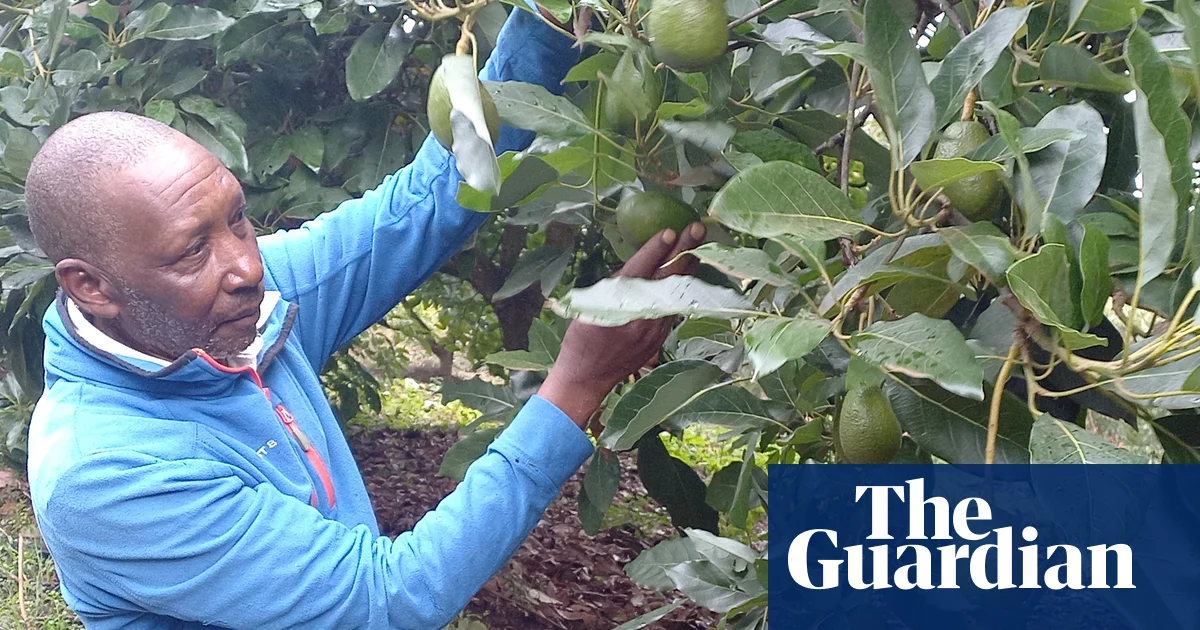
When in 2017 David Nyoro became one of the first farmers to partner with Africa’s first water fund to conserve the watershed of Kenya’s biggest river, he received 180 high-value avocado seedlings. The 67-year-old’s farming methods had been dominated by annual crops that left large sections of his five-acre piece of land bare, increasing soil erosion and contributing to river sedimentation. “We used to lose a lot of topsoil to the river. Such loss of soil nutrients and poor farming practices meant we had less farm produce,” he says.
The avocado seedlings enabled him to grow his farm income to close to 2m Kenyan shillings (about £11,500 at today’s exchange rates), with each mature avocado tree yielding 70kg (154lbs) annually. He introduced cover crops to improve soil health and reduce soil erosion and sediment loads.
“Improving farming methods and conserving the watershed has helped me to feed and educate my six children, while those in Nairobi and others downstream can enjoy more clean water from these rivers,” he says.
A decade of protecting the Tana River is securing the water supply to the capital by delivering more than 27m litres (5.9m gallons) of additional dry-season water daily, say the developers of the Upper Tana-Nairobi water fund trust.
The fund has also achieved a 41% decline in turbidity (cloudiness, indicating water quality), saving urban authorities £900,000 in water-treatment costs and demonstrating how nature-based solutions can safeguard urban water systems against climate variability.
The water fund was created in 2015 in a process spearheaded by the Nature Conservancy (TNC) to help secure the Tana by reducing sediments flowing into key tributaries and restoring degraded landscapes in the watershed region. The river is the source of 95% of water for Nairobi’s 4.8 million residents and another 5 million people living in the basin, while several cascading dams along the river contribute more than 50% of Kenya’s hydroelectric capacity.
More than 470,000 acres (190,200 hectares) of smallholding farms and forests and close to 620 miles of rivers are now under sustainable management. More than 260,000 farmers are adopting climate-resilient land management practices, including the installation of 17,000 water pans that collect more than 2bn litres of rainwater annually.
In addition, over the decade the water fund has supported farmers in planting 5.9m trees, created more than 22,000 green jobs, and generated $118m in additional income for the farmers through fruit, nut and livestock feed value chains.
The fund has been inspired by the pioneering water fund in Quito, Ecuador, replicated in more than 30 cities worldwide, including 16 in Africa. All of the projects are founded on the principle that it is cheaper to prevent water problems at the source than it is to address them farther downstream.
“This model is delivering what growing African cities need: reliable, affordable water in a changing climate,” said Ademola Ajagbe, the regional managing director for Africa at TNC.
A guide to the design and operationalisation of water funds in Latin America says they “attract capital contributions from large water users such as water supply companies, hydropower plants, irrigation districts and agricultural associations, among others, in an organised and transparent manner, adequately investing these resources to maximise their return on investment”.
The Nairobi water fund is structured as a public-private partnership with entities such as Coca-Cola and East African Breweries, the region’s largest beer manufacturer, among major partners. During its inception, it raised 25m shekels, with some of the money used to kickstart watershed restoration projects while accumulated funding – now totalling 500m shekels – is invested in an endowment fund under the oversight of GenAfrica, a local management company.
“Some manufacturers in Nairobi had considered relocating as a result of severe water rationing in the city over a decade ago,” says Fred Kihara, the fund’s public and private partnership director. “We convinced such corporations that for every dollar invested upstream, it was going to generate two dollars to businesses downstream. That business case depends on incentivising farmers within the watershed.”
A short drive from Nyoro’s home lives 75-year-old Francis Mburu. He and his wife faced persistent water challenges despite living near the Aberdare mountain range and one of Kenya’s main water towers that feeds the Tana. The unpredictability of rain-fed agriculture due to a changing climate constrained their farm’s productivity and household income.
In 2020, Mburu installed a small water harvesting structure to irrigate his farm. He followed up with a 100,000-litre water pan that enhanced rainwater harvesting, using the roof of his house as a catchment area. He then terraced his entire farm to control soil erosion, improve in-situ water retention and enhance soil fertility. Today, high-yielding crops including avocados and bananas form part of his farm diversification strategy.
“I now harvest water from my farm rather than rely on the nearby stream, while the terraces help water seep into the soil with very little silt going into the river. These methods mean more food for me and more clean water downstream,” Mburu says.
The headwaters of the Tana are found deep within the Mount Kenya and Aberdare forests, where encroachment by squatters had been interfering with the two fragile biodiversity hotspots.
Stephen Matu was born in Mount Kenya forest. His mother hid in the forest while fighting in the Mau Mau war against British soldiers in the early 1950s. Matu and his wife, Catherine, used to rear sheep and goats within the forest. “Life in Mount Kenya forest was good,” Matu says. “We had temporary residency but had no intention of leaving since the soil was rich for cultivation.”
In 2009, the couple were among 5,000 people evicted from the two government forests, and they were resettled in a 20,000-acre farm hived off from Solio Ranch, one of Africa’s premier rhino-breeding sanctuaries, in Laikipia county.
“Land in Solio was very bare, unproductive and only fit for wild animals. Even the borehole water was salty,” recalls Matu, 54. He did odd jobs in his new home before becoming a full-time farmer with the help of the water fund. With two water pans, each 54 cubic metres, the couple have turned their half-acre farm into a seedbed for propagating fruit trees and green vegetables.
In Gatura village, Murang’a county, John Maina, 31, chose farming over college 15 years ago. He said he could easily have become a delinquent, had he not built a livelihood centred on fast-growing vegetables such as cabbage and broccoli on his half-acre farm.
“A number of young people in this region are steeped in alcoholism due to lack of decent economic opportunities,” says Maina, who is from a family of seven. “I would have ended up in the debased lifestyle had these [water fund] people not helped me improve my farming methods.”
Maina adopted innovative water harvesting techniques that capture run-off water, thus avoiding pumping from the nearby river and helping preserve clean water supplies for the city and other residents downstream. In addition, his farming practices have ensured his family’s health through access to fresh, nutritious food. He has trained willing young people in modern farming methods, helping them to see agriculture as a viable and dignified career.
Caroline Wangari, a field extension assistant seconded to the water fund by the county government of Murang’a, says while the fund’s interventions are not cash-based, they are integrated with the farmers’ need for economic empowerment and securing the crucial watershed.
“The last decade has convinced us that providing farmers with water pan liners or tree seedlings has been a catalyst for community economic benefits,” she says. “You saw [John Maina], the young farmer who has trained over 50 other young people in modern farming techniques. Such youths will only conserve the riparian reserves if they see the economic benefits of doing so.”
The Upper Tana-Nairobi water fund trust has been hailed as the strongest example of delivering returns through reduced water treatment costs, improved water quality and long-term ecosystem resilience, but it requires increased sustainable financing, stronger private-sector participation and deeper community engagement to ensure that the model continues to deliver benefits and be scalable to other Kenyan cities.