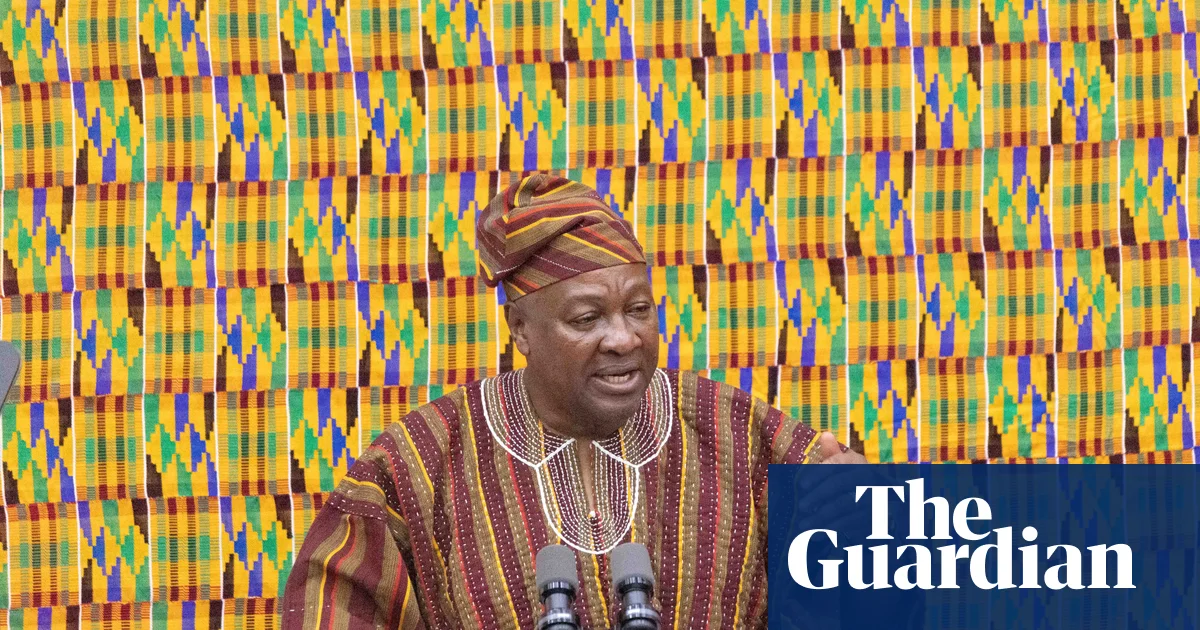
John Mahama knows a thing or two about beating the establishment. On Wednesday, less than two years after completing a remarkable comeback as Ghana’s president with a landslide defeat of the ruling party candidate, he rallied the world to ratify a landmark vote against transatlantic chattel slavery, despite major opposition from the same western entities that drove it for centuries.
The resolution to declare the practice as “the gravest crime against humanity” passed with a decisive majority at the UN general assembly and has been largely welcomed across Africa. Yet the details of the tally reveal a world still deeply divided on the gravity of the sin of enslaving more than 15 million people as chattel over the course of 400 years.
Thus, the 123 states who voted for it were just as noteworthy as those that did not. Most of the assembly was in support including Africa, Asia, the Caribbean, most of Latin America, all former victims, as well as the Arab world, who themselves have the dark history of trans-Saharan slavery under their belt. Russia called it a “long overdue recognition”.
Perhaps because of their history of subjugation of Indigenous people and perpetuation of chattel slavery, the western bloc of Australia, Canada, the UK and the EU states all abstained in the vote, electing to postpone their day of atonement.
The three states to publicly vote against the resolution were Argentina, where two-thirds of the value of all imports arriving at the port of Buenos Aires between 1580 and 1640 were enslaved Africans; Israel and the US, where 11 states seceded rather than obey the Emancipation Proclamation freeing enslaved Africans.
The US ambassador to UN economic and social council, Dan Negrea, took pains to point out the unrelated claim that Donald Trump “has done more for Black Americans than any other president” and stressed that Washington “does not recognise a legal right to reparations for historical wrongs that were not illegal under international law at the time they occurred”.
Human rights advocates believe the collective objection to a resolution that is not legally binding is because its opponents know it opens the door to reparation payments and acknowledgments. Before the vote, there was palpable fear in the room. Representatives of EU states spoke against what they considered retroactive application of international law, but there was also an unspoken desire to censor the past.
The Vatican’s permanent observer to the UN, Archbishop Gabriele Caccia, mentioned examples of papal condemnations of slavery in a speech before the vote and called the resolution a “partial narrative”. Ironically, he skipped the mention of a more impactful papal action: it was Pope Nicholas V’s edicts in 1452 and 1455 approving enslavement of non-Christians in Africa by the Portuguese that facilitated transatlantic slavery.
Inevitably, questions are being asked about what happens next. But after securing such a historic win in the face of heavyweight opposition, Ghana and the African Union will feel energised to continue this long fight. On Wednesday, the UN secretary general, António Guterres, called for “far bolder action”.
All eyes will now be on the African Union, which has called 2026-36 its “decade of reparations” and named Mahama as its reparations’ champion, to find creative ways to extract reparatory justice even in the face of stonewalling from the west.
The resolution itself was the product of collective action. It took months of consultations with a host of bodies across the continent and diaspora to produce the resolution. Some of those who worked on it say that same communality is being used to determine the next steps and nothing can stop an idea whose time has come.
Already, an African Union committee of experts is working on a framework for reparatory justice and engaging descendants of enslaved people all over the world. It is an uphill battle but Mahama, who is in line to be the union chair in 2027, is confident he can be victorious a third time.
“We travel this long road, each step guided by a desire to be better and to do better, each step bringing us closer to the kind of world we would want to leave for our children,” said Mahama in his speech at the UN general assembly.