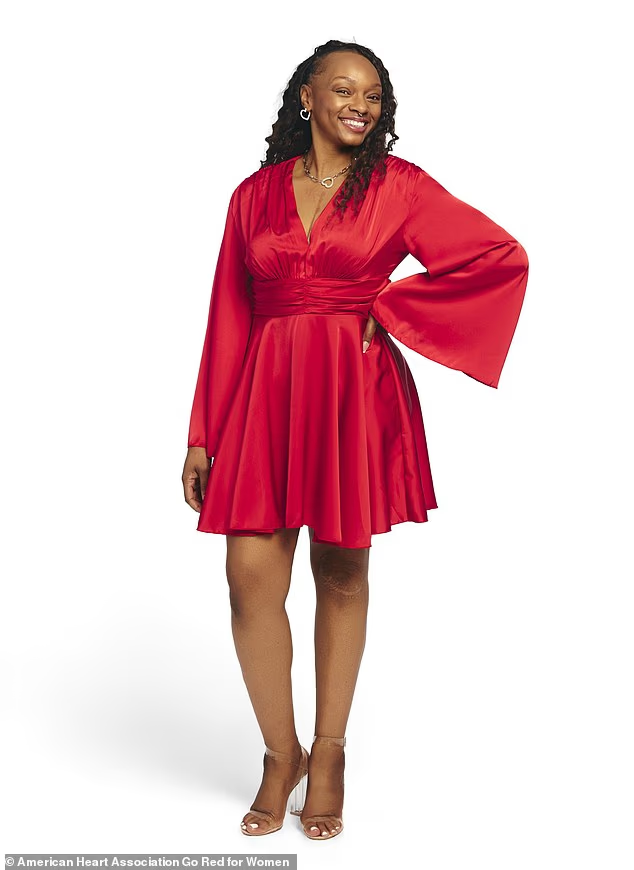
Anjellica Davis couldn’t escape the feeling that she was ‘drowning.’
In the summer of 2022, just weeks after giving birth to her third child, the 34-year-old from South Carolina could hardly walk up a flight of stairs or lay in bed without struggling to catch her breath.
Davis assumed she was just having postpartum setbacks after a relatively smooth pregnancy and needed to lose the baby weight.
‘I brushed it off because I had a baby to take care of,’ Davis, now 38, told the Daily Mail. ‘I was like, “Eventually it will pass.”‘
A few months later, Davis felt so winded she could barely finish chores around the house. Her son’s grandmother, who was battling heart disease, suggested Davis may have developed fluid around her heart, which offered an explanation for the drowning feeling.
Hearing this, Davis rushed to the emergency room, where blood tests and an electrocardiogram (ECG), which measures the heart’s rhythm, revealed a devastating diagnosis: peripartum cardiomyopathy (PPCM), a rare form of heart failure that occurs at the end of pregnancy or a few months after birth.
In PPCM, also called postpartum cardiomyopathy, the heart’s muscle becomes enlarged and weakens over time, leaving it unable to pump blood throughout the rest of the body. The blood then backs up into the chest, causing fluid to form around the lungs.
It occurs in about 1,000 to 1,700 patients per year in the US, with Black women, such as Davis, being at the highest risk due to potential genetic factors, higher likelihood of risk factors like preeclampsia and socioeconomic disparities.
Davis has been named one of the American Heart Association’s Go Red for Women Class of Survivors, which celebrates young, otherwise healthy women who have survived different types of heart disease

Anjellica Davis was diagnosed with peripartum cardiomyopathy (PPCM) after giving birth to her youngest son
Davis said she had never heard of PPCM and didn’t know it could strike her without warning.
‘That was the first time out of having three kids that I had ever heard about that, and it was scary, to say the least,’ she told the Daily Mail. ‘It was definitely scary, but it was also an anger that I felt because I was like, “Why didn’t I know about this?”
‘I felt let down. I literally remember I asked the doctor, “Why didn’t anybody tell me?” And his answer was, “Oh, it’s rare.” As time went on, I’m like, I don’t care how rare it is. I should have known.
‘It is my job to take care of my body, but it’s also my doctor’s job to educate me and inform me of health risks and concerns and things like that that could go on with my body, regardless of how rare it is. I was upset that I wasn’t educated properly.’
Davis credits her son’s grandmother for urging her to get help and alerting her to the signs of heart failure, which include severe fatigue, persistent cough, swelling in the ankles and feet and intense shortness of breath, especially when lying down because gravity makes fluid settle near the lungs and worsen breathing.
‘Had I not had her, I probably wouldn’t be here today because I didn’t know what to look for,’ Davis said. ‘Heart health wasn’t really something I thought of because I was young when I had my kids.’
Heart failure has long been seen as a disease of old age, as eight in ten patients are over the age of 65.
However, emerging research shows more young Americans than ever are being affected by it, which experts suggest could be due to surging rates of obesity, diabetes and high blood pressure, all of which put excess strain on the heart.
As for PPCM, experts believe higher rates of high blood pressure and diabetes, as well as having multiple children and giving birth at an older age, raise the risk.
Pregnancy also raises a woman’s overall blood volume by 40 to 50 percent and increases heart rate by ten to 20 additional beats per minute, gradually rising in each trimester.
On top of that, pregnant women have higher cardiac outputs, meaning their hearts pump 30 to 50 percent more than normal. This figure can increase to 60 percent in twin pregnancies.
All of these changes put additional strain on the heart, raising its risk of failure.

More than three years after her transplant, Davis is urging other Americans to register as organ donors
Doctors prescribed Davis the blood thinner Eliquis (generically known as apixaban) to prevent clots. They also encouraged her to follow a regular exercise routine and heart-healthy diet rich in dark, leafy greens, fatty fish, whole grains and avocado or olive oil.
But by October 2022, Davis’ condition had worsened.
‘[The treatment] didn’t go how it was supposed to go,’ she told the Daily Mail. ‘I was like, “If I need a transplant, let’s just go ahead and get it over with because I’m ready to live. I have a baby, I have older children that I need to live for.”‘
In November 2022, Davis officially became one of the 3,800 Americans on the heart transplant list.
Despite there being 170 million registered organ donors in the country, according to the US Health Resources and Services Administration, only three in every 1,000 Americans each year die in a way that allows them to donate their hearts – criteria is based on donor heart function, age, infections and lifestyle factors that degrade the organ.
Though the average wait for a heart transplant is six months to a year, Davis was fortunate to receive her new organ later that same month.
After the roughly six-hour procedure, Davis spent about two weeks in the hospital, during which she tried to be as active as possible to help her recovery. Every day, she walked laps around the nurses’ station and talked to other patients in the unit, especially those who didn’t have family visiting.
Her time in the hospital, and the following six weeks in cardiac rehabilitation inspired her to rethink an old dream she’d had since high school: going to school for nursing.
‘I was to repay my gift of life with being able to give it back to someone else,’ Davis said.
‘Somebody may be going through the same thing that I went through, and they may not have anybody that understands. And it just so happens that I’m the nurse that had a heart transplant. I’ll be able to walk them through it, talk them through it, even be with them every step of the way they need.
‘I just want to be able to help people like myself and make a difference.’

Davis, seen above with her family, credits her youngest son’s grandmother for warning her of the signs of heart disease. ‘I probably wouldn’t be here today because I didn’t know what to look for,’ she told the Daily Mail
More than three years after her transplant, Davis takes six pills twice a day to keep her body from rejecting the heart – that’s down from 18 pills when she was first discharged.
She also does Pilates multiple times a week and has incorporated more nutrient-rich foods like cottage cheese, avocado and almond butter into her diet to keep her heart strong.
Davis no longer feels like she’s drowning or has any lingering symptoms from her heart failure.
She has been named one of the American Heart Association’s Go Red for Women Class of Survivors, which celebrates young, otherwise healthy women who have survived different types of heart disease.
While Davis has no details about the deceased woman whose heart she received, she has written a letter of gratitude to the family. As a result of her experience, Davis is encouraging Americans to register as organ donors.
‘Organ donation is so important,’ she told the Daily Mail. ‘I would encourage everybody to do it, especially if you’re healthy enough.
‘Because if that person hadn’t been an organ donor, I could not be here.’