The Democratic National Committee (DNC) has released a new Organizing and Political Playbook designed to carry the party to victory in the 2026 midterms and increase its long-term competitiveness as Democrats aim to take new ground in Republican states and rid themselves of their 2024 demons.
Newsweek is the first to report the existence of this playbook, which the DNC states is the first of its kind and exists to share organizing “best practices” across the Democratic ecosystem.
Coinciding with this announcement, the DNC also shared that this week marks its first National Voter Registration Week of Action that will feature on-the-ground partisan registration via over 100 voter registration drives across 26 states. This effort comes on the heels of this past weekend’s “No Kings” protests that drew millions to rally in opposition to the Trump administration.
“At the DNC, our motto is when we organize everywhere, we can win anywhere,” DNC chair Ken Martin said in a statement provided to Newsweek. “We’re putting that belief into action as we invest in on-the-ground organizing that prioritizes listening to voters and earning their support.”
Since becoming DNC chair in 2025, Martin—Minnesota’s former Democratic chair—has implemented a 50-state organizing strategy that prioritizes races up and down the ballot. He’s touted that under his tenure Democrats have flipped 29 state legislative races, including the district that houses President Donald Trump’s Mar-a-Lago, while Republicans have flipped zero.
Nonetheless, his tenure has been marked by scrutiny as Democrats have complained about his leadership style as well as his decision to not release a much-discussed autopsy of the 2024 election. Furthermore, Newsweek and other outlets have covered rising concerns among D.C. Democratic circles that Martin’s prioritization of funding to state parties and state-level races could imperil the party’s ability to flip the House come November.
The DNC faces $17.4 million in debt and just $15.9 million in cash on hand as its focused on moving dollars to the states. Meanwhile, the Republican National Committee (RNC) boasts a $109 million war chest. Nonetheless, Martin has refused to back down from his strategy.
The 212-page playbook reflects Martin’s core belief that grassroots organizing will yield Democratic power. It lays out its recommendations in three categories: incorporating new voter contact methods, prioritizing ongoing relationships with voters, and redesigning the day-to-day work of organizers. And it provides strategies on carrying out those practices by juxtaposing them against issues of the past.
“Over the past decade, the Democratic campaign industry and its funders have become obsessed with massive, shiny output numbers from traditional tactics: Millions of calls made and hundreds of thousands of doors knocked,” the playbook writes. “Despite making 300+ million phone calls in 2024—more than any campaign in history—only 3% of the calls the Harris campaign made actually resulted in a contact with a voter.”
By fixating on these numbers, the playbook, in short, writes that Democrats miss out on opportunities for deeper and more persuasive engagement. To better effectively reach voters, the playbook suggests focusing less on trying to hit a list of targets and instead embracing a greater willingness to seize organic opportunities.
“This might include a conversation with their barista at the local coffee shop or chatting with a group of people gathered outside a house not on a walk list,” it writes.
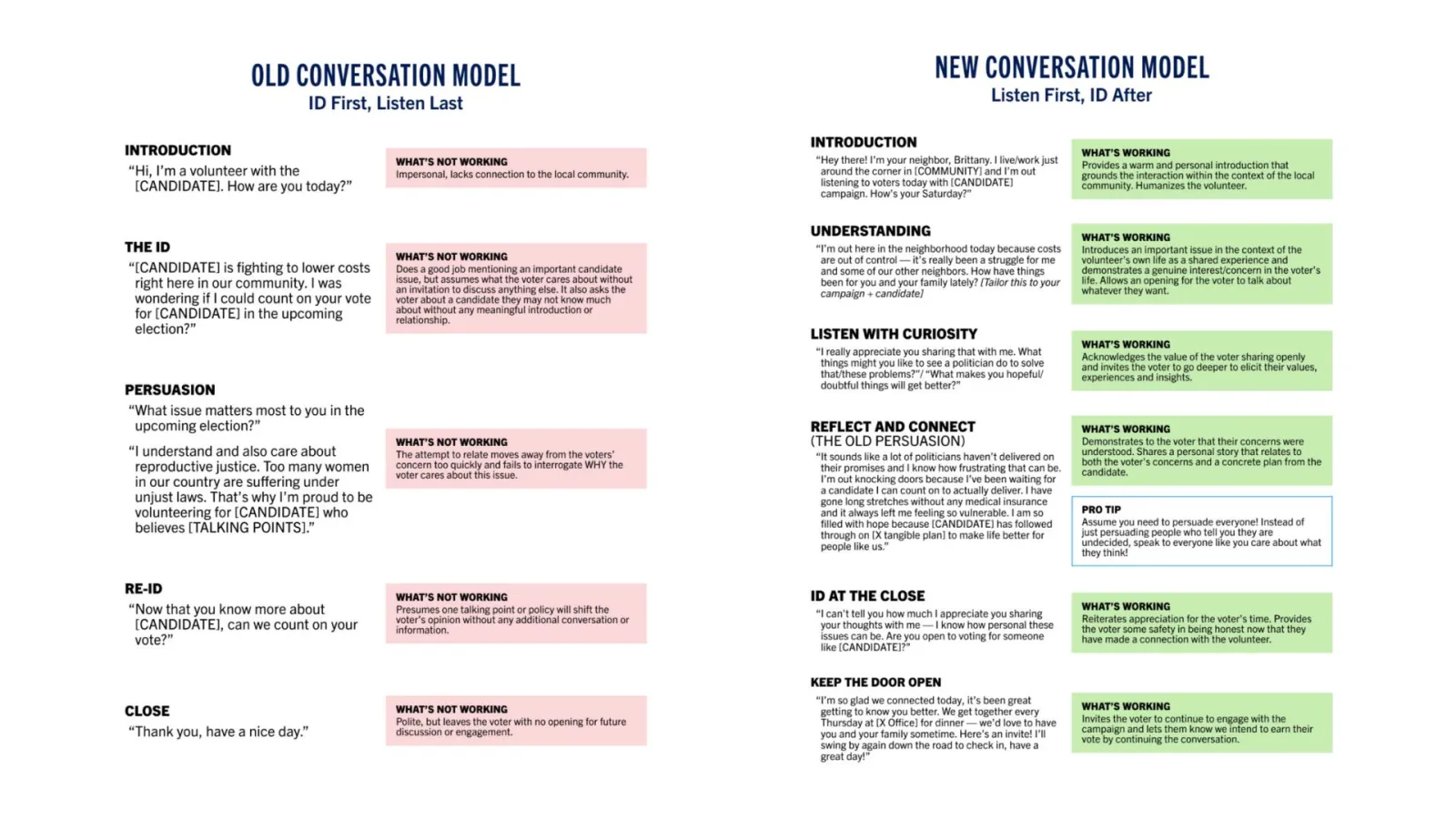
Steering organizers away from metrics, the playbook suggests reorienting conversation models away from a focus on identifying who the voter is and who they’re supporting and instead spending time hearing their concerns from the initial point of contact and building a relationship based on those priorities. That relationship is built through a process the playbook calls “layering,” whereby, for example, a voter connects with the campaign face-to-face, then follows up with a text, followed by an invitation to a campaign event.
Events and community engagement efforts are central to the playbook’s organizing strategy as a means of reaching voters who are skeptical of traditional cold calling and door knocking outreach. The playbook suggests campaigns carry out food drives and mutual aid efforts along with offering educational opportunities, like “Know Your Rights” lectures, and community dinners.
“Organizing isn’t about hitting metrics. It’s about meeting voters where they are and building meaningful connections,” North Carolina Democratic Party chair Anderson Clayton said in a statement shared with Newsweek. “Moving beyond outdated models and investing in resources grounded in what actually works will be critical to winning close races and making sure people know what Democrats are doing for them at every level of government.”
Adapting to the moment also means integrating campaign teams, the playbook writes. It states digital and field organizing should not be separated into individual teams and instead should work alongside each other to create a cohesive and unified outreach effort.
Building on that, it writes that campaigns in regions with sizable constituency groups “defined by shared language or identity,” should consider creating Coalitions Program Regions to “ensure deep and culturally competent engagement” and emphasizes this unit should be part of one centralized organizing team.
Testimonies from organizing leaders involved with six separate identity-based coalitions—Asian American, Native Hawaiian, Pacific Islander (AANHPI), Black, Latino, Native, Workers, and Youth communities—offer advice on how these groups can be reached more effectively.
“Don’t assume Black voters will automatically support Democratic candidates,” one passage writes. “Organizers noted that the Black community increasingly feels taken for granted, reinforcing the need for campaigns to engage Black voters intentionally and early.”
The creation of the Playbook and the launch of the National Voter Registration Week follow the DNC’s seven-figure investment in voter registration efforts, via its “When We Count” initiative, that it launched in January as well as its creation of a National Youth Coordinated Table to reach young voters that it launched in December.
These latest efforts make it ever clearer the DNC remains committed to its grassroots-oriented election strategy and will continue to prioritize these efforts no matter the criticism it may receive from the outside. Come November 4, this strategy could result in Martin being labeled a political genius or something far from that. He’s aware of the pressure he faces and believes recent evidence supports the continuation of his approach.
“Democrats have won tough races up and down the ballot through aggressive, innovative organizing and clear communication,” Martin said. “We’re thrilled to continue building on that momentum with this new playbook as we level up our organizing to meet the moment.”
Read the DNC’s Organizing and Political Playbook: Here