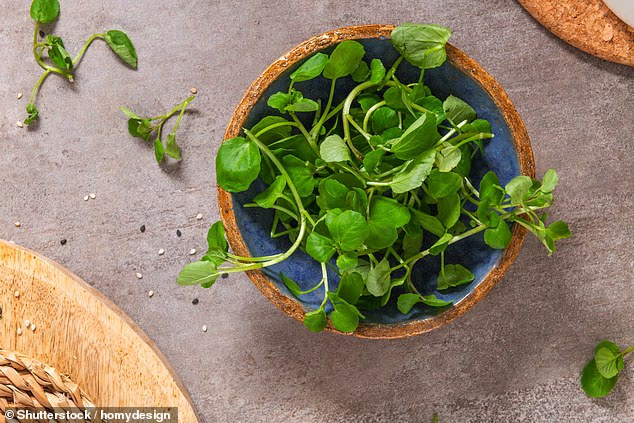
When asked to picture the ‘healthiest vegetable’, it’s unlikely that watercress springs to mind.
Regarded more as a salad leaf, the small, peppery green is actually a member of the brassica family – cousin to broccoli, cabbage, kale and mustard.
Delicate as it may look, watercress is unusually nutrient–dense for such a light leafy green. It’s a great source of vitamins A, C and K, along with folate and calcium, and like other vegetables in the brassica family, it contains plant compounds linked to antioxidant and anti–inflammatory effects.
It’s these credentials that saw it crowned ‘the world’s healthiest vegetable’ in December, after receiving a perfect score on the Centers for Disease Control and Prevention (CDC)’s list of 41 ‘powerhouse’ fruits and vegetables.
But many people tend to veer away from watercress as they’re not sure what to do with it.
Registered Dietitian Nichola Ludlam–Raine tells the Daily Mail it is actually very versatile – and there’s lots of exciting ways to eat it.
‘It works well in salads, blended into soups, stirred into pasta just before serving, added to sandwiches, or blended into pesto,’ she says.
‘It has a peppery flavour that pairs well with eggs, salmon and goat’s cheese.’
Contrary to popular belief, watercress is a vegetable not a salad
Why is watercress so good for you?
Watercress is the most nutrient–dense vegetable you can eat – that’s what helped it soar to the top of the CDC’s league table, which interestingly, saw sweet potatoes languishing at the bottom.
And as slight as they look, those tiny little stems and dainty leaves pack in a lot of nutrients.
Ludlam-Raine says: ‘Watercress is rich in Vitamin K, Vitamin C, Vitamin A (as beta-carotene), folate and small amounts of calcium, potassium and iron.’
The leaves also contain a natural plant compound called glucosinolates, which release a potent enzyme called myrosinase when the plant is chopped, crushed or chewed.
It is technically part of the plant’s defence system, and is what gives them their peppery taste.
Myrosinase converts glucosinolates into biologically active compounds, including sulforaphane, a potent antioxidant and anti-inflammatory.
Watercress has roughly 10-15 kcal per 100g, zero fat, and not a lot of fibre.
Ludlam–Raine adds: ‘A typical serving would be a large handful, around 40-80g, often used in salads or sandwiches.
‘Watercress contains fibre but in modest amounts due to its high water content and so not comparable to wholegrains or pulses in that regard.’
Watercress also has the potential to lower ‘bad’ LDL cholesterol and improve overall lipid profiles, but more trials are still needed.
Is watercress high in antioxidants?
If you want to integrate a plant into your diet that will assist with protecting cells from oxidative stress – a biological process linked to a swathe of diseases including cancer – you can’t go wrong with watercress.
Ludlam–Raine says: ‘Watercress contains antioxidants including beta–carotene, Vitamin C and various polyphenols, These compounds help protect cells from oxidative stress.’
Polyphenols, found naturally in plants, are compounds that protect cells from damage caused by unstable molecules called free radicals. Left unchecked, free radicals attack cell DNA, proteins and lipids.
This induces oxidative stress, an imbalance between free radicals and antioxidants, which causes inflammation that gradually increases the risk of chronic conditions like heart disease and cancer.

Glenn Walsh won the World Watercress Eating Championships 2025 in Hampshire
Regularly eating antioxidant–rich vegetables has been linked to better long–term health, particularly in supporting the body’s natural defence against everyday environmental and metabolic stress.
Watercress is also high in lutein and zeaxanthin, a type of antioxidant called carotenoids which are naturally found in dark leafy greens.
Studies have linked diets high in these carotenoids with a lower risk of several cancers, including breast, colon, and prostate.
Who should avoid eating watercress (side effects and risks)?
Watercress has high levels of Vitamin K, which is essential for blood clotting and preventing excessive bleeding.
Because of this, people who take warfarin and similar anticoagulant medications – also known as blood thinners – need to be careful with their watercress intake.
This is because warfarin promotes blood clotting while blood thinners do the opposite – the combination has the potential to make people seriously unwell.
Ludlam–Raine says: ‘People taking warfarin should keep intake consistent rather than avoid it entirely.
‘As with other leafy greens, consistency is key for stable anticoagulation.’
Keeping your portion sizes steady from week to week helps maintain predictable levels while still allowing you to benefit from the nutrients watercress provides.
People taking lithium also need to be careful with how much watercress they eat as the vegetable has a diuretic effect, causing the body to retain lithium.
Lithium toxicity can cause gastric issues, mental confusion and in extreme cases, seizures.
How to combine watercress with other foods for better nutrient absorption
Watercress makes a great garnish, but it can also be used as the base for a salad – it can really shine when it’s placed at the heart of a dish rather than left on the sidelines.

Liz Hurley previously said she drinks watercress soup to lose weight fast
Not only does it taste great, but eating it with other wholefoods lets it behave as a vehicle for their nutritional benefits, too.
‘Pairing watercress with healthy fats such as olive oil, avocado or nuts helps absorb fat–soluble vitamins like Vitamin K and beta–carotene,’ Ludlam–Raine says.
‘Adding it to meals with a protein source improves satiety, and combining it with vitamin C–rich foods supports iron absorption from plant sources.’
So, if you want maximum impact from your watercress, think in terms of combinations rather than sprinkling it on the side as an afterthought.
A simple salad dressed with olive oil, scattered with nuts or served with eggs, fish or beans will help your body make better use of the nutrients it contains, turning a modest handful of leaves into a far more nutritionally effective addition to your meal.
And while eating it raw preserves its Vitamin C content, watercress can also be gently wilted into soups or added to omelettes at the end of cooking.
Is watercress the same as cress?
Triangular egg and cress sandwiches are an afternoon tea staple – but don’t get the dainty, almost translucent shoots mixed up with watercress.
Ludlam–Raine says: ‘They are related but not identical in flavour or nutrient profile.
‘Watercress is a mature leafy green, whereas cress (such as garden cress) is usually eaten as young sprouts.’
Is watercress good for weight loss and metabolism?
One of the most famous advocates for the plant’s use in weight loss is Liz Hurley, who famously drinks watercress soup when she needs to lose weight.
She previously said: ‘It’s fatless, low calorie, full of vitamins and iron and delicious enough to serve at a dinner party.
‘I drink at least six cups a day when eager to lose a few pounds.’
However, Ludlam–Raine says it’s vital to remember that no single food can cause weight loss – that only happens due to a calorie deficit.
‘Watercress can be helpful as part of a balanced diet because it is low in calories and high in volume, adding bulk and nutrients to meals without significantly increasing energy intake,’ Ludlam–Raine explains.
‘However, no single food causes weight loss on its own – it’s a calorie deficit that elicits that.’