Donald Trump has threatened to “obliterate” Iran’s power stations and fresh water plants if Tehran does not agree to peace terms “shortly”, even as he claimed diplomatic progress in ending the war that was instigated by the US and Israel.
Tehran has remained defiant during the month-long conflict, describing US peace proposals as “excessive, unrealistic and irrational” and firing waves of missiles at Israel.
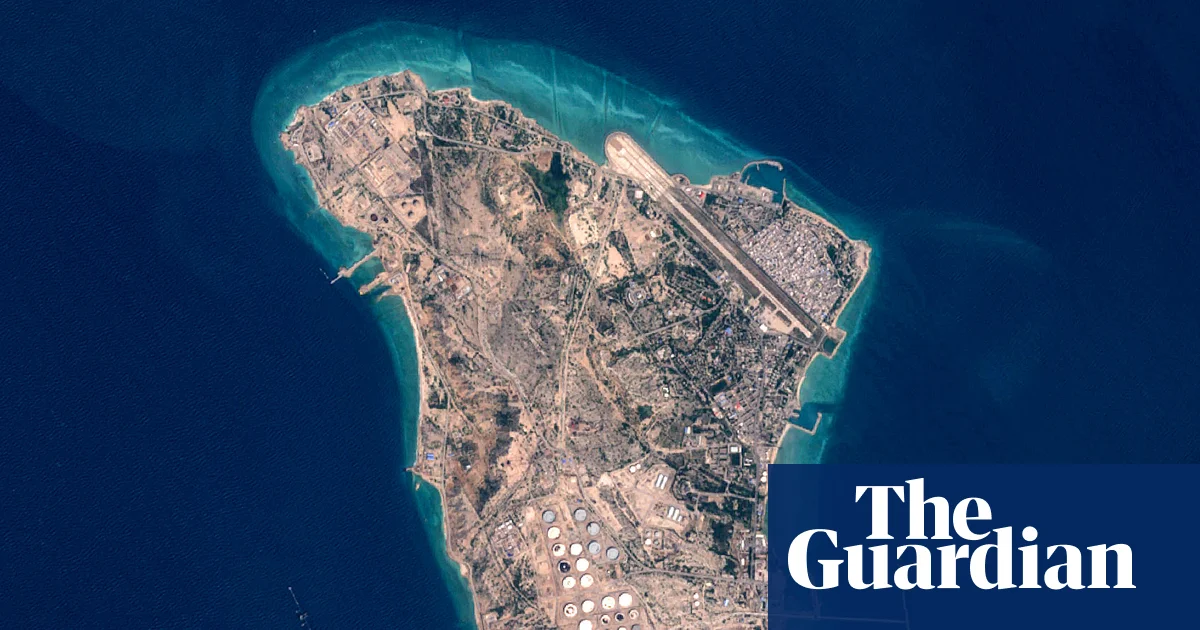
The risk of further escalation, including a US ground operation to seize Kharg Island, continued to send tremors through financial markets. Oil prices are on course for a record monthly rise.
In a post on his Truth Social network, Trump expressed confidence that a negotiated settlement would soon be reached, adding that the US was in “serious discussions” with what he characterised quixotically as “a more reasonable regime” in Tehran.
But he said if a deal was not struck – including to reopen the strait of Hormuz shipping lane – US forces would destroy “all of their Electric Generating Plants, Oil Wells and Kharg Island (and possibly all desalinization plants!)”. Destroying civilian infrastructure such as power and water facilities would be illegal under international humanitarian law and would probably constitute a war crime.
Later on Monday, the White House press secretary, Karoline Leavitt, said Trump would be willing to ask Arab countries to help foot the bill for the Iran war. “I think it’s something the president would be quite interested in calling them to do,” she told reporters. “It’s an idea that I know that he has.”
The proposal adds a striking new dimension to the warfare, suggesting Washington may seek to offload war costs on to the very Gulf states now scrambling to broker a peace deal.
The US president’s social media post and indications from the White House press team came amid continued garbled messaging. In an interview with the Financial Times, Trump said his preference would be to “take the oil in Iran”, which analysts believe would require using US troops to seize Kharg Island, the terminal through which nearly all of Iran’s oil exports pass.
Esmail Baghaei, the Iranian foreign ministry spokesperson, on Monday acknowledged Tehran had received a 15-point proposal from the Trump administration after talks on Sunday between the foreign ministers of Pakistan, Egypt, Saudi Arabia and Turkey. However, he said there had been no direct negotiations with Washington, adding that the US demands were “excessive, unrealistic and irrational”.
Mohammad Bagher Ghalibaf, Iran’s parliamentary speaker, dismissed the talks in Islamabad as cover for more US troops being brought to the region, adding that Iranian forces were “waiting for the arrival of American troops on the ground to set them on fire and punish their regional partners for ever”, according to state media.
Human rights groups criticised Trump’s threat of punitive strikes on civilian infrastructure. Erika Guevara-Rosas, Amnesty International’s senior director for research, advocacy, policy and campaigns, said: “Intentionally attacking civilian infrastructure such as power plants is generally prohibited. Even in the limited cases that they qualify as military targets, a party still cannot attack power plants if this may cause disproportionate harm to civilians.
“Given that such power plants are essential for meeting the basic needs and livelihoods of tens of millions of civilians, attacking them would be disproportionate and thus unlawful under international humanitarian law, and could amount to a war crime.”
While Trump officials, most prominently Pete Hegseth, his bellicose defence secretary, have sneered at conflict law, Washington’s conduct of its joint war with Israel against Iran has had serious diplomatic ramifications. Spain announced on Monday that its airspace was closed to US planes involved in the conflict.
Keir Starmer, the UK’s prime minister, reiterated: “This is not our war and we are not going to get dragged into it.” And in an unusually forceful intervention, Abdel Fattah al-Sisi, the Egyptian president, called on Trump to end the Middle East war, now in its second month.
“I say to President Trump: no one will be able to stop the war in our region, in the Gulf … Please, help us to stop the war, you are capable of it,” Sisi said at a press conference in Cairo, underlining the growing international discomfort.
There is a lack of clarity over the status of Pakistan’s efforts to mediate talks aimed at ending the war, which is threatening to plunge the global economy into recession and trigger shortages of food and pharmaceuticals. Oil rose to almost $117 a barrel, close to the $119.50 a barrel figure reached earlier in March, before easing back. Brent crude is now on track for its largest ever monthly gain. It is up by 54% since the start of March, beating the previous record of 46% in September 1990 after Saddam Hussein invaded Kuwait.
The International Monetary Fund said “all roads lead to higher prices and slower growth worldwide” should the conflict in the Middle East continue to throttle flows through the Gulf.
Amid weekend reports in the US media that the Pentagon was preparing for weeks of ground operations in Iran, Tehran appeared to be calling for volunteers for a so-called Janfada – “sacrificing life” – operation, recalling the human wave of assaults from the Iran-Iraq war of 1980 to 1988, which included young volunteers.
Experts have warned that a US ground operation would probably push the conflict towards an ever deepening regional war. Maziyar Ghiabi, the director of the Centre for Persian and Iranian Studies at the University of Exeter, said: “As the US president prepares for a ground invasion – even though it may be limited to Iranian islands in the Persian Gulf – the trajectory of the war is moving towards a point of no return.”
Ghiabi warned of the risk of “a full regional conflict involving Yemen and the Bab-el-Mandeb strait, Iraq, as well as Lebanon, which is already going through an Israeli ground invasion. The effects of this turn of events will be unpredictable and very long-lasting in terms of humanitarian as well as economic outcomes.”
Meanwhile, Tehran struck a critical water and electrical plant in Kuwait and an oil refinery in Israel, while Israel and the US launched a new wave of strikes on Iran. Fighting continued to spread in Lebanon as Israel moved to seize more territory in the country’s south. At the weekend, Yemen’s Houthi rebels fired missiles at Israel for the first time since the war began.
Elsewhere, Syria’s military said a large-scale drone attack had targeted its bases near the border with Iraq, in the latest such incident since the outbreak of the war. It was not immediately clear who had launched the attack.