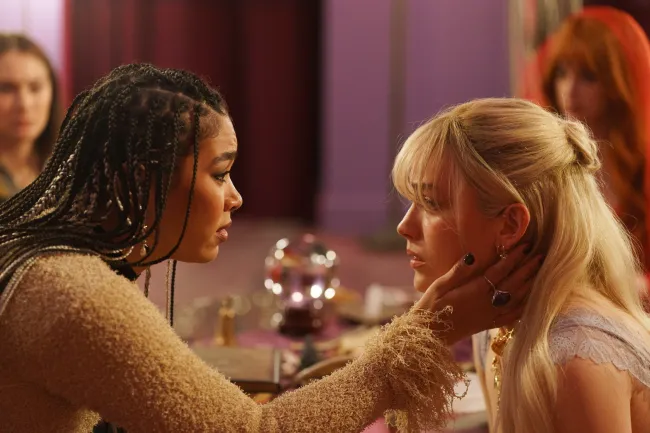
No one wants to pick on “Forbidden Fruits.” But the latest release from Shudder and Independent Film Company — a witchy satire starring Lili Reinhart, Victoria Pedretti, Lola Tung, and Alexandra Shipp, set inside an ethereal Texas shopping mall — just fell prey to a familiar marketing ploy.
With the film’s cast, crew, some critics, and even its early fans routinely comparing director Meredith Alloway’s feature debut to old favorites like “Jennifer’s Body,” “Jawbreaker,” and “The Craft,” this dark fantasy riff akin to an even meaner “Mean Girls” is already being widely hailed as a “cult classic.”
And yet, much like “jumbo shrimp,” an “instant” cult film is a contradiction in terms. That rare moniker is earned only when audiences track and fuel a film’s cultural staying power over time. And calling something a “cult hit” too soon risks undermining the very process that establishes serious genre canon.

With $1.2 million in opening weekend sales, “Forbidden Fruits” isn’t a disaster, nor is it a breakout. So far, it’s a modest performer that’s been buoyed by strong critical buzz out of SXSW — and a savvy press cycle with a popular cast. That’s the kind of chaotic energy that has led plenty of iconic girl-rot cinema to niche greatness in the past. But is it enough to give the Fruits a stable shelf life now?

Cult Classics Aren’t Declared. They’re Discovered.
Cult films aren’t defined by their opening weekends. They’re defined by what happens after the initial release, when the crowd comes back and turns beloved moments into a kind of shorthand for community. Sometimes that unlikely canonization leads to lasting success, as was the case with the 50-year-old “Rocky Horror Picture Show.” Other times, fringe films carry on in the margins. Movies like “Ginger Snaps” built their reputations on years of passionate advocacy, particularly from female fans.
More recently, “The People’s Joker” found its audience through a harrowing distribution journey that emphasized its importance throughout broader trans film. And other contemporary indie gems, from “F*cktoys” to “Hundreds of Beavers,” went straight from the U.S. festival circuit to international tours, with these low-budget wonders playing packed theaters that feel more and more like concert stadiums.
In every case, these cult followings formed gradually. And the behind-the-scenes stories that explain how audiences found their way to each movie proved just as important to building the projects’ mythology as the films themselves. Rushing that experience threatens to cut its best parts short.

Community Accolade… or Subtle Self-Own?
Of course, there’s nothing wrong with enthusiasm. If you love a movie, say you love it. If it feels specific, strange, or somehow made just for you, even better! But as a label, “instant cult classic” doesn’t describe a piece of media so much as it describes the speaker’s hope for it. And too often, the term — however well-intentioned — reads like an awkward hedge.
Because what does “cult film” really mean in practice? Not that a movie was a hit, but that its success should be measured differently. In other words: This film isn’t for everyone; it’s only for audiences who will “get” it. That framing shows up all over the conversation surrounding “Forbidden Fruits,” and, to be fair, the film’s literal occult themes invite that discussion openly.
Alloway’s freshman effort is a maximalist collage of tones and ideas, combining horror and camp through a feverish reflection on curated girlhood identity. For the right audience, that’s the main appeal. But categorized with the speed seen here, the effect also raises an uncomfortable question: If you’re calling something “cult” on arrival, are you celebrating its unique qualities… or managing expectations?

You Can’t Bottle Underdog Energy
Part of what makes the “cult” label feel especially slippery here is the level of polish surrounding “Forbidden Fruits” as a production. This isn’t some random one-off, shoestring attempt fighting to be seen. It’s a well-packaged, medium-sized release with big stars and a clearly defined, marketable aesthetic. That doesn’t disqualify it from cult status down the line. (Plenty of fringe hits have resources.)
But there’s a difference between being adopted as an outsider versus being introduced as one. Cult classics aren’t just weird. Their strangeness is so striking that its contents are actively claimed by viewers who feel like they’ve discovered or understood something that other cinephiles couldn’t.
You can’t get through that reclamation in a single weekend, and you certainly can’t brand your way into it. Suffice to say, a movie that launches with a major beauty collab, as was the case with “Forbidden Fruits,” can be an underdog… but your case for it being a true cult film will have further to go.

TikTok Never Knows What Lasts
Online culture accelerates this entire cycle, and “Forbidden Fruits” is thriving on TikTok right now. Social media consensus, whether through early festival rumors or at the time of a wide release, can determine a film’s reach in a tangible way. But going viral isn’t the same as becoming enduring, and a clip that circulates for one day on TikTok isn’t the same as a moment that lives on in film history for decades.
That’s the part we can’t measure in real time. We don’t know yet which images from “Forbidden Fruits” will stick, which lines will be quoted, or which scenes will become ritualized viewing experiences. We just know that some of them are ripe for having fun today. At a time when AI, algorithms, and platform economics are flattening how we talk about movies — reducing everything to scores, rankings, and anonymous verdicts — “cult” is one of the few terms that implies something slower and more human.
When female-driven, queer-coded, or subculture-centered stories are immediately framed as “cult,” it can also imply an invisible ceiling. Effectively, it asserts that these audiences are inherently niche, and the film’s success will come later, somewhere else, on different terms. That may be true, but it shouldn’t be assumed. Because once you start marketing a movie as a “cult hit in the making,” you’re not just predicting its future. You’re shaping, and possibly stunting, how it’s received in the present.

Take a Beat and Let the Weird Stuff Breathe
Maybe “Forbidden Fruits” will endure. Maybe people will return to its strangest swings (the bedazzled cowboy boot, the Marilyn Monroe worship, the [spoiler alert] escalator crushing!) and construct a lasting ceremony out of its best parts. Or maybe they won’t. That’s not a failure. That’s just how this works.
The point of slow-burn “cult” status isn’t to deny a movie its potential, but to instead let that potential unfold on its own terms without trying to name it in the moment of a debut. To resist the urge to pre-label something before it’s had the chance to live, because anything else just isn’t cult. It’s branding. And that kind of movie almost always tastes rotten — no matter how long it’s been sitting in theaters.
From Shudder and Independent Film Company, “Forbidden Fruits” is now in theaters.