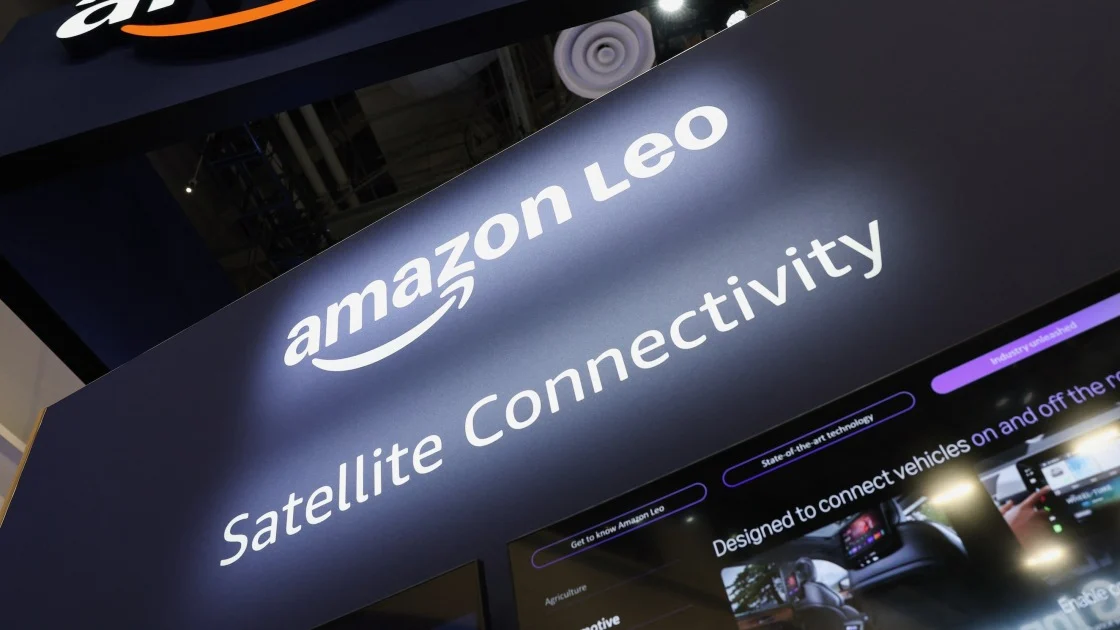
Amazon has been working with an Israeli company on a custom antenna to connect to the company’s Starlink challenger, Leo.
In a filing last week with the Federal Communications Commission, Amazon asked for experimental authority to test the equipment just north of Los Angeles. The custom antenna comes from Get SAT, an Israeli developer of smaller satellite communication terminals that sells to governments, defense agencies, and enterprises. It was reportedly acquired by French aerospace and defense company Thales in 2024.
Get SAT’s large catalog of satellite antennas includes the Sling Blade Nano, a 9-pound device that’s slightly larger than Amazon’s 2-pound Leo Nano dish, which can offer speeds up to 100Mbps. However, Get SAT’s model appears to be more rugged and possibly more powerful.
Get SAT’s Nano on the left, Amazon’s portable Leo Nano on the right. (Credit: Get SAT/Amazon)
“With excellent antenna directivity and gain, it ensures powerful transmission and reliable reception even in challenging environments,” Get SAT says in marketing materials.
Amazon’s filing asks to test a pair of custom Nano antennas outfitted with an “Amazon Leo Modem Module” (ALMM) to connect to the company’s upcoming satellite internet system.

(Credit: Get SAT)
“Amazon seeks to commence testing as soon as possible, by April 15, 2026,” the company writes. “The custom SATCOM terminal comprises a standalone Ka band phased array antenna manufactured by GET Sat connected to an Amazon Leo-developed Merlin ASIC modem chip and radiofrequency transceiver support circuitry on a printed circuit board card,” alluding to the modem module.
The plan is to test the Get SAT equipment at fixed locations on the roof of a building. Amazon applied for the experimental authority over a month after the company told the FCC it was considering partnering with third-party satellite antenna makers. To do so, the company has been developing the Amazon Leo modem module, which a vendor could adopt to connect their dish equipment to the Leo satellite internet system.
Recommended by Our Editors
Amazon’s new FCC filing adds: “The purpose of the test is to confirm the compatibility of the configurations with the Amazon Leo System and to collect performance data. Ultimately, the ALMM is meant to be integrated with several different standalone antenna systems manufactured by Amazon partners; this test is a critical step in qualifying our ALMM hardware for this purpose.”
Opening up the Leo tech to third parties might help Amazon compete with SpaceX’s Starlink, which already has a huge head start with 10+ million active customers. In December 2022, SpaceX also announced Starshield, a satellite communications service that piggybacks on Starlink, but is meant for government and military customers.
Amazon’s Leo is also hoping to lure both enterprise and government customers, as well as regular consumers. Although Leo has already attracted some notable customers in Delta Air Lines and JetBlue, the satellite internet system remains in a private beta with only select business customers. Currently, Leo spans about 200 satellites, but Amazon has been talking up its plan to launch hundreds more in the coming months as it lobbies the FCC to extend a deadline for the satellite constellation’s operations.

Get Our Best Stories!
Your Daily Dose of Our Top Tech News

Thanks for signing up!
Your subscription has been confirmed. Keep an eye on your inbox!
About Our Expert

Michael Kan
Senior Reporter
Experience
I’ve been a journalist for over 15 years. I got my start as a schools and cities reporter in Kansas City and joined PCMag in 2017, where I cover satellite internet services, cybersecurity, PC hardware, and more. I’m currently based in San Francisco, but previously spent over five years in China, covering the country’s technology sector.
Since 2020, I’ve covered the launch and explosive growth of SpaceX’s Starlink satellite internet service, writing 600+ stories on availability and feature launches, but also the regulatory battles over the expansion of satellite constellations, fights with rival providers like AST SpaceMobile and Amazon, and the effort to expand into satellite-based mobile service. I’ve combed through FCC filings for the latest news and driven to remote corners of California to test Starlink’s cellular service.
I also cover cyber threats, from ransomware gangs to the emergence of AI-based malware. Earlier this year, the FTC forced Avast to pay consumers $16.5 million for secretly harvesting and selling their personal information to third-party clients, as revealed in my joint investigation with Motherboard.
I also cover the PC graphics card market. Pandemic-era shortages led me to camp out in front of a Best Buy to get an RTX 3000. I’m now following how President Trump’s tariffs will affect the industry. I’m always eager to learn more, so please jump in the comments with feedback and send me tips.