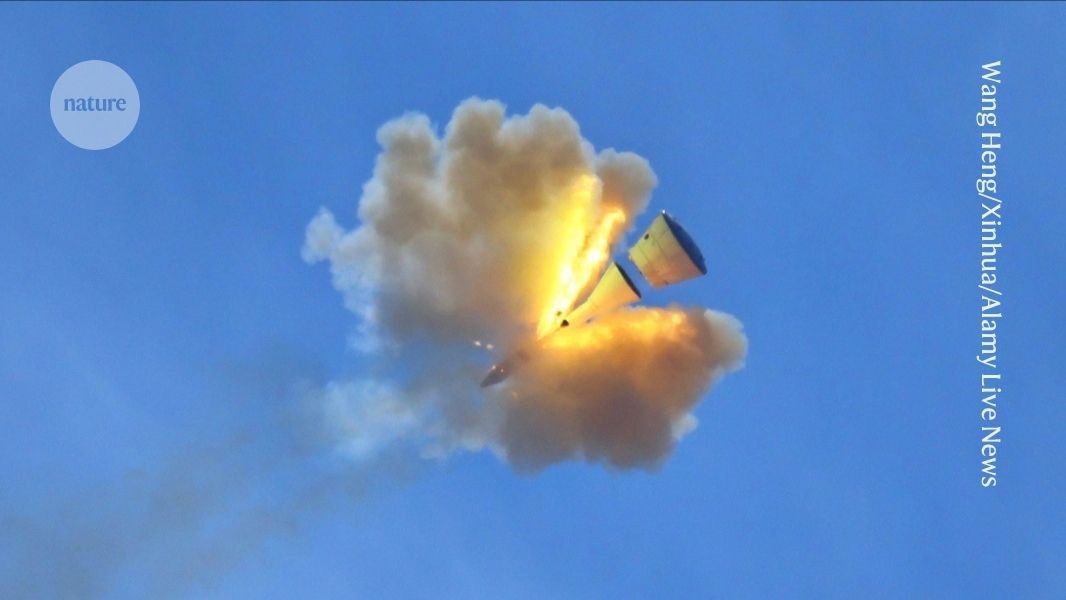
Early this year, a test flight showed the Mengzhou capsule separating from its rocket.Credit: Wang Heng/Xinhua/Alamy Live News
All eyes were on the sky yesterday, as NASA launched four astronauts on its Artemis II mission to the Moon. The lunar fly-by is the latest step in the agency’s ambitious plan to return people to the Moon’s surface in 2028. But the United States isn’t the only country eyeing such an achievement: China plans to send its first crew to the lunar surface by 2030.
China intends to send several astronauts to the Moon in a spacecraft called Mengzhou (or ‘dream vessel’) onboard a Long March 10 rocket. A separate rocket will transport a lunar lander called Lanyue (‘embracing the Moon’) that will rendezvous with Mengzhou in lunar orbit. It is a similar size to the Orion crew capsule on Artemis II. It can carry up to seven astronauts to low Earth orbit, but will take around three to the Moon.
In February, the China Manned Spaceflight Agency (CMSA) launched Mengzhou on its first test flight without people, demonstrating its abort system and how it would detach from its rocket.
Later this year, an uncrewed Mengzhou craft is set to launch on an initial test mission to China’s orbiting Tiangong space station. “It looks like it’s almost ready to go,” says Quentin Parker, director of the Laboratory for Space Research at the University of Hong Kong. More test flights are expected before a lunar landing is attempted in 2030, although China has yet to reveal details of those missions.
NASA had originally planned to land back on the Moon in 2024, but the mission was delayed because the hardware — such as the lander, either SpaceX’s Starship vehicle or Blue Origin’s Blue Moon — was not yet ready. Both are still in development. The schedule could slip further than 2028, leaving the door open to China being the first nation to land on the Moon’s surface since Apollo 17 astronauts last visited in 1972.
China’s pretty good at keeping to its timelines, says Parker. “There is a possibility that China will get to the Moon first.”
Since 2007, China has launched a series of robotic missions to the Moon, including landing on the far side in 2019, returning China’s first lunar samples in 2020 and the first samples from the far side in 2024.
Landing and bases
For its first Moon landing in 2030, China might target a location near the Moon’s equator where the surface is flatter and safer for a craft to land. It is considering 14 landing sites, one of which is an ancient volcanic region called Rimae Bode that is slightly north of the Moon’s equator. Jun Huang, a planetary scientist at the China University of Geosciences in Wuhan, and his colleagues published an analysis of the location’s geology in March1.
“Landing at Rimae Bode would be like opening a high-definition history book of the Moon’s life,” says Huang, because the site is thought to host material from the deep lunar mantle as well as debris from giant impacts. “This site provides a rare all-in-one opportunity to solve long-standing puzzles about the birth and evolution of both the Moon and Earth.”
Both China and the United States are eventually hoping to land at the Moon’s south pole, where water ice might be abundant. The hope is that the ice could be split into hydrogen and oxygen, ingredients of rocket fuel. China hopes to build a permanent Moon base with Russia, called the International Lunar Research Station (ILRS), in the 2030s. They plan to study lunar geology and conduct astronomy, among other goals, the China National Space Administration (CNSA) said last year.
Last month, NASA, too, announced plans to build a Moon base. Writing in The Economist, Bhavya Lal, a policy analyst at the RAND School of Public Policy and a former NASA associate administrator, says that competition with China seems to be the driving political force behind creating the base, but that that might not be enough to sustain the decades-long commitment needed to build the facility.
One-sided race
The United States has been vocal about wanting to beat China back to the surface of the Moon. In February, NASA administrator Jared Isaacman said that the agency faced “credible competition from our greatest geopolitical adversary” and needed to “move faster, eliminate delays and achieve our objectives”.