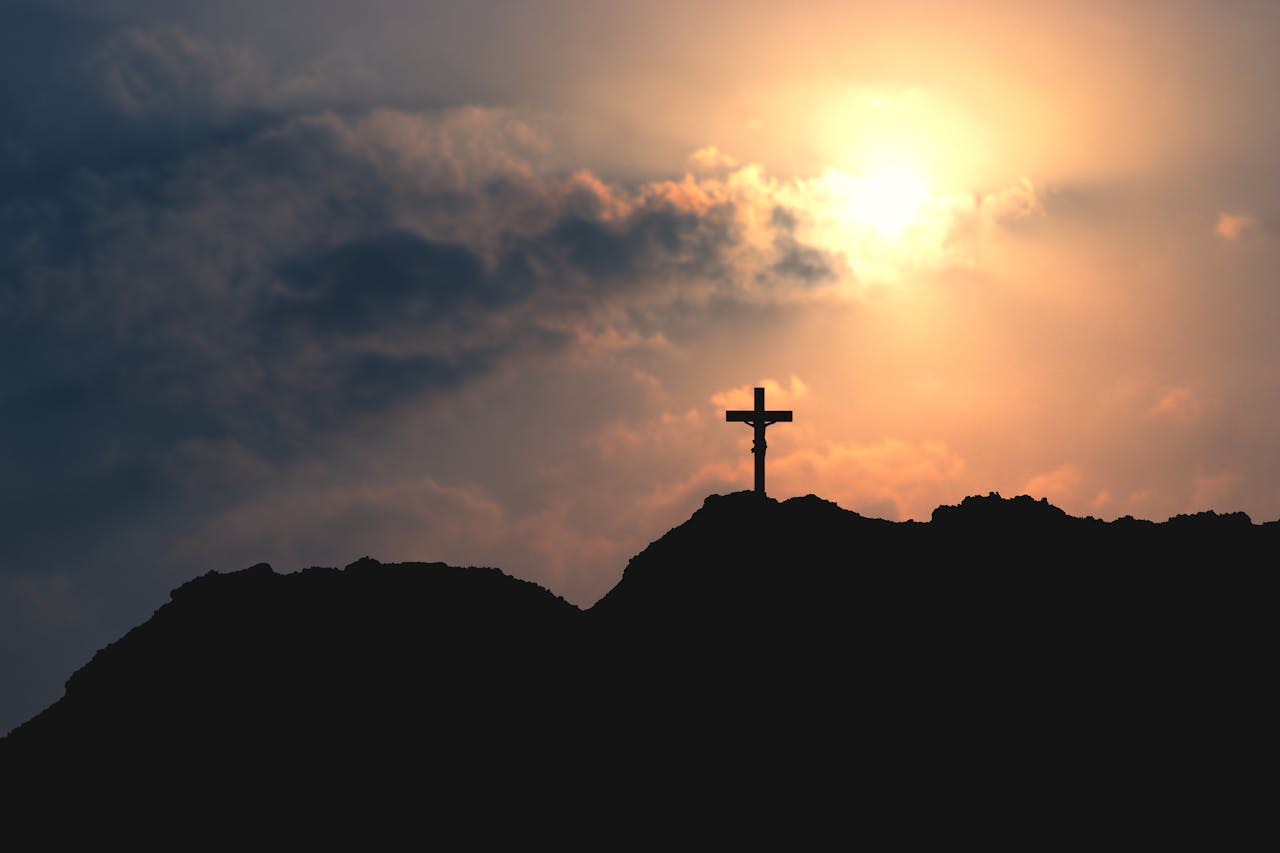
This week is Holy Week for Christians around the world, some of the most significant days on our calendar, moving from the celebration of Palm Sunday through the darkness of Good Friday to the joy of Easter morning. I was in church last Sunday as they were reading the passion narrative, the account of Christ’s final hours, when something caught my attention that I had not paid attention to before.
When Jesus cries out from the cross, some of the bystanders think he is calling for Elijah. I had read past this detail countless times. Elijah was a towering figure in Jewish history. But why would a crowd standing near a dying man hear the name Elijah specifically? Why that name and not something else?
He cried out in Aramaic, the everyday language of Galilee, the tongue His mother spoke to Him: “Eli, Eli, lama sabachthani.” My God, my God, why have you forsaken me? And in Aramaic, Eli (my God) sounds nearly identical to the first syllables of Eliyahu, which is Elijah. They share the same root. A dying man forcing sound through His chest in the noise of a crowd, and El-ee becomes El-ee-ya fast enough. The confusion only makes sense if you know which language was being spoken.
That small detail pulled me into something much larger.
Jesus was not crying out in wordless anguish. He was quoting a psalm. In first-century Jewish practice, quoting the first line of a psalm invoked the entire text, the way you might cite a chapter by its opening sentence. The Mishnah records that rabbis tested students by reciting a psalm’s opening line and watching them complete it from memory. Every learned person at the cross who heard those first words would have known immediately which psalm He was praying and would have begun running through the rest of it in their mind.
The psalm is Psalm 22, written by David approximately 1,000 years before the crucifixion, several centuries before crucifixion even existed as a method of execution. I want you to read it before I say anything more about it.
Psalm 22 (ESV):
My God, my God, why have you forsaken me?
Why are you so far from saving me, from the words of my groaning?
O my God, I cry by day, but you do not answer,
and by night, but I find no rest.
Yet you are holy,
enthroned on the praises of Israel.
In you our fathers trusted;
they trusted, and you delivered them.
To you they cried and were rescued;
in you they trusted and were not put to shame.
But I am a worm and not a man,
scorned by mankind and despised by the people.
All who see me mock me;
they make mouths at me; they wag their heads;
“He trusts in the LORD; let him deliver him;
let him rescue him, for he delights in him!”
Yet you are he who took me from the womb;
you made me trust you at my mother’s breasts.
On you was I cast from my birth,
and from my mother’s womb you have been my God.
Be not far from me,
for trouble is near,
and there is none to help.
Many bulls encompass me;
strong bulls of Bashan surround me;
they open wide their mouths at me,
like a ravening and roaring lion.
I am poured out like water,
and all my bones are out of joint;
my heart is like wax;
it is melted within my breast;
my strength is dried up like a potsherd;
my tongue sticks to my jaws;
you lay me in the dust of death.
For dogs encompass me;
a company of evildoers encircles me;
they have pierced my hands and feet,
I can count all my bones,
they stare and gloat over me;
they divide my garments among them,
and for my clothing they cast lots.
But you, O LORD, do not be far off!
O you my help, come quickly to my aid!
Deliver my soul from the sword,
my precious life from the power of the dog!
Save me from the mouth of the lion!
You have rescued me from the horns of the wild oxen!
I will tell of your name to my brothers;
in the midst of the congregation I will praise you:
You who fear the LORD, praise him!
All you offspring of Jacob, glorify him,
and stand in awe of him, all you offspring of Israel!
For he has not despised or scorned
the suffering of the afflicted one;
he has not hidden his face from him
but has listened to his cry for help.
From you comes my praise in the great congregation;
my vows I will perform before those who fear him.
The afflicted shall eat and be satisfied;
those who seek him shall praise the LORD!
May your hearts live forever!
All the ends of the earth shall remember
and turn to the LORD,
and all the families of the nations
shall worship before you.
For kingship belongs to the LORD,
and he rules over the nations.
All the prosperous of the earth eat and worship;
before him shall bow all who go down to the dust,
even the one who could not keep himself alive.
Posterity shall serve him;
it shall be told of the Lord to the coming generation;
they shall come and proclaim his righteousness
to a people yet unborn,
that he has done it.
The prophetic fulfillments are precise enough to make you stop. Verses 14 and 15 describe hypovolemic shock, dislocated joints, a heart like melting wax, and a tongue sticking to the jaw. All descriptions of the pain and suffering you undergo through crucifixion. The soldiers dividing garments and casting lots appear word-for-word, and John pauses the narrative to note the fulfillment explicitly.
The mockers quoting verse 8 back at Jesus (“He trusts in God, let God deliver him”) are phrases Matthew records the chief priests actually saying at the cross. Those were educated men who knew this psalm and knew its messianic weight. In reaching for it as a weapon to discredit Jesus, they were completing it. The psalm ends with a single Hebrew verb, asah, meaning “He has done it,” and Jesus’ final word from the cross in Greek is tetelestai, meaning “It is finished.”
Jesus chose this psalm deliberately. He was not grasping at a childhood memory through pain. He was doing what He had done throughout His ministry: pointing, teaching, saying look carefully at what is happening around you.
But the part of the psalm that I want to draw your attention to, and that I believe is directly relevant to the work of Them Before Us, comes earlier in the text.
Before the description of suffering, before the mockery, before the soldiers and the garments and the lots, the psalm locates the speaker’s relationship with God here: Yet you are he who took me from the womb; you made me trust you at my mother’s breasts. On you was I cast from my birth, and from my mother’s womb you have been my God (Psalm 22:9-10).
Not from the moment of ministry, not from baptism, not even from the moment of birth, but from the womb. God was already his God before he drew his first breath, before any declaration of faith, before any conscious act. That is where the psalm places the origin of this relationship.
And then I thought about what we know of Jesus’ own story. Luke records that the first recognition of His identity happened between two children still in the womb. When Mary arrived at the home of her relative Elizabeth, the unborn John leaped in Elizabeth’s womb at the sound of Mary’s voice, and Elizabeth was filled with the Holy Spirit (Luke 1:41). The Greek word Luke uses for John in that moment, brephos, meaning an unborn child, is the same word he uses for Jesus lying in the manger. Luke makes no distinction. No hierarchy of personhood based on location or stage of development. One word for both, carrying the same weight.
The psalm Jesus chose to pray as His final public theological statement is a psalm that begins with God’s knowledge of a person and God’s claim on a person from before birth. Both the psalm and the Gospels are making the same claim: that life, dignity, and the image of God are not present after birth but from the very moment life begins. That is where personhood starts. That is where God already knows us.
One of his final acts before the cross was to anchor our beginning in the womb, connected to a God who foreknew us, and then look ahead past the cross to what only the resurrection can make possible.
The psalm that opened with God’s knowledge of a person before birth closes with its gaze on the future: Posterity shall serve him; it shall be told of the Lord to the coming generation; they shall come and proclaim his righteousness to a people yet unborn (Psalm 22:30-31). The psalm begins and ends with the unborn. That is a beautiful picture, and it is the picture Christ chose to leave the watching world as His final public act.
At Them Before Us, we spend a great deal of our work arguing that children deserve to be protected from their very first moment of life, that their rights matter after birth, and that all adults should sacrifice to ensure that they and future generations flourish. I hope you find these final words from Jesus Christ as affirming and encouraging as we have.
This Good Friday, may we all hear this psalm with new ears.
This article was originally published by Them Before Us on Substack.