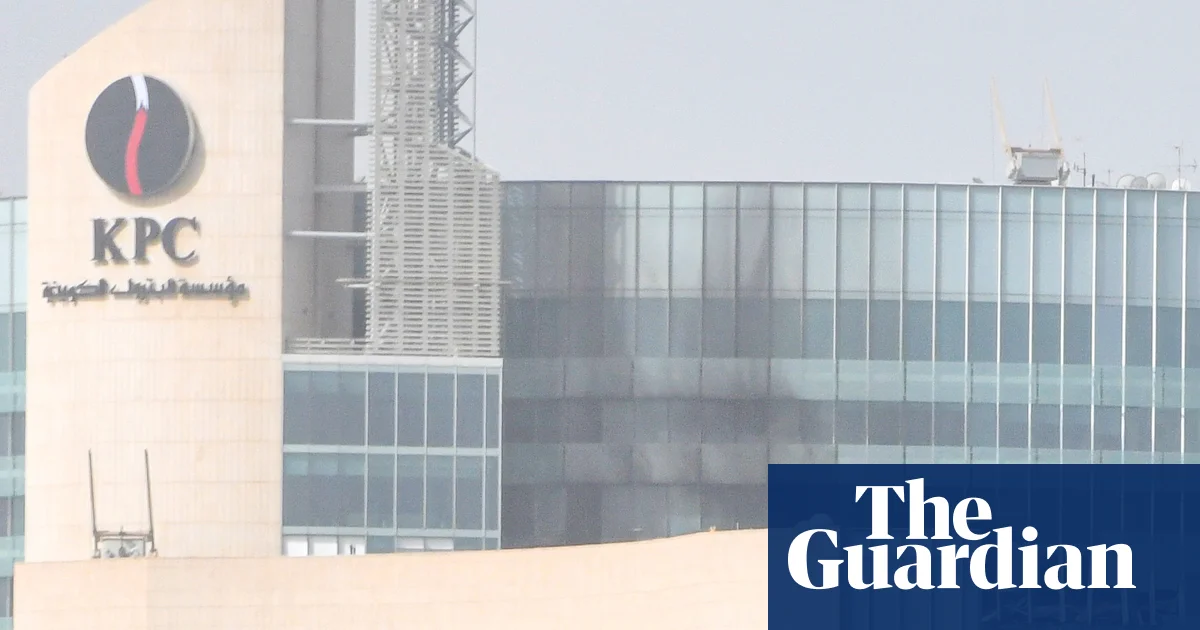
Iranian drones have struck Kuwait’s oil infrastructure, causing “severe material damage” that threatens to further disrupt oil supplies already hit by the US-Israel war on Iran.
The drone strikes on Sunday came hours before members of the Opec+ group of major global oil suppliers gathered to discuss how to bolster output despite Iran’s effective closure of the strait of Hormuz shipping route.
Iran’s Islamic Revolutionary Guard Corps said it had attacked petrochemical plants in Kuwait, as well as the United Arab Emirates and Bahrain. The Kuwait Petroleum Corporation reported damage and fires at its subsidiaries. The company said fires had earlier broken out at its Shuwaikh oil sector complex, which houses the oil ministry and KPC headquarters, after a separate drone attack.
Iranian drones also reportedly hit an office complex for Kuwaiti government ministries, which caused significant damage but no casualties, while local media reported two power and water desalination plants had been attacked.
Meanwhile, Iran’s central military command rejected an ultimatum by Donald Trump, who had threatened to destroy vital Iranian infrastructure if Tehran did not accept a peace deal within 48 hours. On Saturday, an Israeli attack on Iran’s petrochemical plants killed at least five people, according to Iranian media reports.
The drone attacks on Kuwait are just the latest hit to Middle Eastern oil infrastructure since the US and Israel started the war against Iran at the end of February. Israel’s attack on a production facility in Iran’s largest gasfield at South Pars in mid-March triggered retaliation by Tehran, which subsequently struck Qatar’s Ras Laffan industrial complex. That came days after drones struck oil storage facilities at the port of Salalah in Oman.
Members of Opec+ said on Sunday that repairing energy facilities damaged in recent attacks would be costly and take a long time, and would potentially hit global oil supplies well into the future. They also stressed the “the critical importance of safeguarding international maritime routes to ensure the uninterrupted flow of energy”.
The group, which consists Opec members and other oil-producing countries, reportedly agreed in principle to raising output by 206,000 barrels a day in May, according to Reuters. However, the agreement remains largely symbolic while Iran continues to effectively block the strait of Hormuz.
The strait is a vital trade artery though which about 100 tankers would typically pass each day. Approximately 20% of the world’s total crude oil goes through the narrow waterway and Iran’s blockade has severely constrained distribution.
The conflict has now resulted in the largest disruption to oil supplies in history.
The price of Brent crude has soared, rising more than 50% since the start of the year in response to the war and hitting a peak of $119.50 a barrel in March. It is now trading at about $109 a barrel.
That has pushed up energy costs for consumers, including in the UK and the US, where motorists have been hit hard.
In the UK, the average price of a litre of unleaded petrol was 154.45p on Sunday, according to the RAC, while the average for diesel was 185.23p.
Just before the Iran war started, a litre of petrol cost 132.83p on average, while for diesel it was 142.38p.
Last week, average US fuel prices passed $4 a gallon for the first time in four years, and on Sunday the national average was $4.110.
Opec+ members had already agreed to increase output by an extra 206,000 barrels a day throughout April in response to the Iran war, at their last meeting on 1 March. The latest meeting suggests they will be poised to again increase output once tankers are allowed safe passage through the strait.