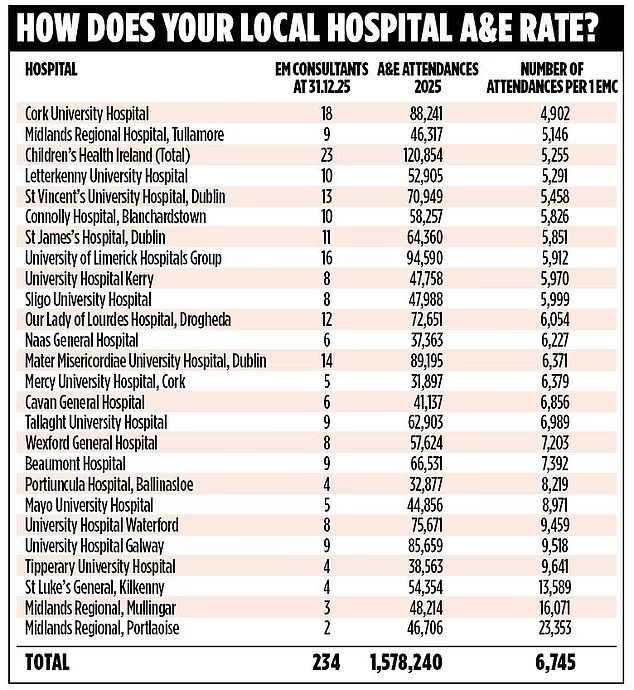
Your postcode can play a major role in your chances of seeing a specialist consultant in your local A&E department, new figures seen by the Mail show.
And those living in the west and south–east of the country have the worst chances of seeing a specialist doctor should they find themselves in the emergency room.
Although international guidelines state that hospitals should aim to have one Emergency Medicine (EM) consultant for every 3,600–4,000 A&E visits, in Galway and Waterford’s main hospitals there is roughly only one EM consultant for every 9,500 patient visits to their A&Es.
In smaller hospitals, the figures are even more stark, with the Midlands Regional Hospital (MRH), Portlaoise having just two specialists in emergency medicine on its payroll at the end of last year – one for every 23,353 patient visits to its A&E in 2025.
However, not even the A&E with the most consultants in the country – Cork University Hospital – reaches the recommended target. It has one EM consultant for every 4,902 visits.
Despite having the fourth busiest A&E in the country, University Hospital Galway had just nine EM consultants at the end of 2025.
The hospital saw 85,659 visits from patients in need of emergency care – the equivalent of 9,518 attendances for each consultant on its roster.
Similarly, University Hospital Waterford had eight EM specialists at the end of 2025. With A&E attendances there reaching 75,671, that equates to one consultant per 9,459 patient visits.
The figures contrast sharply with other major hospitals with similarly busy A&Es.
St Vincent’s University Hospital in Dublin saw 70,949 A&E patient visits. With 13 EM consultants, this equates to one senior clinician for every 5,458 A&E attendances.
While the MHR at Portlaoise had the highest patient–to–consultant ratio in the country, this was followed by MRH Mullingar, which had one EM specialist for every 16,071 A&E visits.
St Luke’s Hospital in Kilkenny had four EM consultants – one for every 13,589 visits.
Not even the A&E with the most consultants in the country – Cork University Hospital – reaches the recommended target, as our table above shows
In contrast, MRH Tullamore’s nine EM physicians meant it had one senior doctor for every 5,146 A&E patient interactions last year.
The 10 consultants in Letterkenny University Hospital’s A&E meant that there was one for every 5,291 presentations.
A total of 23 paediatric EM consultants work in Children’s Health Ireland sites at Crumlin, Tallaght and Temple Street in Dublin, which saw 120,854 young patient visits last year – the equivalent of one consultant for every 5,255 A&E attendances.
Nationally, there was one EM consultant for every 6,745 A&E attendances last year.
The need for greater numbers of EM consultants in the public health service was highlighted in a 2024 report by the HSE’s National Doctors Training and Planning (NDTP) programme.
It recommended that this workforce should increase to 369 full–time equivalent staff by 2038 in order to meet the needs of a growing and ageing population.
At the end of last year 234 specialists in emergency care were working across the country’s 26 public A&Es.
‘When you look at how Ireland compares internationally, we’re far behind the curve, and in terms of the HSE’s own targets that they have set down, they are far behind,’ said Labour Party Health spokeswoman Marie Sherlock.
She called for the sharing of skills across hospitals to ensure that patients are not missing out on vital care based on their local A&E’s staffing levels.
The President of the Irish Association of Emergency Medicine (IAEM) said some of the variation in EM consultant numbers was down to additional roles certain hospitals have as centres for major trauma and illnesses such as strokes and heart attacks.
‘CUH is a hub ED (Emergency Department) in the South Trauma Network which includes Munster and South Leinster,’ said Conor Deasy, who is also Professor of Emergency Medicine based at the Cork hospital.
‘The growth in consultants in emergency medicine numbers is in response to service needs, new service developments and an agreement that the consultants would work one unsocial shift per week – this may be an evening or late shift, an on-call shift or a weekend shift.
‘Cork University Hospital is a major trauma centre. A key performance indicator is that a patient sustaining major trauma would be received by a trauma team led by a consultant.
‘This has required an uplift in consultant numbers to provide rostered shop floor presence into the night and at weekends.
‘CUH has an audio–visually separated children’s emergency department seeing circa 25,000 children per year.’
According to the HSE, there were around three–and–a–half EM doctors per 100,000 population across the country in 2024.

Conor Deasy, the President of the Irish Association of Emergency Medicine (IAEM) said some of the variation in EM consultant numbers was down to additional roles certain hospitals have
Increasing consultant numbers to 369 by 2038 would lead to the country having just over six of these specialists for every 100,000 people. This target would also bring Ireland in line with staffing guidelines from the Royal College of Emergency Medicine in the UK.
A HSE paper highlighted a lower number of EM consultants per capita here compared to international peers, and an over–reliance on non–consultant hospital doctors (NCHDs) in emergency settings.
Prof Deasy says his organisation would like to see more consultants in emergency medicine.
‘We lag considerably behind the UK, and further still behind Australia and North America,’ he said

A Department of Health spokesperson said the expansion of the hospital workforce is a priority for Health Minister Jennifer Carroll MacNeill
‘Until the recent expansion in consultant numbers, many EDs in Ireland did not have an on–call emergency medicine consultant available 24/7.
Thankfully, this has been resolved in most places at this stage. The greater the numbers of consultants in emergency medicine, the greater the depth of cover into the evening and at weekends, and the greater the supervision of NCHDs.
‘The training programme for emergency medicine in Ireland should be expanded to increase the trained consultants in emergency medicine available to take up such posts; the combined effect would improve quality of care and patient flow in our EDs and greatly enhance the patient experience.’
The Government has committed to increase the number of EM consultants by 50 per cent over its lifetime.
A Department of Health spokesperson said the expansion of the hospital workforce is a priority for Health Minister Jennifer Carroll MacNeill. Since taking up office, the Minister has been keen to see more consultants working during evenings and weekends.
It’s thought that, by having senior decision makers in A&Es and elsewhere in hospitals for longer, patients can be discharged more quickly, freeing up vital space in overcrowded facilities.
Key to this goal is widespread uptake of the public–only consultant contract (POCC). Doctors who sign up to the 2023 agreement can be rostered to work from 8am to 10pm Monday to Friday, and from 8am to 6pm on Saturdays.
At the end of February, 159 EM consultants had signed up to the contract.
‘The POCC has now been signed by 69 per cent of the workforce,’ said the Department of Health spokesperson.
‘The number of consultants employed by the health service has increased from 3,250 Whole Time Equivalent in 2020 to 4,855 at the end of February 2026, a 49 per cent increase.
‘The expansion of the POCC and increased rostering over weekends results in better discharge management and improved overall performance for our EDs.’