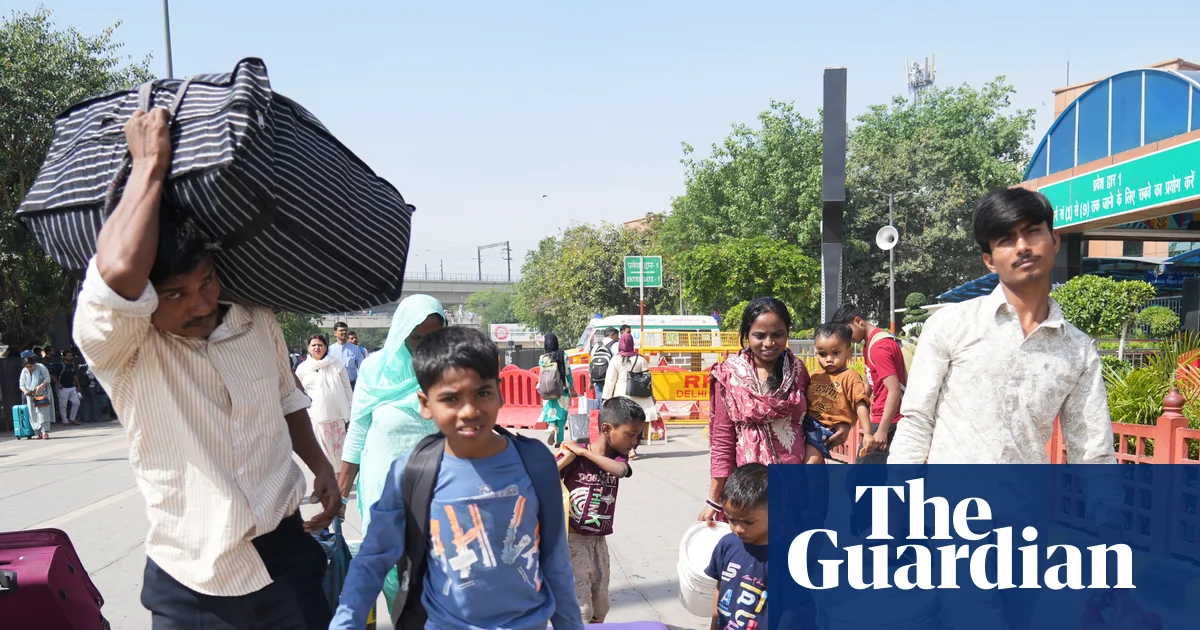
At 9am on a Saturday, 35-year-old Raju Prasad rushes through Anand Vihar railway station in Delhi, a heavy bag slung over his shoulder. Beside him, his wife clutches their youngest daughter with one arm and a white plastic bucket with the other. Their three other children trail behind – one dragging a trolley bag, the others holding on to whatever little they can manage. With Prasad’s brother, the family of seven is leaving for Gorakhpur, Uttar Pradesh.
They had moved to India’s capital nine months ago. The couple worked as ragpickers and were paid about 500 rupees a day (about £4), working long 10-hour shifts. But any dreams of building a more secure future in Delhi and sending their children to school have been lost, as rising food costs and the impact of the Middle East crisis on fuel availability and prices have meant the past few weeks have been a fight for basic survival. Now they are moving back to their village.
“If we stay here even a few more days, our children might die of hunger. They don’t understand what this crisis is – we just see them crying for food,” Prasad says.
Their last gas cylinder finished 15 days ago and they haven’t been able to find more. At first they managed by collecting fire wood but now “we have nothing left. Our savings are almost gone, so we decided to return to the village – at least there, we can cook on a temporary mud stove,” he says.
Delhi, home to millions of people from states such as Uttar Pradesh, Bihar and Jharkhand, is seeing a sudden reverse migration – an evacuation of some of its vast workforce back to rural areas. As global fuel prices surge with the supply disruptions from the US and Israel’s war with Iran, daily life has been destabilised.
The city, heavily dependent on food served through its dense network of dhabas, street vendors, small eateries and restaurants, is facing a cascading crisis. Without gas and with spiralling food prices, the street vendors are closing up. Students, daily wage labourers and low-income migrants, who rely almost entirely on eating at such cheap food spots, are among the worst affected.
As the Parsad family disappears into the crowds at Anand Vihar station, 25-year-old Sarfaraz from Bihar is sitting beside his bags and a small table fan. He has been waiting since early morning for someone from his family to transfer 300 rupees to his account so he can buy a train ticket home.
“I came here to support my family, but now I am asking them to send me money so I can return,” he says sadly.
Sarfaraz came to Delhi to work on the construction site of Jewar Noida International Airport, Uttar Pradesh, where thousands of workers are building the new facility. Now, like many others, he sees little choice but to leave as the gas shortage has made life impossible.
“I’ve not had proper food for the past two days. All my savings are gone,” he says.
Sarfaraz, who married at 18 and is now a father of four, moved to Delhi with the hope of giving his children an education and a better life. He was paid about 550 rupees a day, working long hours at the construction site. But for the past 20 days his gas supply has been exhausted. The price of a gas cylinder on the black market has risen sharply, with prices rising from 900 rupees to 4,500 rupees, far beyond what he can afford.
“Even outside, food has become too expensive. Prices have doubled, and we cannot afford to eat,” Sarfaraz says.
India’s government has repeatedly claimed that, despite the shortages of liquefied petroleum gas (LPG), those who book online are receiving their cylinders within a few days. But people gathered outside gas agencies report long and uncertain waits, even after booking cylinders with the city’s domestic gas consumer cards. Migrant workers and students are not eligible for the cards.
The owners of small eateries and restaurants in cities such as Delhi, Mumbai, Pune and Lucknow have been reducing menus, hiking prices, laying off employees or closing up shop completely.
Anil has been running a restaurant in Nehru Place, Delhi, for the past 30 years. He has never seen a crisis like this.
“It is the first time in my life that the gas cylinder price on the black market has reached 4,500 rupees. I have had to increase prices and cut down many items from the menu,” he says.
“We have shifted back to traditional open-fire cooking on a chulha. It takes more time, and if this situation continues, it will affect my workers too. I have about 10 employees and, with fewer customers now, it is becoming difficult to sustain.”
Praveen Shankar Kapoor, the BJP’s Delhi spokesperson, says authorities are working to stabilise supply across domestic and commercial sectors. “We are actively trying to resolve the shortages being faced in both household and commercial LPG supply chains,” he says.
However, Kapoor admits that smaller cylinder users remain particularly vulnerable. “Yes, the 5kg LPG category is facing more acute challenges at the moment, especially among migrant and low-income groups who depend on it for daily cooking,” he says. “We are hopeful that these issues will be addressed soon and supply will normalise in the coming days.”
In Delhi, the majority of students in some colleges and universities come from outside the city, often from low-income families. Frequently housed in cramped conditions, they rely heavily on canteens or cheap eateries. With rising costs and closures, these options are becoming limited.
Farheen Naaz, a media student at Jamia Millia Islamia University, moved from West Bengal to Delhi and lives in lodgings. She says the situation has been worsening with each passing day.
“I have not had gas for the last 10 days, and most of the time now I skip breakfast,” she says. “Many canteens in the university have closed, and the food that is available has become expensive. We come from low-income families and cannot afford this.
“It is starting to affect our health. About 50 girls live here, and all of us are facing the same problem. If this continues for a few more days, we may have to go back home, even though it will affect our studies,” Naaz says.
Prices of induction hobs and electric rice cookers have surged since the war began. “The induction cooktop we used to sell for 1,300 rupees is now being sold for 5,000 rupees,” says Ahmad, a wholesale seller at ZamZam Crockery.
“Prices have increased from the backend, and we cannot control it. Nearly 60% of other food-making electrical items have also become more expensive,” he says.
As Sarfaraz waits for his ticket money to come through, he constantly checks his account balance in his phone. He hopes he will soon be joining those boarding trains home, where he can find food still available and village cooking fires still burning.