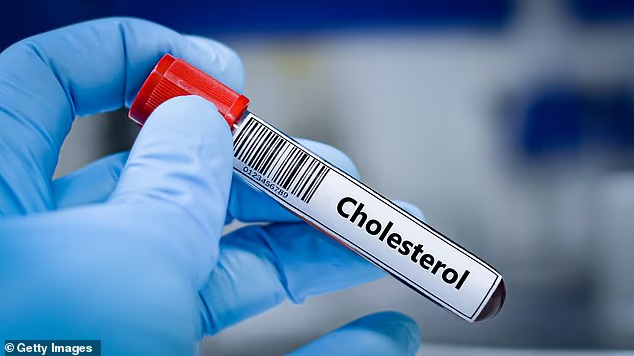
A simple cholesterol test could be the key to identifying people who are at risk of suffering heart attack and stroke, a new study suggests.
More than half of British adults have high cholesterol, a condition in which fatty substances build up in the blood and can clog arteries.
It is often linked to poor diet, lack of exercise, smoking and obesity, and is a major risk factor for heart disease.
Cholesterol is usually assessed by measuring levels of low-density lipoprotein (LDL-C), known as ‘bad’ cholesterol.
However, this does not directly measure the number of harmful particles found in cholesterol that can damage arteries – called apolipoprotein B (apoB).
However, researchers from Northwestern Medicine, in the US, found that measuring apoB could save more lives than standard testing approaches which simply measure cholesterol levels.
The apoB test, which is not routinely used in the NHS, measures the number of the harmful particles present in the blood, and lets doctors prescribe either medication or lifestyle changes years before a patient falls ill.
To examine whether the apoB test was worthwhile, researchers used a simulation model of 250,000 US adults who were eligible for statins – drugs that lower bad cholesterol – but did not yet have cardiovascular disease.
A cholesterol test costing as little as £36 could better identify people at risk of heart attacks and strokes than traditional methods, a new study suggests
Using the data, they forecasted what would happen to the cohort if doctors prescribed medication depending on if their blood was tested for ‘bad’ LDL cholesterol, non-HDL cholesterol (which covers all forms of cholesterol, including LDL) or levels of apoB.
It found that focusing on apoB markers could prevent around 1,000 more heart attacks and strokes per 250,000 people than current alternative approaches.
In turn, this could be cost effective for health providers as it means that the expensive emergency care and recovery needs of heart patients could be avoided.
The study, published in the journal JAMA, suggests that wider use of apoB testing could improve treatment decisions.
Ciaran Kohli-Lynch, the study’s lead author and assistant professor of preventive medicine at Northwestern University, said: ‘We found that apoB testing to intensify cholesterol-lowering medication would prevent more heart attacks and strokes than current practice.’
Experts have previously called for the NHS to adopt the test – which costs just £36 at many private high street health clinics – more widely.
However, one expert on cholesterol previously said it didn’t need to be an all or nothing approach.
Dr Richard Webb from Liverpool Hope University, previously called on the NHS to use the apoB test alongside current practices.
He said some patients may have normal LDL cholesterol results that do not raise concern, despite still being at risk.
Dr Webb said: ‘Our findings show they could very well be consuming a poor diet and also be predisposed to chronic disease.’
The number of patients missed is a ‘relatively low number’, he said.
While the number of missed patients may be relatively small, Dr Webb added that it could still amount to many thousands of people who are not warned about their risk of a heart attack.