This is all well and good. But the Artemis program’s most lasting scientific discoveries will almost certainly only come when astronauts get down to the surface. That may happen in 2028, depending on how fast SpaceX and Blue Origin can move forward with their commercial landers.
Neal said one of the big takeaways from Artemis II, apart from the performance of the Orion spacecraft itself, will be to teach NASA how to make geology part of human spaceflight again. The last Apollo landing mission in 1972 included astronaut Harrison “Jack” Schmitt, the only professional geologist to travel to the Moon.
“We have much more productive science return with humans in the picture at the Moon than we do with them out of the picture,” Neal said. “And we see that with the Apollo missions, the landed missions.”
Members of the Artemis II science team at NASA’s Johnson Space Center in Houston.
Credit:
NASA/Luna Posadas Nava
Observations from future missions orbiting closer to the Moon than Artemis II might also offer some scientific return. There wasn’t much point, Neal said, in adding spectrometers or other types of instruments to the Artemis II crew’s toolkit. They were simply too far away to make any unique spectral measurements not already available in NASA’s archive.
Still, the views returned from Artemis II inspire awe.
“The big thing for me was reliving when I was a kid growing up, watching my Mum praying every time they went behind the Moon,” Neal said. “I had a few flashbacks, but the big thing is listening to the excitement of the science team. Kelsey Young, who was on the NASA broadcast, just couldn’t stop smiling.”
“You might think that, after looking at hundreds of images taken of the lunar surface, I would get sick of it,” Young said. “I have not, nor do I anticipate getting sick of it.”
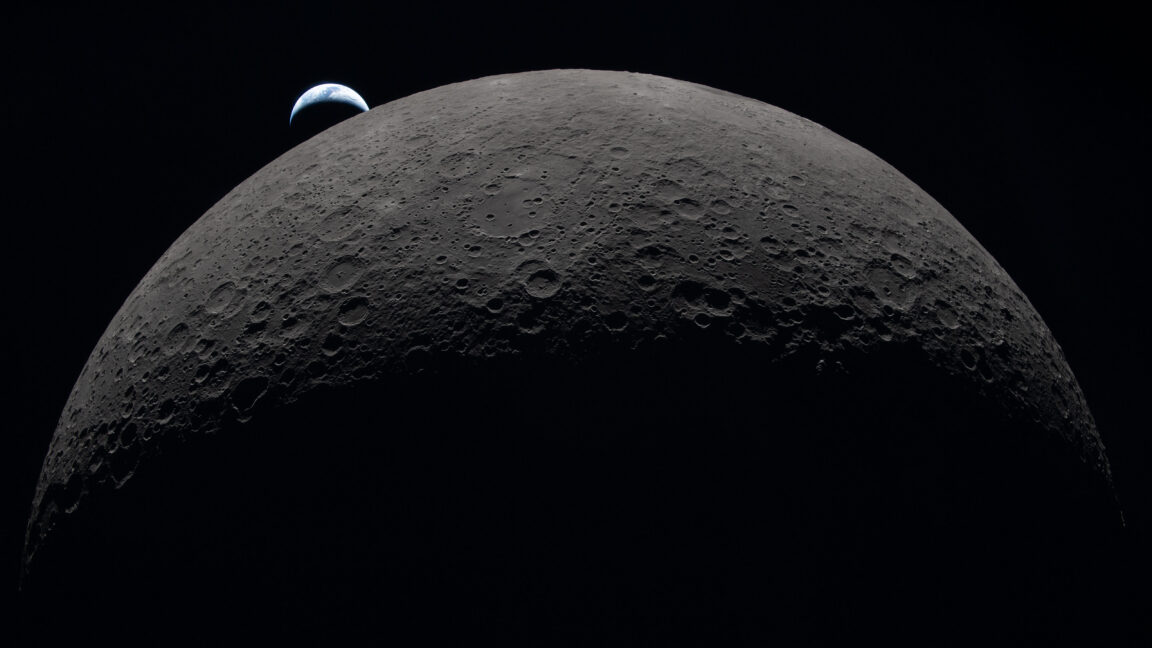
“It was quite infectious,” Neal said. “The Earthrise image that they took is one for the ages.”