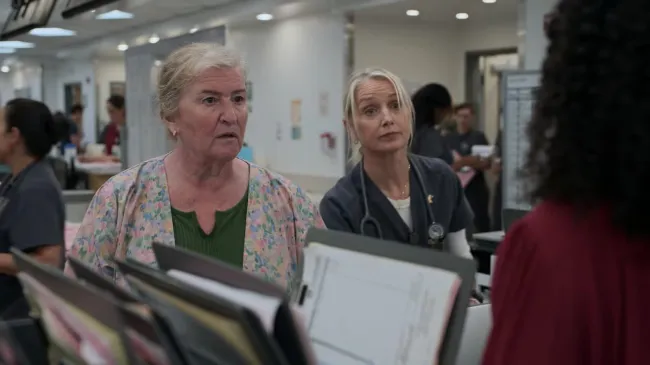
By design, “The Pitt” limits each season to a single hospital shift — well, plus a little extra coverage of the changeover from Doctor Robby’s (Noah Wyle) day shift to Doctor Abbott (Shawn Hatosy) and his “nightcrawlers” in order to get all the way to 15 hours of story. No flashbacks. No locations beyond those connected to the Pittsburgh Trauma Medical Center. The restricted perspective allows the team behind the camera to shoot in continuity, starting with page one of the first episode and going more or less in order. Production designer Nina Ruscio credits the intense, rigorous continuity for the grace and power of “The Pitt.”

But that continuity requires its own intense, rigorous work, as well as a huge cross-departmental collaboration to seamlessly age the emergency department (ED) throughout the day. “There is this complexity and simplicity,” Ruscio told IndieWire. “Because we shoot it in continuity, I think that fuels the experience for the performers and allows for subtle, gradual changes to be made.”
That subtlety is fueled by a lot of spreadsheet data and exhaustive injury lists. Costume designer Lyn Paolo and her team have to track somewhere between 300 and 400 people per season of “The Pitt” — from the core cast to the background artists who’ll end up lying on gurneys for months of the Season 2 shoot.
“Where did they go? Were they eating lunch? Did they get something spilled on them? Was there blood?” Paolo listed some of the concerns the costume department deals with as patients cycle in and out of PTMC’s emergency room. “The actual buildup to the show in the beginning is massive. It’s a massive amount of clothing.”
However many sets of scrubs and bloody Fourth of July t-shirts you’re imagining, imagine 10 to 15 more of each. While scrubs, especially black ones, are pretty indestructible, the costume department still meticulously ages them and accounts for wear as the day shift goes on.
“Every single costume has to have multiples,” Paolo said. “We track how many episodes each character will be in, and then we have to age and track their belt, their shoes, their socks, their underwear. Every single article of clothing. So we dress them inside and out completely. Nothing they wear belongs to them, including their underwear. That has to be tracked.”

The fine-grained level of detail applies to every bed, every whiteboard, and every piece of medical equipment that moves throughout the ED. The art team uses the massive diagrams created by Ruscio in order to track them all. “There’s not a single thing that happens casually. It all happens with coordination between multiple departments. A physical machine needs to be handled by the prop department; it needs to be handled by the set decoration department; it needs to be handled by an actor, by video technicians, all of it. Every single spot that anything is in needs to be charted,” Ruscio said. “You’ll see where the path of a bed, of a person, of a machine goes.”
There’s no resetting back to one. What is labeled on the outside of a drawer actually lives in that drawer. When something is taken out of a drawer and used, that drawer stays empty. “We take great pride in this level of accuracy, down to the tiniest detail, because it’s so important that we’re able to look in 360 degrees. At any point in time, [a wrong detail] could completely corrupt the reality,” Ruscio said.
Non-medical details are handled with the same amount of care. Paolo found a vintage Liberty Bell pin that was perfect for Charge Nurse Dana Evans (Katherine LaNasa) to wear, but of course needed to fabricate multiples of that pin for the different stages of wear Evans would go through over the course of the shift.

“So who did I call? I called Rick Kerns, our prop master, who I’ve known for 30 years, and [who] is just so collaborative. And he said, ‘I’ll do that for you,’” Paolo said. “This whole team has been together for so long. Rick and I started doing commercials together. Nina, I must have known for 16 years. The writers, productions, production design, art team, Matt [Callahan] from set dressing, we’ve all worked together for many years, and I think that helps with the seamless quality of the show.”
Ruscio agreed. “ That’s part of what is unique about this project. There is a deep respect for everyone, no matter what might, in a common environment, be considered a marginal, irrelevant, dismissable detail. Nothing is dismissible here. And it’s really beautiful to be part of everyone taking great pride in that.”
“ We do not want a ‘Game of Thrones’ moment on ‘The Pitt,’” Paolo joked, referring to the mishaps in final season of the HBO series, where real-world coffee cups and water bottles found their way into the frames on Westeros.
While a lot of changes that “The Pitt” production team tracks are the size of a coffee cup — or, even more finicky, the amount of blood on clothing and bedding and the doctors — they can do big changes, too. Ruscio added an extension to the show’s Season 1 set to account for more time spent in triage in Season 2. She’s hoping that nobody notices it hasn’t been there the whole time.
“No one is going to know,” Paolo said. “And you know what that means? That means you did your job.”
“Exactly,” Ruscio added. “That’s what we do.”
“The Pitt” is now streaming on HBO Max. The Season 2 finale will air on April 16.