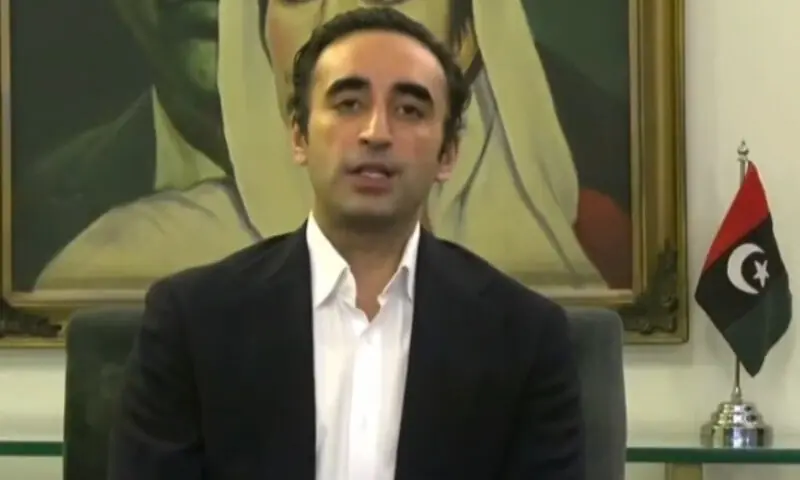
Former foreign minister and PPP Chairman Bilawal Bhutto Zardari has said that the world does not have a “plan B” if the US-Iran talks fail to yield the desired results and emphasised the need for the negotiations to lead to a peaceful resolution to the Middle East war.
Bilawal shared these thoughts in an interview with Sky News, where he was asked ahead of the talks scheduled in Islamabad for Saturday, “don’t result in a formal treaty” during the two-week ceasefire between the US and Iran, “do you have a plan B to prevent a return to full-scale hostilities”.
In his response, Bilawal said: “I think the international community doesn’t have a plan B. Our Plan A needs to be achieving a peaceful resolution to this conflict and a more permanent peace. I think the way this conflict has played out has proven that a war of this nature, a war of this scale, is not an option.”
He continued: “It’s up to us, up to the disputing parties, up to all countries, to push all sides to agree to that peace so that we don’t get drawn into potentially broader conflict than what we have seen over the course of last month.”
His remarks come a day before Islamabad is to host peace talks between the delegations of Washington and Tehran, after Pakistan brokered a temporary ceasefire between the two warring parties.
During the interview, Bilawal said all eyes were on the visiting delegations arriving in Islamabad.
“Pakistan, London, New York and many other countries in the Middle East have been affected by this war,” he said, adding, “We can measure the toll of this conflict not only in the loss of human lives but the economic cost that is borne by the people in my country and in yours.”
So, he continued, “we all are hopeful that this space that has been achieved, this ceasefire that has been achieved is now be built upon towards a more lasting and permanent peace for the benefit of the international community”.
Asked about the challenges being faced by Pakistan in its diplomatic efforts, he said: “Pakistan’s role is to play the host to both these parties that will be directly negotiating here in Islamabad.”
“The biggest achievement so far is that we reached this point,” he said.
Bilawal added that there would be challenges for the US and Iran as well, particularly highlighting the “wide trust deficit that exists between the two warring parties”.
“But as with all diplomatic negotiations and engagements, I am confident that there will be confidence-building measures that both sides will take in order to increase the space for dialogue and diplomacy in their pursuit of peace,” he said.
He was also asked to share his views on the “chatter regarding the Nobel Peace Prize nomination for Pakistan’s leadership” and “critics who suggest that they are prioritising, I suppose, the international image over complexities of the talks”.
Bilawal said in his response: “The first I heard about the Nobel Peace Prize for Pakistan is from you, and this criticism about focusing on the image also.”
He continued: “Iran is our neighbour; Afghanistan is our other neighbour. We witnessed two decades of war and two different conflicts in Afghanistan, and are still dealing with the consequences. We are in perpetual conflict with India. We absolutely do not want the conflict in Iran to be exacerbated.
“The people of Pakistan can’t afford it. I would argue that people all across the world can’t afford it. That is in and all of Pakistan’s motivation, desperation, that all sides achieve peace.”
He added, “It’s a particularly hairy situation for us here economically, and the news we have seen, internationally, from everywhere, from Australia, from the Philippines, from Europe — there is an incredible concern that it is going to be one of the significant economic shocks in our lifetime as well. So, as far as the peace prize is concerned, I think Pakistan and everyone would settle just to achieve peace.”