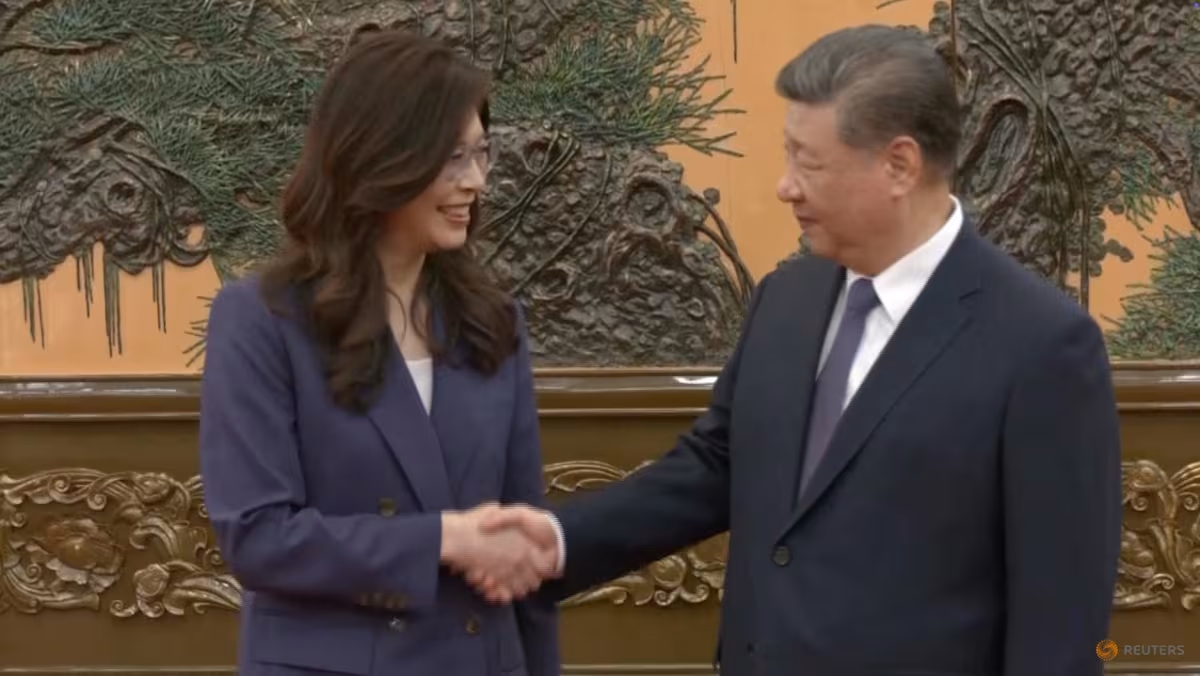
Cheng also framed cross-strait engagement as a broader responsibility beyond party lines, during the meeting as well as in her comments to the media afterwards.
The issue should not be treated as “a tool for partisan competition or electoral manoeuvring” but as “a choice between peace and war”, she said – urging all political parties in Taiwan to “set aside differences … and work together for peace”.
Cheng also said Xi had shown “significant goodwill” and added that such exchanges “are certainly not limited to the Kuomintang and the Communist Party”.
She added that she hoped the Taiwan Strait would “no longer be a focal point of potential conflict”.
“Both sides should transcend political confrontation … and seek a systemic solution to prevent and avoid war, so that the Taiwan Strait can become a model for peaceful conflict resolution in the world,” she said in comments carried by Taiwanese media outlets.
China views Taiwan as a renegade province that must eventually be reunified with the mainland, and has not ruled out the use of force to achieve that goal.
OUTREACH WITH CONDITIONS
Analysts told CNA that Xi’s remarks point to a broadening of Beijing’s outreach on paper, but one with tight conditions.
Beijing is willing to engage beyond the KMT – but only within its defined political framework, said James Chen, an assistant professor of diplomacy and international relations at Tamkang University.
“Xi (said he is opening) the door broadly to engage with Taiwan regardless of political affiliation – if the ruling DPP chair Lai Ching-te accepts the political basis, he too would be welcome in Beijing,” Chen noted, referring to Taiwanese President William Lai.
But such willingness to engage is limited in practice, noted Chong Ja Ian, an associate professor from the National University of Singapore (NUS) and non-resident scholar at Carnegie China.
The DPP has also said that they are “willing to engage the CCP – but with no preconditions”, Chong said. “That is not something that the CCP (would be) willing to accept.”
“So unless the DPP is willing to accept the CCP’s conditions, or the CCP is willing to not be consistent on its conditions, that gap remains.”
He added that domestic political incentives in Taiwan also make a shift unlikely.
“If you look at opinion polls … the KMT didn’t have that much support for it,” Chong said, referring to past high-level cross-strait engagement. “If it’s more or less the same, then the DPP will have very little incentive to try to do anything different.”