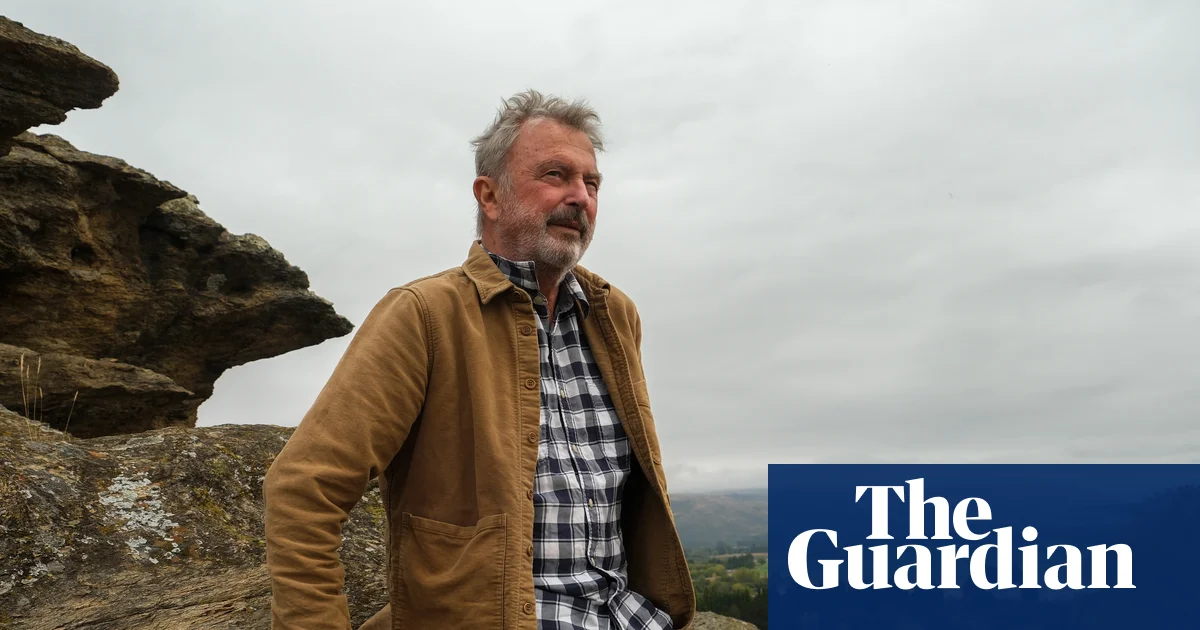
The grapevines in Sam Neill’s vineyard in Central Otago – a picturesque region known for its undulating hills and wines – are pregnant with pinot noir grapes, almost ripe for picking as autumn arrives.
“My family has been here for over 150 years. I’m connected to this land like nowhere else on earth,” the 78-year-old actor and winemaker says. “It’s perfect for wine. It’s great for tourism. And it’s one of the most beautiful and strange, remote places in the world.”
But this unblemished landscape could soon change permanently.
Mere kilometres from Neill’s vineyard lies the Dunstan mountains, shrouded in a crown of clouds. It is an area legally enshrined as “outstanding natural landscape” by the Central Otago district council, and it is in those ranges Australian mining company Santana Minerals is pushing to expedite a controversial 1,000 metre by 850 metre open-cast goldmine, called Bendigo-Ophir. In November, the company applied for consent from the New Zealand government to tap into an estimated $6.75bn of gold deposits.
Located 20km north of Cromwell in a region where a gold rush exploded in 1861, Bendigo-Ophir has been dubbed by its proponents as the country’s most significant gold discovery in decades.
But the proposed goldmine has ignited a fierce division between communities.
Local environmental group Sustainable Tarras views the mine as a fast track to environmental destruction and a threat to tourism in one of New Zealand’s best wine-producing regions, which also has the lowest unemployment rate in the country.
Post-Covid, two New Zealands are emerging: one that draws tourists globally to its Lord of the Rings-esque landscapes; and another, where the government has moved to abolish its dedicated environment ministry and is fast-tracking mining projects it says will boost the economy.
Critics claim Bendigo-Ophir mine will dampen tourism and threaten up to 650,000 native lizards, which Santana Minerals disputes. Opponents have also warned that a dam storing toxic waste from the mine could burst in an earthquake, a claim the company calls unfounded.
A Sustainable Tarras spokesperson says this “industrial-scale mine in the middle of one of New Zealand’s most pristine and iconic districts is not just a major risk to our environment, it’s also damaging to New Zealand’s ‘clean, green, 100% pure’ reputation.”
Neill, best known globally for his role in the Jurassic Park movie franchise, is backing the group and has presented a mini-documentary for the cause.
“I’m not against mining. I’m against this mine,” says Neill, who has grown wine under his Two Paddocks label in the region for 30 years. “If this mine goes ahead – and God willing it won’t – everything that you see [there] is under a claim [by the mining company]. And there will be mining all around us, and that’ll be the end.”
The Bendigo-Ophir goldmine is among hundreds of applications being considered under the coalition government’s controversial fast-track law, which prompted thousands to march in protest in 2024 and nearly 30,000 public submissions on the bill.
The resources minister, Shane Jones – a self-avowed disciple of the “drill, baby, drill” mantra – says the mine will create 357 jobs and indirectly support another 500 jobs annually. He wants New Zealand to double its mineral mining exports by 2035.
Tarras local Mark Davidson, 64, who has worked in farming and the wine industry, says the mine is a local solution to record numbers of New Zealanders leaving the country – most departing for Australia.
“It’s getting harder and harder to put a deposit on a house,” Davidson says. “If the economy here was better, I think you’d find that a lot of people overseas would come home.” He claims most locals are in favour of the mine.
The prospective mine will be assessed under the fast-track law, which can expedite energy, mining, roads and other large projects.
Some fast-track applications include “zombie projects” – such as a previously rejected hydro scheme on the Waitaha river. Despite being rejected in 2019 under Jacinda Ardern’s Labour government, it was provisionally approved under the fast-track law in March.
The former New Zealand prime minister Helen Clark accuses the current government of having “little regard” for the environment. “Its fast-track legislation overrides key environmental and conservation protection laws. It is amending planning law over all in favour of development,” she says.
Hayden Johnston, a local businessman of Māori Ngāi Tahu and Scottish descent, runs a wedding venue and the Kuru Kuru winery within 5km of the mine site.
The opencast mine won’t be visible from his venue. But its processing plant will operate 24 hours every day under a 30-year permit, so he says it will probably be heard, a claim Santana Minerals says is not supported by modelling data.
Johnston, who has run his wine label for 24 years, says: “We would never have created a world-class wine region [here] in Bendigo if we knew there was going to be an opencast pit among us.”
Growing grapes is sustainable, he says. “Gold is a one-off. You crush the land. You make a huge, toxic legacy, but you can only take the gold out once.”
The mining industry has a long history of environmental disasters caused by poorly stored waste in tailings dams – a type of dam that will also be built for Bendigo-Ophir. Poisonous waste, including arsenic, will be stored there in perpetuity.
Prominent Māori businessman Ian Taylor worries about the 600km-long alpine fault running down the South Island. “[The dam] is going to hold toxic material in an area that has a seismic zone,” he says. “The liability or the risk we are placing – or Santana is placing – will last generations after they are gone.”
Santana Minerals states the dam has been carefully designed to withstand a one-in-10,000-year earthquake, and insists “there is no credible long-term failure mode that could result in a breach”. The company rejects its mine will negatively affect tourism, and says it is investing $10m in two lizard sanctuaries, totalling 67 hectares. The majority of the hundreds of jobs created, it says, will stay in the region. Many of the claims opposing the mine lack evidence, it says. “Critics have produced fear,” the company says.
A few kilometres from the proposed site, the only remnants of the 19th-century Central Otago gold rush are scars from dynamite blasts and rosehip bushes planted by Chinese miners.
For mine supporter Davidson, concerns over the tailings dam are unfounded.
“The miners back in the 1800s didn’t really give a toss about the environment,” he says. “Times have changed … Now, you’ve got things like the Environmental Protection Agency who make sure that things are done properly.”
But since taking office in 2023, New Zealand’s rightwing coalition government has faced growing criticism for its environment and climate policy agenda.
Under the previous government, Ardern had promised to ban new mines on conservation land – but the three parties in government failed to reach an agreement over the proposal. However, in 2018, they did halt the granting of new offshore oil and gas exploration permits.
Jones has described Ardern’s permit ban as “the most destructive decision in the history of New Zealand’s industry”, and he has promised to restart exploration. Jones declined to comment on the mine.
A decision on Bendigo-Ophir mine is expected by the end of the year.
Back at Neill’s farm he points out the native trees and the vineyards he has personally grown and tended to for decades.
Mounds of dirt punctuate the horizon stretching ahead of Neill’s vineyard from another mine.
For Neill, it is not simply an eyesore.
“I own land, but I’m not a land owner. The land is part of me, and I’m a part of the land,” Neill said, referring to the Māori concept of kaitiakitanga, being a custodian for future generations. “It comes with a responsibility, and you need to leave the land better than you found it.”